Waiting times crisis
The situation in Northern Ireland’s hospitals is bleak as patients face waits of several years for appointments, emergency department performances decline, all Department of Health targets are missed, and the region performs significantly worse than its neighbours. Gareth Hamill writes.
The Executive’s Programme for Government, published in March 2025, identified cutting “unacceptable” health waiting times as one of its priorities for 2027.
In May 2025, then-Health Minister Mike Nesbitt MLA published an implementation and funding plan, committing up to £215 million towards tackling the crisis.
This included £85 million for red-flag and time-critical patients, £80 million to expand elective care capacity, and a further £50 million to clear existing backlogs. The plan also included mega-clinics intended to provide appointments for almost 20,000 additional patients, alongside a commitment to clear four-year waits for around 3,100 patients.
The PfG’s annual progress report, published in May 2026, states that £135 million was invested in 2025/26, resulting in more than 237,000 additional outpatient, diagnostic, and inpatient procedures.
Additionally, in July 2026, then-Minister Nesbitt confirmed that the remaining £80 million is part of the draft budget to be spent during the financial year to reduce waiting times and improve elective care.
This investment has helped deliver some slight improvements in outpatient waiting times. However, given how small these are and how bad the situation is, they are merely a drop in the ocean and have yet to translate into meaningful improvements for patients.
Appointment waits
In June 2026, 504,537 patients were waiting for a first consultant-led outpatient appointment, a 5 per cent (26,765) decrease from September 2025.
The median waiting time for an appointment stood at 59.1 weeks, a reduction of five weeks over the same period. The 95th percentile waiting time also fell from 305.6 weeks to 282.6 weeks, meaning that 5 per cent of patients had been waiting almost five-and-a-half years for their first outpatient appointments.
The Department of Health’s target is for no more than 50 per cent of patients to wait longer than nine weeks for a first outpatient appointment, and for no patient to wait longer than 52 weeks. In June 2026, neither target was remotely close to being met.
Of the 504,537 patients waiting for an appointment, 85.2 per cent (430,008) had been doing so for over nine weeks. This is a 1.2 per cent decrease from September 2025.
Over half of these patients (53.7 per cent), equivalent to 270,731 people, have been waiting longer than 52 weeks, a 1.9 per cent improvement from September 2025.
Additionally, none of Northern Ireland’s five HSC trusts met either target. The best performance against the nine-week target was in the Belfast Trust, where only 16 per cent of patients were seen within nine weeks. The Northern Trust performed best against the 52-week target with 48 per cent of patients seen within a year.
Neither target has ever been achieved in Northern Ireland since being introduced in 2016.
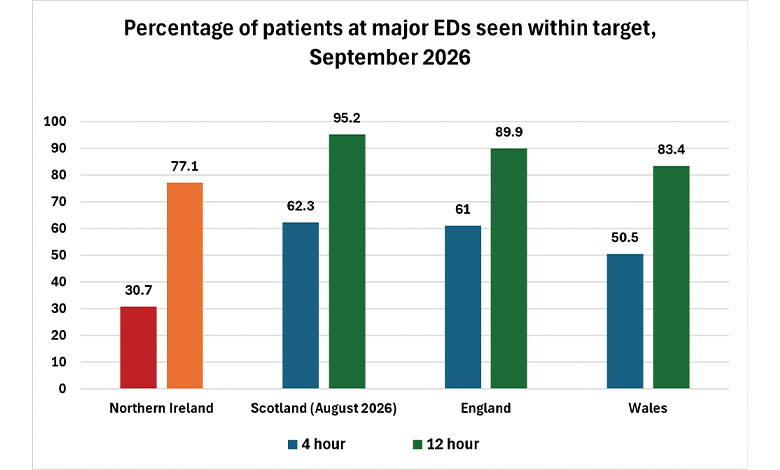
Cancer waiting times are even worse. Between April and June 2026, only 28.4 per cent of patients began treatment within 62 days of an urgent referral.
This is a decrease from the previous year of 4.1 per cent and means that of the 1,459 patients who received their first cancer treatment in this period, only 414 did so within the targeted timeframe.
Emergency departments
The situation in Northern Ireland’s emergency departments (EDs) is similarly concerning, with the Department’s latest statistics highlighting worsening performances across the region.
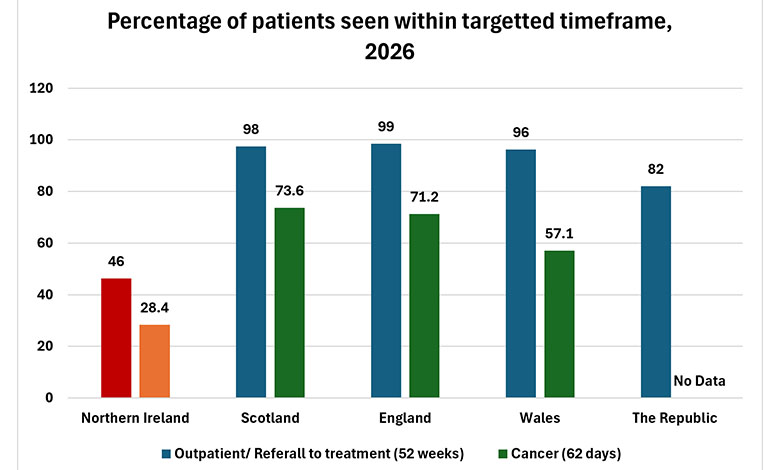
In September 2026, only 30.7 per cent of attendees at type one EDs – major, consultant-led 24-hour hospital A&Es – were discharged or admitted within the target of four hours, a decline of 3.1 per cent since September 2025.
Over the same period, the number of patients spending over 12 hours in these departments increased by 19 per cent from 10,782 to 12,815, accounting for 23 per cent of all attendances.
A Royal College of Emergency Medicine report from April 2026 finds that 1,032 excess deaths were associated with waits of 12 hours or more in Northern Ireland’s EDs in 2025, equivalent to 19 each week.
Perhaps most concerning is that in September 2026, 5 per cent of patients who were admitted to type one EDs spent over 62 hours and 15 minutes waiting, an increase of 3 hours and 43 minutes from September 2025.
This decline in performance has been compounded by growing demand. Attendance at all 10 type one EDs in September 2026 increased compared to the previous year, resulting in a total increase of 7.3 per cent from 52,236 to 56,049.
Although there is widespread poor performance, waiting times between hospitals vary significantly.
In September 2026, less than one-in-five patients at the Royal Victoria and the Ulster hospitals (both 14.2 per cent) were discharged or admitted within four hours.
Conversely, this proportion was over twice as high at Causeway Hospital (42.2 per cent) and the South West Acute (39.6 per cent).
The only hospital in which more than half of patients spent less than four hours was the Royal Belfast Hospital for Sick Children (RBHSC), with 64.8 per cent.
Overall, nine of the 10 type one EDs reported worse four- and 12-hour performances compared to September 2025. Additionally, no ED met the ministerial targets of 95 per cent of patients being discharged or admitted within four hours and no patient waiting longer than 12 hours.
Waiting times elsewhere
The scale of Northern Ireland’s waiting times crisis becomes particularly apparent when compared with neighbouring health services.
The proportion of patients waiting over 52 weeks for an outpatient appointment in September 2026 in Northern Ireland (53.7 per cent) is 21 times the rate in Scotland (2.5 per cent), 14 times that of Wales (3.8 per cent), and almost three times the Republic’s rate of 18 per cent. In England, approximately 1.5 per cent of patients have been waiting over a year for treatment.
Additionally, Northern Ireland’s rate of patients beginning cancer treatment within 62 days of urgent referral (28.4 per cent) is less than half that of Wales (59.9 per cent) and almost three times worse than England (71.2 per cent) and Scotland (73.6 per cent) according to the most recent figures for each region.
The contrast is similarly stark in type one EDs. The proportion of attendees admitted or discharged within four hours in Northern Ireland (30.7 per cent) is less than half the rate as in Scotland (62.3 per cent). Northern Ireland also significantly trails England (61.1 per cent) and Wales (50.5 per cent) in this metric.
Comparison with the Republic is more difficult because it does not use the four-hour target, however, available figures show that Northern Ireland’s performance trails significantly.
The Republic’s Health Service Executive (HSE) data for the week ending 18 October 2026 shows median ED waits of five hours and 33 minutes for admitted patients and four hours and 28 minutes for those not admitted.
In Northern Ireland, the median wait for subsequently admitted patients was 14 hours and 28 minutes in September 2026, compared with five hours and 27 minutes for those discharged.
Additionally, 8.1 per cent (5,756) of all ED attendees in Northern Ireland left before completing treatment, up significantly from 6 per cent (3,971) in September 2025.
This is a higher proportion than the 7 per cent of attendances, or 70,000 people, who left an ED without being seen between January and July 2026 in the Republic.
Addressing the challenge?
When Robbie Butler MLA became Health Minister in August 2026, he stated: “I take on this role with no illusions about the scale of the challenge. Too many people are waiting too long for care.” However, he added that this situation was not “inevitable”.
With no agreed budget and this Assembly term set to end in May 2027, the scope for significant progress during Butler’s tenure is limited.
So far, Butler’s main intervention on waiting lists has been to provide an additional year’s funding of £500,000 to the Support While Waiting Grant Scheme which helps voluntary and community organisations provide support to people on waiting lists.
Butler’s predecessor Mike Nesbitt MLA said in May 2026 that it would take approximately five years to get waiting lists “to where they should be”, although he did not specify what this would entail.
However, given the scale of the backlog, the lack of progress against existing targets, deteriorating ED performance, and the political and financial uncertainty surrounding the Executive, this target appears to be another that Northern Ireland’s health service will not get close to achieving.