Northern Ireland outperforming Britain but lags behind Republic of Ireland
2026 marks 10 years since the Brexit referendum which brought political turmoil to these islands. agendaNi tracks how Northern Ireland’s economy has performed over the last 10 years compared to the UK as a whole and the Republic of Ireland.
Northern Ireland has endured a long road towards post-Brexit stability, with three post-Brexit trading arrangements having been mooted. Eventually, the 2024 Windsor Framework was agreed and this has provided Northern Ireland with dual market access to Britain and the EU for goods and services, with trade between Northern Ireland and Britain having been disrupted by new customs checkpoints.
Economically, the last decade has produced a mixed picture for Northern Ireland. In the immediate aftermath of the Brexit vote, Northern Ireland was already growing more slowly than both the UK and Republic of Ireland. In the year to Q4 2016, Northern Ireland’s output grew by 1.6 per cent, compared with 1.8 per cent for the UK and 5.2 per cent in the Republic.
More recently, however, the gap has narrowed in Northern Ireland’s favour. The region’s economic output was 11.2 per cent above its pre-pandemic level by Q4 2025, compared with 5.1 per cent for the UK. In Q1 2026, the region’s output increased by 3.6 per cent year-on-year, against 1.1 per cent UK GDP growth.
However, the growth rate lags behind the Republic of Ireland. The Republic’s GDP grew by 8 per cent in 2025, although this was driven heavily by multinational-dominated sectors. A more representative measure of domestic activity, modified domestic demand, grew by 4.7 per cent.
Employment
Northern Ireland has also made substantial progress in employment. Its employment rate for 16–64-year-olds has risen from 69.4 per cent in 2016 to 74.3 per cent in 2025.
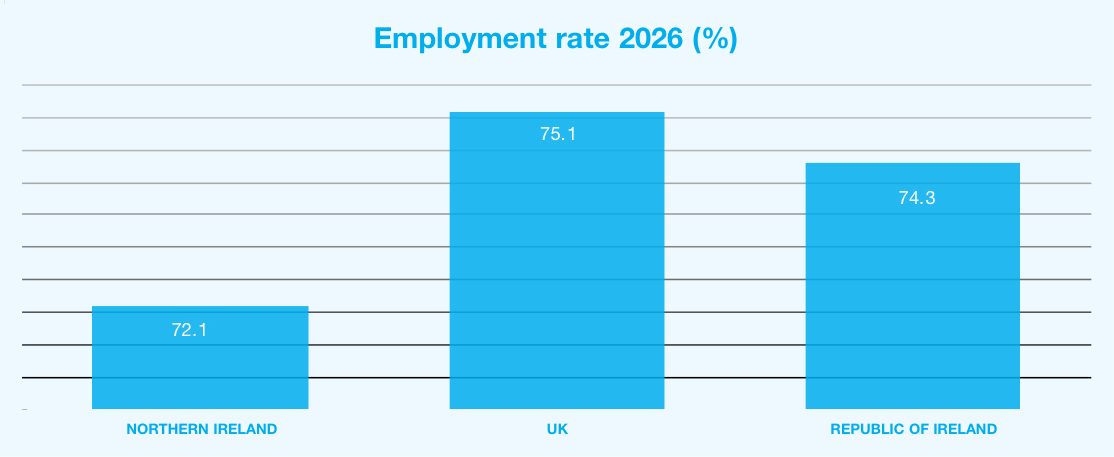
However, the region continues to lag Britain and the Republic. Northern Ireland’s employment rate was 72.1 per cent in March-May 2026, compared with 75.1 per cent across the UK. The Republic’s comparable rate stood at 74.3 per cent in Q2 2026.
While Northern Ireland’s official unemployment rate is now at around 2 per cent, its relatively high economic inactivity rate means a significant proportion of the working-age population remains outside the labour market.
Living standards
The strongest recent evidence of improvement comes from household incomes. In 2024, Northern Ireland recorded the UK’s fastest growth in real household disposable income per head, at 4.1 per cent, compared with 3.1 per cent across the UK.
But the level remains substantially lower. Northern Ireland’s gross disposable household income was £20,403 per head in 2023, just 82.2 per cent of the UK average.
The Republic has pulled further ahead on household incomes. Median household disposable income reached €61,666 in the latest CSO SILC release, with real median income increasing by 2.4 per cent.
Innovation and productivity
The most persistent weakness is productivity and innovation. Northern Ireland’s R&D base has expanded with a total of £1.001 billion spending reached in 2024, with business expenditure accounting for £713.8 million, and the number of full-time-equivalent R&D workers rose by 9.2 per cent to 9,730.
Innovation activity remains below the UK average. Just 32 per cent of Northern Ireland businesses were innovation-active during 2020-22, compared with 36 per cent across the UK.
The Republic’s innovation ecosystem is considerably larger relative to the size of its economy, underpinned by major multinational investment in technology, pharmaceuticals, and life sciences. Its 2025 economic figures also demonstrate the scale of R&D and intellectual-property investment. The CSO says the sharp increase in capital formation was predominantly driven by R&D investment.
Broad analysis
Ten years after the referendum, in spite of funding challenges due to Executive mismanagement, Northern Ireland cannot straightforwardly be described as an economic failure. It has recently outperformed the UK on output and real household-income growth, while employment has recovered strongly.
However, the longer-term structural weaknesses such as lower employment participation, lower household incomes, weaker innovation, and a persistent productivity gap remain.
On all said metrics, Northern Ireland lags significantly behind the Republic. Therefore, it is reasonable to assert that Northern Ireland has benefitted from the dual market access granted to it by its special post-Brexit arrangements. However, the UK as a whole has lagged significantly behind the EU in terms of growth, and the Republic of Ireland is now significantly wealthier, more business friendly, and investable than both Northern Ireland and the wider UK.