Regional imbalance
The persistence of a significant productivity gap between different areas in Northern Ireland means that regional inequality remains a substantial challenge which is getting worse. Gareth Hamill writes.
Regional imbalance has long been identified as a significant challenge in Northern Ireland, with the Executive identifying it as one of four priorities of its economic vision in 2024.
To tackle this imbalance, the Department for the Economy (DfE) launched the Sub-Regional Economic Plan, designed to correct long-standing disparities and rebalance economic development.
The plan uses a figure to assess regional balance which combines those in employment with those in further or higher education.
Using this metric, research from the Ulster University Economic Policy Centre (UUEPC), found that there was a 10 percentage point gap between the top and bottom performing local government district (LGD), Mid Ulster and Derry City and Strabane, respectively, in 2022.
This is a significant reduction in the gap which stood at 19 percentage points in 2017.
However, this figure does not accurately reflect regional imbalance in Northern Ireland, which appears to be worsening.
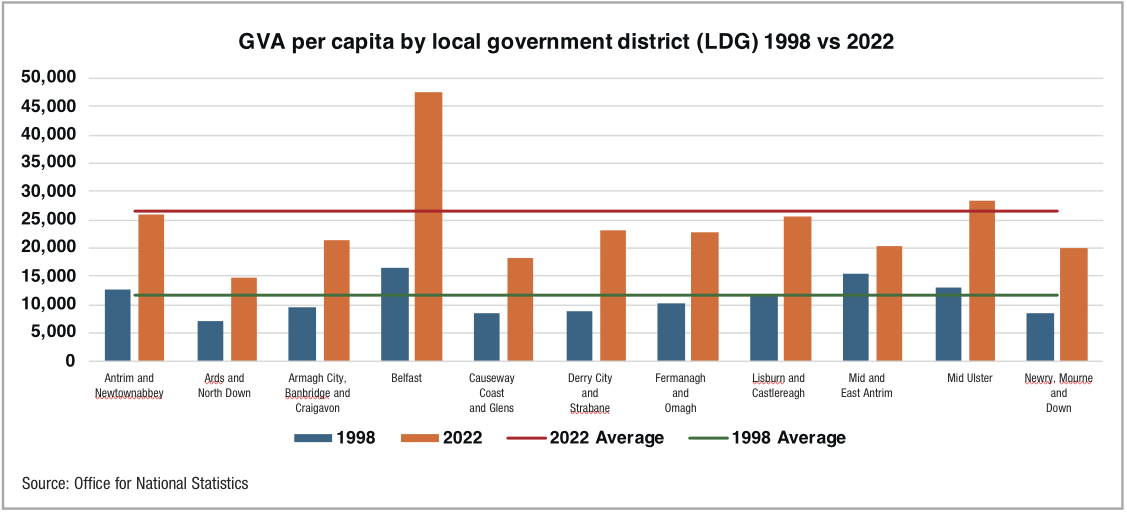
The percentage share of the gross value added (GVA) to Northern Ireland that was attributable to the Belfast LGD increased from 28.8 per cent in 1998 to 32.9 per cent in 2023, according to the most recent data Office for National Statistics (ONS).
In 1998, Northern Ireland’s GVA per capita was £11,684 and in Belfast it was £16,673, meaning Belfast’s GVA per capita was almost 42 per cent above the average.
Belfast’s annual growth rate since 1998 has been 0.4 percentage points faster than the second fastest-growing LGD, Derry City and Strabane.
This means that in 2022, Belfast’s GVA per capita was £47,466, 80 per cent above the average of £26,538.
Additionally, in 1998, Belfast’s GVA per capita was 130 per cent larger than the LGD with the lowest GVA per capita, Ards and North Down, which was £7,227.
In 2022, Ards and North Down still had the lowest GVA per capita, sitting at £14,847, meaning Belfast’s was 220 per cent larger.
Additionally, in 2025, Belfast’s proportion of good jobs was the highest at 74.8 per cent, making it one of only two LGDs with a rate above the region’s average of 69 per cent.
The areas containing Northern Ireland’s two largest cities lead the way in terms of business productivity.
In 2024, Belfast and Derry City and Strabane LGDs recorded the two highest number of business births, 1,435 and 755, respectively.
As well as this, the two also had the highest business birth rate, the proportion of active businesses which began trading within a year, with Belfast’s rate 12.1 per cent and Derry City and Strabane’s 15.1 per cent.
Regional imbalance elsewhere
Northern Ireland is not the only region struggling with regional inequality, as significant imbalance exists in the UK and the Republic of Ireland.
The OECD Regional Outlook 2023 identified both as countries with high levels of GDP per capita but increasing regional inequalities.
Additionally, since 2017, the Republic and the UK have moved ahead of the overall OECD trend towards higher inequality of GVA per capita at the regional level, according to analysis from the UUEPC.
This analysis also found that the border and midland areas of the Republic consistently having a GVA per capita of around a third of the average means that it may have worse regional inequality than the UK.
The UK’s imbalance is primarily caused by the strength of London’s economy, with its GVA per capita almost twice the UK average.
Comparisons with the devolved nations of the UK provide a better perspective of the imbalance in Northern Ireland.
According to ONS data, in 2023 the most productive region in Wales had a GVA per capita 34 per cent higher than the average, and in Scotland that figure was 96 per cent.
In Northern Ireland, this figure is 80 per cent, meaning that while the region does not have the worst levels of regional inequality in the UK, progress could be made.
Improving regional balance
At the heart of the DfE’s Sub-Regional Economic Plan is a £45 million Regional Balance Fund which is to be distributed across all 11 councils over three years.
To best utilise this funding, local economic partnerships have been established across all council areas, and each is moving into the delivery phase of its action plan.
An additional aspect of the Executive’s strategy to tackle regional imbalance is through increased investment in higher education to increase student numbers outside of Belfast.
This has resulted in increased student number in the University of Ulster’s Magee campus by 22 per cent and 11 per cent in its Coleraine campus.
There is little data available to monitor the progress of reducing the imbalance in regional productivity since 2024 but there appears to have been little tangible action taken on this matter.
With the Assembly elections due to take place in 2027, it is unlikely that any significant further progress will be made in this area by this Executive.
Owing to frustration that regional inequality is not being tackled in a thorough manner, in June 2026, the SDLP’s Sinéad McLaughlin MLA introduced the Regional Balance Bill, a private member’s bill, to the Assembly.
The bill proposes creating a legal duty for the Executive to establish a Regional Balance Strategic Framework to address the longstanding economic disparities between regions.
It would require all Executive departments to have due regard to the framework when developing policies, strategies, and public services and would create an annual accountability mechanism to measure and evaluate progress.
In September 2026, the bill received cross-party support and completed its second stage in the Assembly.
Speaking after this, McLaughlin said: “For decades, communities like Derry and the North West have heard promises about addressing regional imbalance, but too often the investment, jobs and opportunities have failed to follow.
“That is why the SDLP as the Official Opposition has made tackling regional inequality a key priority and why I brought forward this bill. It will put regional balance at the heart of government and ensure that tackling regional disparities is a responsibility shared across every department.”