Minister Caoimhe Archibald MLA: ‘You have to be optimistic in this role’
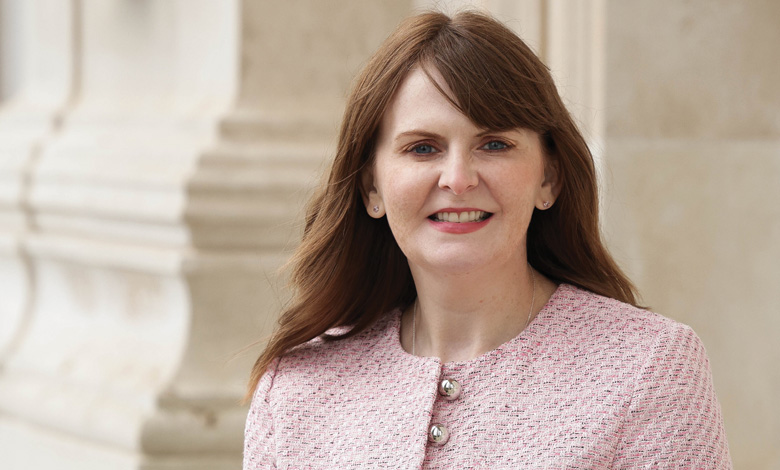
Economy Minister Caoimhe Archibald MLA speaks to Joshua Murray about the future of the Good Jobs Bill, regional economic development, north-south economic cooperation, and the legacy she hopes to leave ahead of the next Assembly election.
Reflecting on her time in office as Minister for the Economy, Caoimhe Archibald MLA reiterates the four priorities in the Department’s Economic Vision against which she believes the current mandate should be judged: creating more good jobs, improving productivity, driving regional balance, and decarbonising the economy.
Of her proudest achievements to date, Archibald singles out the expansion of the Ulster University campus in Derry as an important success. But it is a more personal policy achievement that she identifies as perhaps the most meaningful aspect of her ministerial tenure.
Paid miscarriage leave, introduced during her time as Minister, is something she says has generated more correspondence from the public than anything else she has done in the role.
The policy originated during the previous Assembly mandate, when Archibald was chair of the Economy Committee and introduced an amendment to legislation. As Minister, she was subsequently able to implement it.
“I am really proud of the progress we have made to date. But one of the things I am personally proud of, and I am really privileged to have been in the position to do, was to introduce paid miscarriage leave.
“It is something that actually touches people’s lives. Why I do this job is because you want to make things better for people.”
“I do not think you can get away from the fact that you have an economy a couple of hundred miles down the road that is performing significantly better.”
Good Jobs
Minister Archibald is optimistic that the Good Jobs Bill can overcome political opposition and progress through the Assembly, despite continued uncertainty over when the legislation will be brought forward.
The legislation is intended to strengthen employment rights across Northern Ireland, including provisions for neonatal care leave and carers’ leave, alongside measures aimed at strengthening workers’ representation.
Minister Archibald says significant work has already gone into ensuring that the legislation strikes an appropriate balance between the interests of workers and employers.
“For me, the Good Jobs Bill is about improving people’s lives at work,” she says. “We have worked really hard to ensure that it is a balanced bill, a bill that will work for both employers and for workers.”
The Minister has faced opposition from within the Executive to the legislation, with the DUP having raised concerns about aspects of the Bill. However, Archibald says she has engaged extensively with ministerial colleagues, including deputy First Minister Emma Little-Pengelly MLA.
“I have listened to some of the issues that she has raised. I have responded to those, and I think the legislation, as it is crafted, strikes that balance between being good for workers, but also being good for businesses.”
Archibald says she will continue working with her Executive colleagues to ensure the legislation progresses after the summer recess.
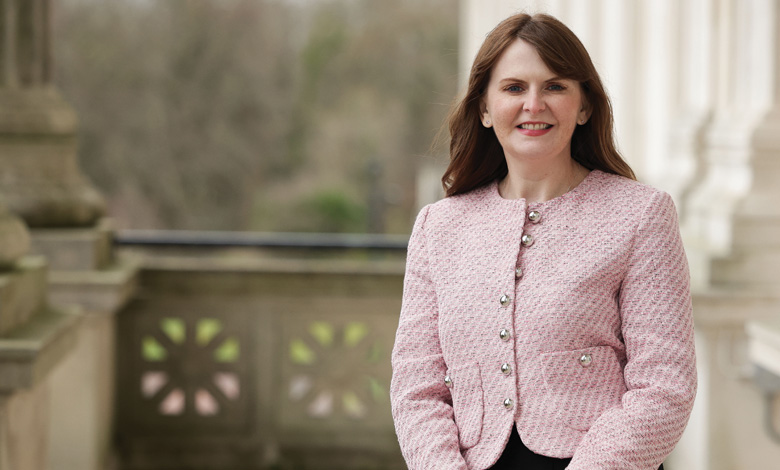
Asked whether she is optimistic that it will happen, her answer is characteristically straightforward: “I am always optimistic. You have to be optimistic in this role.”
While she does not speculate on the reasons for the DUP’s opposition, Archibald says she believes the legislation is fundamentally progressive and that all ministers should support it.
“What the DUP have for their reasons, for blocking or frustrating things in the Executive, that is a matter for them. I am just going to continue to do my job to the best of my ability to try and deliver for people.”
All-island collaboration
Beyond the immediate political challenges facing the Department, Archibald is also focused on the wider economic relationship between north and south.
She points to the growth in north-south trade in recent years as evidence of the potential that exists from closer economic cooperation. “Over many decades, we have seen the consequences of partition on this island, and it has negatively impacted this state in particular,” she says.
At the same time, Archibald argues that Northern Ireland’s economic performance should not be viewed solely through comparisons with the Republic. She points to stronger economic growth, exports, and employee wage growth compared with Britain as positive indicators.
The Minister attributes some of that performance to the post-Brexit trading arrangements, while also highlighting investment in skills and innovation. Nevertheless, she acknowledges that the gap with the Republic remains significant.
“I do not think you can get away from the fact that you have an economy a couple of hundred miles down the road that is performing significantly better,” she says.
However, she adds that this difference represents an opportunity as much as a challenge. “There are, from my perspective, huge opportunities there.”
Cross-border trade reached €14.5 billion in 2024, with organisations such as InterTradeIreland supporting businesses on both sides of the border to enter export markets.
The Department is also placing greater emphasis on all-island cooperation, with a memorandum of understanding (MOU) between the Department for the Economy and its southern counterpart intended to facilitate closer working.
Archibald points to the Shared Island Enterprise Scheme, which involves €30 million of investment and cooperation between agencies including InterTradeIreland, Invest NI, and Enterprise Ireland.
She also highlights collaboration in further and higher education, arguing that there are areas where closer cooperation makes practical and economic sense irrespective of the constitutional question.
“When you are working with a budget as we are, which is so fiscally restrained, we will look at opportunities to collaborate and to do things across the island that are beneficial for both jurisdictions,” she says.
“There are huge synergies in terms of the work that we are doing, the policy objectives that we have, and what we are trying to achieve.”
Regional balance
That same emphasis on efficiency is reflected in Archibald’s approach to regional economic development within Northern Ireland.
Regional balance is one of the four priorities identified in the Executive’s economic vision, and the Minister points to a narrowing of the gap between the highest- and lowest-paid council areas as evidence of progress.
The Department has established local economic partnerships across all 11 council areas, with each now moving into the delivery phase of its action plan.
Higher education is another significant component of that regional strategy.
Archibald highlights increased investment in Ulster University’s Magee campus, which has been accompanied by a 22 per cent increase in student numbers. There has also been a 12 per cent increase at the university’s Coleraine campus.
Minister Archibald believes that regional balance needs to extend beyond direct departmental spending, with universities, colleges, and arm’s length bodies all having a role to play.
She also points to tourism and social enterprise as sectors with strong regional footprints, including the inclusion of Fermanagh within Ireland’s Hidden Heartlands tourism brand.
However, the Minister acknowledges that addressing regional inequality will not happen quickly.
“I am very clear also that the decades of underinvestment, particularly in the northwest, but not only in the northwest, and the focus on the economy around the Belfast region is going to take time to redress.”
The challenge, she says, is therefore to maintain that focus over the long term.
With the next Assembly election approaching in May 2027, Archibald is also beginning to consider what she wants her time as Economy Minister to represent.
Asked whether she would like to remain in the role for another term, she says yes, while cautiously smiling and reiterating that any such decision rests with her electorate and party.