Persisting poverty

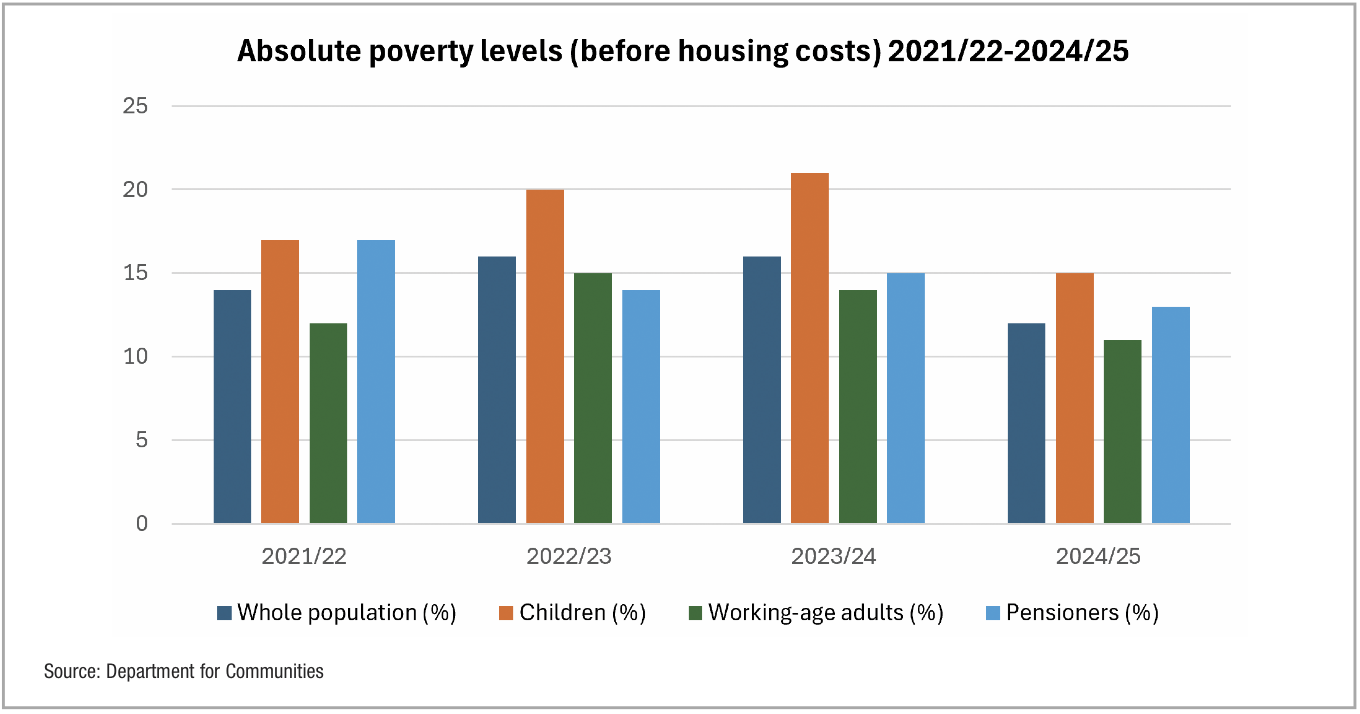
Poverty levels have decreased across all age groups in Northern Ireland in 2025 and sit below the UK average, although one-in-eight people still live in poverty and the rate for children is one-in-seven.
In 2024/25, 12 per cent of people in Northern Ireland, (approximately 232,000) were living in relative poverty before housing costs (BHC), a decrease from 14 per cent in 2023/24 when 261,000 lived in poverty.
The same proportion of the population, 12 per cent were in absolute poverty (BHC), the equivalent of 232,000 people, a decrease of 65,000 from 2023/24, when the rate was 16 per cent.
An individual lives in absolute poverty if their household has an equivalised income below 60 per cent of the UK median income in 2024/25.
Relative poverty refers to an individual living in a household with an equivalised income below 60 per cent of the UK median income in a given year.
As 2024/25 has replaced 2010/11 as the reference year against which absolute poverty is calculated, absolute poverty and relative poverty levels are the same in 2024/25.
Equivalised income means that the amount is adjusted according to the size and make-up of the household.
The absolute poverty threshold for a couple with no children is £22,509, which rises to £34,440 for a couple with children aged 5 and 14.
The decreases in poverty were recorded across all age groups.
There were approximately 123,000 working-age adults in absolute poverty (BHC) in 2024/25, a decrease from 14 per cent to 11 per cent compared to 2023/24.
The rates of poverty for pensioners also decreased in the same period, dropping from 15 per cent to 13 per cent, meaning there are 41,000 pensioners living in absolute poverty (BHC).
Child poverty
There were also decreases in the levels of child poverty in Northern Ireland in 2024/25, although it remains the age group with the highest poverty rate.
An estimated 15 per cent of children, (approximately 67,000), were in absolute poverty (BHC), an annual decrease of 6 per cent.
Child poverty rates vary significantly across Northern Ireland. Belfast West is the parliamentary constituency with the highest levels of absolute poverty (BHC), with a rate of 25.1 per cent, which is equivalent to 5,697, according to data from the UK Government.
This is almost double the rate of the constituencies with the lowest levels of child poverty, North Down, and Belfast South and Mid Down where the rate in each area is 13.7 per cent.
This data also highlights that child poverty is a particular problem in the west of the region.
In Foyle, West Tyrone, East Londonderry, Upper Bann, and Fermanagh and South Tyrone one in five children live in absolute poverty (BHC), while every constituency west of the River Bann, has a child poverty rate above the UK Government-calculated Northern Ireland average of 18.9 per cent.
Poverty elsewhere
This calculation of Northern Ireland’s child poverty rate means that it ranks sixth of the UK’s 12 regions, slightly below the UK average of 19.3 per cent.
Northern Ireland poverty rate also places it in the middle of the UK’s devolved regions, sitting slightly below Wales (21.1 per cent), but drastically behind Scotland which is the lowest of the 12 regions at 12.2 per cent.
The UK Government calculates that the rate of people in relative poverty (BHC) on a three-year average from 2022/23 to 2024/25 was 14 per cent, making it the fourth lowest of the UK’s regions and below the UK average of 16 per cent.
Additionally, by this metric Northern Ireland is the devolved region with the lowest poverty levels, significantly lower than Wales (19 per cent) and marginally better than Scotland (15 per cent).
Northern Ireland does not compare as favourably to the Republic of Ireland, although poverty rates in the Republic are increasing according to an Economic and Social Research Institute (ESRI) report from September 2026.
In 2024, the number of individuals living in a household with an income less than 60 per cent of the median household income of €34,574 was 12.9 per cent, equivalent to 692,000 people.
This is an increase from 12.2 per cent in 2023, when the figure was 640,000, and is the second year in a row that the rate has risen by 0.7 per cent.
Given the high costs of housing in the Republic, when the figures are calculated after housing costs (AHC) are added, there is a substantial difference.
The AHC poverty rate increased from 14.6 to 15.6 per cent in 2024, equating to 835,000 individuals and significantly higher than the 12 per cent rate in Northern Ireland.
The rate of child poverty, defined as the share of children both experiencing material deprivation and who are below the poverty line was 8 per cent in the Republic, compared to Northern Ireland where it is 9 per cent.
Reducing poverty
To reduce the levels of poverty in Northern Ireland, in June 2025, the Department for Communities published the region’s first ever draft Anti-Poverty Strategy which outlines the Executive’s approach to tackling poverty over the next 10 years.
The strategy is underpinned by three pillars; minimising risks, minimising impacts, and exiting poverty.
However, its objectives and outcomes are vague with the Committee for Communities report on the strategy saying it “currently lacks the structural mechanisms, funding commitments, and precise targets required to enact systemic, generational change”.
In June 2025, almost 50 charities and anti-poverty organisations including Save the Children wrote to the Executive saying “it is more harmful to have a strategy that will not address poverty, than no strategy at all”.
Speaking at an Assembly debate in May 2026, Communities Minister Gordon Lyons MLA said: “We are not complacent about poverty levels, but it is worth noting that there has been a statistically significant decrease in child poverty from 21 per cent to 16 per cent.
“It is still too high, but it shows some of the progress that has been made. It is a much better figure than that for other parts of the UK, but there is much more still to do.”