Technology can enable reform but cannot substitute for it

Justene Ewing, CGI’s Vice President Health and Care, argues that AI can create capacity, but only when technology follows system redesign, co-production, and the outcomes that matter to people.
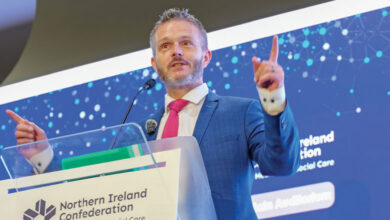
NICON26 called for Reset for All | Action by All.
Northern Ireland is professionally fascinating to me and personally close to my heart. My husband is from here and much of our family is here. At NICON26, listening to people who care deeply about its future, one word kept returning: capacity.
I do not mean capacity as an abstract measure in a plan. I mean the space to listen, the time to make a good decision, and the ability to act before a person’s health deteriorates or a family reaches crisis.
Northern Ireland’s health and social care system does not lack commitment, expertise or ideas. It lacks room to breathe. Staff are working incredibly hard while fragmented information, repetitive administration, and complicated processes consume too much of their time.
When budgets are exhausted, demand continues to rise, and the workforce has nothing more to give, technology can feel like the only lever left to pull. That is understandable, however, it is also dangerous.
AI can reduce administrative burden, connect relevant information and support planning, giving professionals more time with people.
But we risk investing in AI with a false sense of possibility that technology will somehow create the integration, capacity, and transformation we have struggled to achieve through other means.
It will not; not on its own.
AI cannot repair a badly designed pathway. It cannot resolve unclear accountability, join up organisations that are not ready to collaborate or tell us what matters to people if we have never properly asked them.
If ‘reset’ means anything, it cannot mean placing a digital veneer over the way services already work. It must mean being prepared to redesign them.
The greatest risk is not simply that we adopt AI too quickly. It is that we use powerful new tools to preserve processes nobody would design today. Digitising low-value work does not make it valuable. It simply allows us to do the wrong things faster.
Perhaps we should stop asking only what AI can do and start asking what it could help us stop doing. Where are skilled people repeating work or performing tasks that do not require their expertise? Where are resources being consumed without delivering something that matters?
This is where prudent and value-based healthcare provide discipline. Prudent care asks us to work with people as equal partners, prioritise greatest need, do only what is needed and reduce inappropriate variation. Value-based healthcare asks whether our resources produce the outcomes that matter across a person’s whole journey of care.
More activity is not the same as more value. Capacity released in one part of the system is not a success if it simply creates pressure somewhere else.

Capacity is not the outcome. Value is.
That value must be defined with patients, families and staff, not for them. ‘Action by all’ cannot mean change done to communities, followed by consultation after the important decisions have been made. It must mean change shaped with them from the beginning.
CGI’s experience across Great Britain reinforces this. In Wales, we worked with Hywel Dda University Health Board to co-create a whole-system digital strategy and transformation roadmap. We did not begin with a product. We began by listening, understanding the pressures and identifying where service redesign enabled by technology could improve outcomes and make better use of scarce resources.
In England, our work on NHS Notify shows what can happen when a common problem is redesigned at scale. The reusable service has processed hundreds of millions of patient messages through the NHS App, text, email and letter. Accessibility including braille, large print and translated communications was part of the design, not an afterthought.
The learning we bring is consistent: start with people, understand the desired outcomes then redesign the whole pathway, build reusable foundations and measure value. These are principles to adapt to Northern Ireland’s context, not a model to import.
Northern Ireland’s integrated health and social care system, universities, clinical expertise, businesses, and connected communities create strong conditions to test, learn and scale. The Academic, Health, and Economic Partnership launched at NICON26 offers a way to bring those strengths together around real needs.
That collaboration will support the neighbourhood model of care, using trusted data and appropriate technology to identify risk earlier, coordinate support and help more people remain independent at home. The objective is not another app. It is caring that feels simpler, earlier, more joined up and more human.
The foundations still matter. AI may attract headlines, but data quality, interoperability, cyber resilience, governance, and workforce confidence will determine whether it delivers. Technology should follow a clear purpose and a redesigned pathway, not the other way around.
Industry must accept this challenge too. Innovation cannot simply mean selling health services more technology to implement and manage. If we claim our work creates value, we should help define that value, measure it, and remain accountable for whether it is realised.
The question is not whether we have the appetite for new technology. It is whether we have the courage to redesign the system around the people who depend on it.
Technology can enable that reform. It cannot substitute for it. And action by all must begin by listening to all; most importantly, the people whose lives will be changed.

For further information on CGI’s work in Northern Ireland visit: