Noise pollution’s health impacts

Enda Murphy, head of the Department of Urban Development and Mobility at the Luxembourg Institute of Socio-Economic Research (LISER), outlines the health risks associated with environmental noise and the scale of exposure across Europe.
Enda Murphy defines environmental noise as “unwanted sound that is created by human activities”, adding that “it can have very significant health impacts”. Murphy says: “Most of the sources of environmental noise are transport-related; air, rail, and predominantly road traffic. Industry has a role as well, but it is mostly the transport sources.”
Environmental noise has increasingly been recognised as a public health issue, with Murphy noting awareness of its effects has increased significantly in recent decades.
“We did not really know this probably 20, 30 years ago, but we know it pretty well now,” he says.
Murphy outlines the link between noise and health: “There are two pathways that lead to disease-based outcomes over the longer term. The first is via sleep disturbance. The second is via annoyance.”
During sleep, the auditory system remains active. This means noise can stimulate brain activity, causing changes in blood pressure and vascular activity without waking an individual.
In the long term, these physiological disturbances can reduce the amount of deep sleep a person gets.
Murphy explains the effects this has on an individual’s health. “Deep sleep is crucial for physical recuperation of the human organism. If we spend less time in deep sleep, it can increase our risk of certain disease outcomes,” he says.
The annoyance pathway, Murphy says, is caused by unwanted noise causing “exposure to negative emotions, which can trigger the release of stress hormones in the bloodstream such as cortisol”.
If these hormones are repeatedly and continuously released, the body’s stress load increases which, over the long term, can contribute to an increased risk of developing conditions such as ischaemic heart disease and diabetes.
Additionally, environmental noise can have significant effects on cognition, particularly affecting young people.
While there is limited evidence for this in older adults, Murphy says children are “particularly vulnerable” to the cognitive impacts of noise exposure, especially with memory recall, reading, and comprehension difficulties.
Murphy emphasises that the relationship between transport noise exposure and development of certain diseases is one of increased risk rather than definitive cause and effect.
He says that the increases in relative risk are nevertheless notable, at 3 per cent for heart disease, 6 per cent for diabetes and depression, and 4.5 per cent for dementia.
Scale of exposure
Research demonstrates the scale of exposure to environmental noise across Europe.
Approximately 109 million European citizens, over 20 per cent of Europe’s population, are exposed to long-term unhealthy transport noise levels when measured against the European Noise Directive (END) reporting thresholds of exposure levels of 55 decibels (dB) or above during the day-evening-night period.
Road traffic is the primary source of noise pollution across Europe. END data from 2022 found that approximately 92 million people are exposed to road noise levels of 55dB or higher during the day-evening-night period.
According to the World Health Organization’s (WHO) stricter recommended levels of noise exposure, it is estimated that over 30 per cent of the European population, approximately 145 million people, are exposed to unhealthy noise levels from transportation sources.
Additionally, a 2025 report from the European Environment Agency found that transport noise pollution in Europe leads to the loss of approximately 1.5 million healthy life years annually, as measured using disability-adjusted life years (DALYs).
Murphy says he would like to equalise the END and WHO reporting thresholds, saying: “It is a problem that they are not harmonised because we are still reporting at thresholds way above what we know is impactful on health.
“It is important to remember that the END reporting threshold is not a safe threshold, which is often a common misconception.”
Policy outlook
The EU’s END, introduced in 2002, established a framework for assessing and managing exposure. It requires member states to complete noise-mapping every five years in cities with populations over 100,000, as well as along major roads, railways, and airports.
This mapping process identifies exposure levels and the associated health impacts. Member states are also required to develop noise action plans to reduce exposure and protect quiet areas, however, Murphy says there has been a lack of work on this.
“We are doing quite a lot on mapping the exposure, but in terms of acting on or mitigating the issue, we are not doing a great job,” he says.
European policy has moved from mapping towards health assessment in recent years. In 2018, WHO guidelines on environmental noise were introduced and an annex to the END was introduced in 2020 which introduced common methods for estimating harmful effects of exposure such as sleep disturbance and heart disease.
Despite these developments, there has been a lack of action taken to address the issue of exposure to environmental noise, Murphy asserts. As a result, the EU is significantly behind its target for 30 per cent less people to be chronically exposed by transport noise in 2030, compared to 2017, as the current figure is 3 per cent.
Concluding, Murphy outlines the need for environmental noise to receive the attention its health impacts warrant: “I often say noise is the forgotten pollutant because it seems to be given less attention. But some of the data and information that we are generating suggests that it could be a bigger problem than air pollution.”
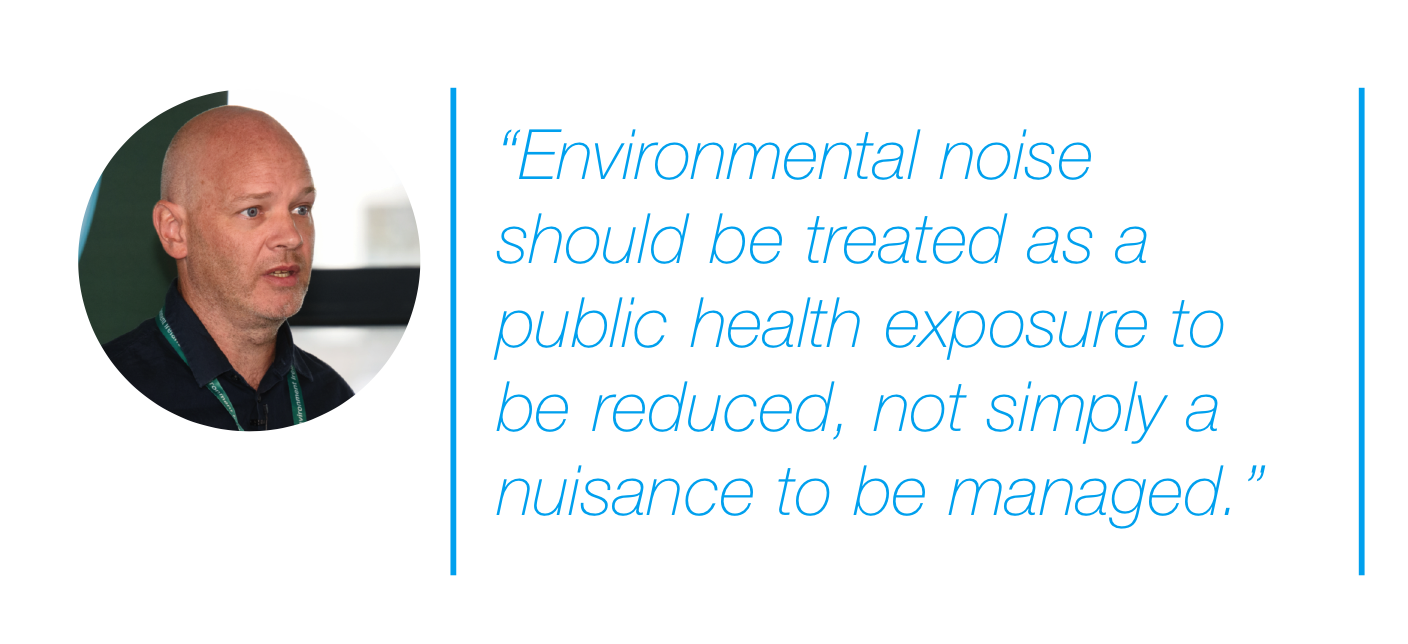
His key takeaway for policymakers is: “Environmental noise should be treated as a public health exposure to be reduced, not simply a nuisance to be managed.”