The Rule of Law in Perspective
A new initiative from the Bar of NI and the Office of the Lady Chief Justice.
In short, the rule of law means that laws, not individuals, govern. It means no individual is above the law and that no one is above its protection. Laws must be clear, fair, and applied equally by courts that are independent from the government, and the rights and freedoms of all citizens must be protected under those laws.
This principle shapes our everyday lives, from our ability to speak freely, to knowing that our system of justice is designed to treat everyone as equals. In jurisdictions where the rule of law is strong, we find stronger economies, better educational opportunities for all, greater peace and social cohesion.
The importance of the rule of law is often lost in the complexity of modern life, our systems of democracy and our legal and justice systems. If the rule of law operates as an invisible hand, it stands at risk of being pushed away.
A new initiative from the Bar of NI and the Office of the Lady Chief Justice
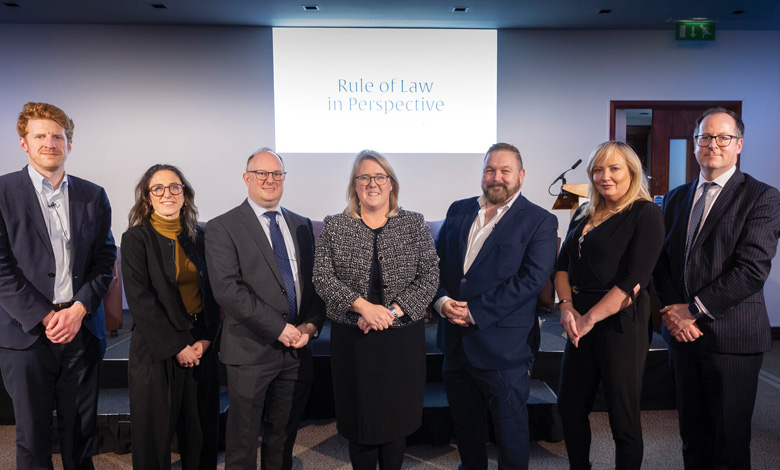
The Rule of Law in Perspective is a new collaboration between the Bar of Northern Ireland and the Office of the Lady Chief Justice which seeks to promote the value and meaning of the rule of law. The initiative promotes informed dialogue and involves the business community, civic society, the judiciary, the legal professions, and elected representatives.

The first event in the series took place in November 2025 and focused on defining the rule of law and its connection to economic performance and the realisation of rights and equality and took the form of a well-attended and insightful panel discussion.
Contributions were offered from former Head of the Northern Ireland Civil Service David Sterling; public law expert Fiona Doherty; Chief Commissioner of the Equality Commission for Northern Ireland, Geraldine McGahey; Tracy Stuart, Head of Legal at Invest Northern Ireland; and Senior Associate at Phoenix Law, Sinead Marmion.
The panel discussion underscored the critical role of the rule of law in shaping and supporting economic growth. The correlation between the rule of law and stable, just and prosperous societies was clearly articulated by the panellists.
The discussion also distilled the role of public law in upholding the rule of law by ensuring that public bodies operate lawfully and fairly. The development of common law and its importance in advancing the rule of law was also outlined.
The launch event was also an opportunity to preview a campaign video that accompanies the public debates and contextualises the aims of the series.
Challenges to the rule of law
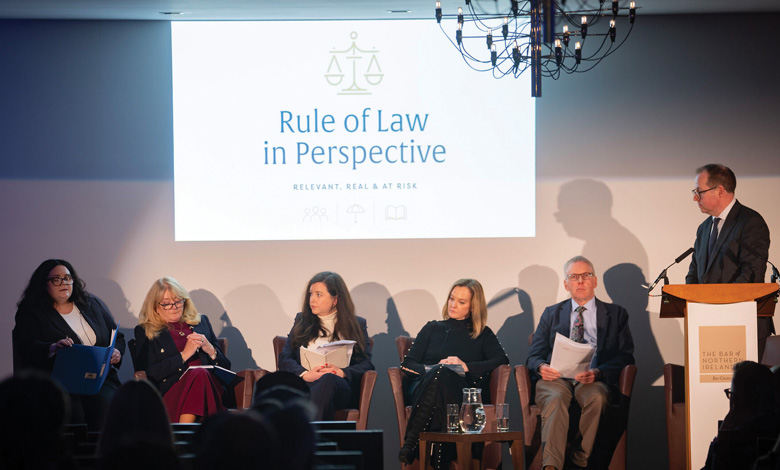
The second event in the series explored challenges to the rule of law at home and beyond our jurisdiction and took place in March 2026.
The panellists tasked with exploring the issues brought together figures drawn from politics, media, the judiciary and legal reform groups. Astute and lively contributions came from journalist Allison Morris, Justice David Scoffield, Stephanie Needleman of the law reform charity Justice, and South Belfast MLA Matthew O’Toole.
Broadcaster William Crawley chaired the discussion, creating an immersive atmosphere, bringing in questions and contributions from the audience throughout.
Broadly, the consensus attributed backsliding on the rule of law to rising global authoritarianism, underfunding of the legal and justice systems, the spread of disinformation undermining trust in institutions, and threats to judicial independence.
How can the rule of law backslide be halted?
But what can be done by way of a response and how can the backslide on the rule of law be halted?
The scale of that challenge is clear. Recent global events have led UN Secretary-General António Guterres to describe how the rule of law is being superseded by the law of force, reflecting a growing reliance on coercive power over diplomacy and legal safeguards.
Backsliding on the rule of law across Europe has been evidenced through a recent report by the NGO Liberties. Drawing on evidence from a collaboration of 40 human rights organisations across 22 EU member states, the report highlights a serious, deliberate erosion of the rule of law in five countries (Bulgaria, Croatia, Hungary, Italy, and Slovakia) and shows that even historically strong democracies, including Belgium, Denmark, France, Germany, and Sweden, are experiencing regression.
Closer to home, threats to the rule of law are becoming evident. The law reform charity Justice has identified structural and cultural issues that threaten the rule of law in the UK context, including:
- rushed, complex legislation with senior judges describing rules as a “bewildering flurry,” and immigration law described as “Byzantine”;
- an increased use of framework bills that set out the principle of policy direction but leave the detail to be filled in later by ministers through delegated powers, thereby bypassing scrutiny;
- underfunding of the legal and justice system, leaving access to justice more difficult for litigants through the administration of publicly funded legal services; and
- public confidence corroding through online disinformation and misinformation and the lack of a co-ordinated approach to assisting people to understand and advance their rights through public legal education.
The shared responsibility of the rule of law
The Lady Chief Justice described the advancement and protection of the rule of law as a “shared responsibility”. The rule of law belongs to every part of society: to the courts who interpret it, to the professionals who practise it, and the public who rely on it.
The Rule of Law in Perspective series is aimed at giving effect to that shared responsibility. The Bar of Northern Ireland and the Office of the Lady Chief Justice look forward to continuing the dialogue through an exploration of how the rule of law can be maintained and advanced.
T: 028 9024 1523
W: www.barofni.com