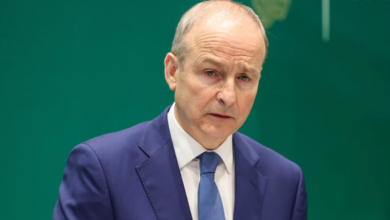
Irish Language Commissioner Pól Deeds: ‘Using the Irish language in public bodies’

Pól Deeds was appointed as the first Irish Language Commissioner in Northern Ireland in October 2025 under the Identity and Language (Northern Ireland) Act 2022. He sits down with Ciaran Brennan to discuss advancing the Irish language in public bodies, the opportunities arising from the legislation, and his role in fostering reconciliation.
This piece was originally written in Irish. Please click here to access the Irish language version.
Pól Deeds took up his post as the Irish Language Commissioner in November 2025. His term in office will last five years. Previously, he served as the chief executive of An Droichead, an Irish language organisation in south Belfast and as deputy chief executive of Foras na Gaeilge, a cross-border body responsible for promoting Irish on the island of Ireland.
Under the act, the Irish language was given official recognition. It also provided for the establishment of the Office of the Irish Language Commissioner and appointment of an Irish language commissioner. The primary aim of the commissioner is to protect and enhance the use of the Irish language in public bodies when providing services to the public or a section of the public.
“I am here to provide the Irish language with official recognition in public life and to demand that public bodies provide better services through the Irish language for people that use it in society,” says Deeds.
The Act provides for the development of standards of best practice for the use of Irish in public bodies. These will be developed by the Office of the Irish Language Commissioner. Public bodies will be required to have due regard for these standards when they are published. After publication of the standards, the commissioner will have to promote them and continuously monitor them.
Deeds and his team are currently conducting research for the development of the standards after which they will undergo consultation. They must be approved by the First Minister, Michelle O’Neille MLA, and the deputy First Minister, Emma Little-Pengelly MLA before publication. Deeds intends to present the standards to them before the end of 2026.
Pending approval and publication of the standards, the office will have to design a complaints procedure. Should somebody feel that a public body has failed to have due regard to the standards, they are to be able to make a complaint to the Office of the Irish Language Commissioner which the commissioner will have to investigate.
The Act also identifies other ways that official recognition is given to the language including through the commitment of the Northern Ireland Executive to deliver a strategy for the development of the Irish language, through the work of Foras na Gaeilge, and through the provision of Irish medium education.
“As well as the legislative duties I have, I would like to contribute to the advancement of reconciliation and peace,” says Deeds.
Deeds says he has an opportunity to ensure that “there is a brighter future for the generations to come” in collaboration with Katy Radford, director of the Office of Identity and Cultural Expression, and Lee Reynolds, Commissioner for Ulster Scots.
“Through our work, we have to be attentive to those parts of the Act that speak about reconciliation, peace, and showing respect for people; that people can choose, develop, and celebrate their identity.
Lessons from other jurisdictions
In February 2026, Deeds and his team met with the Irish language commissioner from the South and the Welsh language commissioner. He was familiar with operations regarding the Irish language in the South from his experience with Foras na Gaeilge, but saw a “completely new” system in Wales.
“The value of the local minority language is recognised all over the place in public life. It was clear that everybody in the organisations had respect for their language,” says Deeds.
This was particularly evident at the Cardiff University where students were supported to speak Welsh while the leadership of the university encouraged them to use the language. Furthermore, Deeds says Welsh was visible throughout the campus on bilingual signs.
“This was a huge encouragement for me and my team who came with me,” says Deeds.
Deeds asserts that the visibility of a minority language is a foundational step in its protection and that the visibility of the Irish language will be central to the standards.
The commissioner was accompanied by representatives from the University of Ulster and Queen’s University on the trip to Wales. Deeds says that both universities are examining methods to promote minority languages, and that he has drafted advice regarding bilingual signs for both universities.

“I am here to provide the Irish language with official recognition in public life and to demand that public bodies provide better services through the Irish language for people that use it in society.”
“I want to discuss that with both universities and I will be giving it to them shortly to advance bilingual signs on their campuses,” says Deeds.
‘Political difficulty’
Identifying “some problems” with the legislation, Deeds says that it does not provide language rights to the Irish speaking community. He also says that the fact the Act stipulates that the standards must be approved by both the First Minister and deputy First Minister poses “political difficulties”.
Deeds says the political animosity regarding the Irish language is the biggest challenge he faces. He asserts that there are people in political life that are “working actively against my office, against the advancement of the Irish language”. Deeds says politicisation of the language does not help society and “encourages people to be virulent towards the language”.
“These people are loud and they are provided with a platform. That is the biggest challenge in front of me as commissioner,” says Deeds. “They will not do damage to the work itself, I do not believe, because it is provided for by law. The public bodies are ready, I believe, to adhere to my advice.”
“But the attacks will do damage to the other efforts I want to make to: make life more peaceful here, and to advance reconciliation.
“If there is any way we can move the language out of that political realm, I would like to do that.”
Deeds believes that these aspects constrict the amount he is able to achieve as commissioner. However, he says: “I am happy with the duties I have and the powers I have that I will be able to put the Irish language in a much better place than it currently is in the public sector.”
Heady period
Describing the current state of the Irish language, Deeds says it is in a “heady period” and that the establishment of his office is “a historic aspect of that environment”.
There are many visible changes happening in society regarding the Irish language including the erection of bilingual street signs throughout the North. Deeds thinks a section of the community is “anxious about the future” as a result of these changes and asserts that he wants to be “compassionate to these people” in his role.
That is not the only change. The demographic of the Irish speaking community is also changing. Previously, Deeds says that Irish was connected with the nationalist identity, but that nowadays unionists are learning the language.
He is specifically referencing people learning the language as part of the Irish language project, Turas, on the Newtownards Road in east Belfast, a loyalist area. He says: “If they can overcome that, I think more people are able to rectify that problem and overcome that.
“If you believe that you are someone that is 100 per cent Irish, or 100 per cent British, or somewhere in the middle, the Irish language can be central in your life and you can enjoy speaking and learning Irish,” says Deeds.
Concluding, Deeds says: “If politicians work with us, we can make big changes in public life that would recognise, for the first time, the value of the Irish language, the identity of the Irish speaking community, and create a neutral space for the visibility of the language, and that is very important.”
This piece was originally written in Irish. Please click here to access the Irish language version.