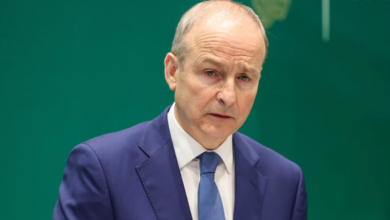
Kinecx Energy Chief Executive Niall Martindale: ‘An unmissable opportunity’

Kinecx Energy Chief Executive Officer Niall Martindale talks to Owen McQuade about the potential of renewable gas to secure Northern Ireland’s future energy supply, create jobs, and make a real impact on the region’s nutrient challenge.
Kinecx Energy is a gas distribution business that has been operating since 2005. The company, formerly known as firmus energy networks, has a gas network which stretches from Newry in the southeast to Derry in the northwest.
The company has built out its network over the last 21 years and it is now accessible to around 200,000 homes and businesses, of which 78,000 have already been connected. Kinecx Energy is headquartered in Antrim, which is geographically in the centre of its network and employs 66 people.
When asked to outline Kinecx Energy’s main strategic priorities, Niall Martindale says: “Mission number one is to connect and bring the benefits of gas, initially natural gas and ultimately renewable gas, to those remaining 122,000 homes and businesses that are not yet connected to our network.
“The second mission, equally important, is to decarbonise the gases within our network by displacing the fossil fuel natural gas with renewable gas, which will be predominantly biomethane.”
Since the start of the development of Kinecx Energy’s network in 2005, the company has contributed to the decarbonisation of Northern Ireland’s energy mix. Gas has up to 50 per cent less CO2 emissions than home heating oil, which is still the predominant source of heating in Northern Ireland.
“Gas is very much a transition fuel and we believe that the gas network will remain the back bone of the Northern Ireland energy system security. As more renewables come onto the electricity system, natural gas is required to support that increase.
“Although anaerobic digestion may not be the silver bullet for Lough Neagh, it would make an enormous contribution to solving the nutrients challenge.”
Niall Martaindale, Kinecx Energy
“When the wind does not blow and the sun does not shine, the gas network is critical for energy security. It is a £1.2 billion asset that does not get the attention that perhaps it deserves, as it is all at least one metre below ground,” Martindale explains.
Biomethane
Although Kinecx Energy has been contributing to the decarbonisation of the Northern Ireland economy, Martindale says that there is now a huge opportunity to go further by developing a biomethane economy. “The development of a biomethane economy is an unmissable opportunity for Northern Ireland.”
The potential for biomethane development in Northern Ireland is well documented. A study in 2022 by Centre for Advanced Sustainable Energy Research (CASE), a partnership between Queen’s University Belfast, University of Ulster, and the Agri-Food and Biosciences Institute, found that there is enough feedstock in Northern Ireland to support 6TWh of biomethane, which is equivalent to 80 per cent of current gas demand.
Additionally, the gas network operators undertook a request for information (RFI) process that identified 3.5TWh of biomethane available in a relatively short time frame from plants that were either in operation or in planning. That equates to 45 per cent of all network demand, or 90 per cent of industrial and commercial demand.
Indigenous renewable sources of energy have become more important in recent years with energy security moving up the political agenda. In addition to the many environmental, economic, and societal benefits, there is also a benefit in the price stability with biomethane production.
A report by the European Biogas Association in 2023 quantified the ‘external value’ of biomethane; that is all the value outside the energy value and includes things such as job creation, environmental benefits, and energy security amongst others. These benefits were determined to be between £70 and £150 per MWh. This external value, which is additional to the actual energy value of biomethane, is potentially greater than the cost of production.

“That is very much a flashing neon light in terms of the attractiveness of biomethane and in a Northern Ireland context, the arguments become much more compelling. We are heavily reliant on agriculture which is also the sector with the highest CO2 emissions. Biomethane offers a solution to address this,” says Martindale.
“There is increasing geopolitical volatility and indigenous biomethane production offers an unmissable opportunity for Northern Ireland to mitigate this volatility as it directly impacts on gas prices. Although customers are focused on price, price volatility comes a close second in terms of concern, especially for businesses. A biomethane economy with locally produced, renewable methane would significantly address this energy price volatility.”
Environmental benefits
The RFI by the gas network operators in 2024 had 86 responses from interested operators who were either operating or planning biomethane plants. This identified a potential availability of 3.6TWh in the short to medium term and 44 per cent of the total potential from the 86 responses was located within the Lough Neagh catchment area. The anaerobic digestion (AD) process used to produce biomethane provides an opportunity to manage nutrients, which includes slurry from housed livestock. A byproduct of the AD process is digestate, which is nutrient rich and can be used locally or exported to provide a revenue stream. “Although anaerobic digestion may not be the silver bullet for Lough Neagh, it would make an enormous contribution to solving the nutrients challenge.”
Economy
An important aspect of the wider value of the biomethane economy is job creation. Creating a biomethane economy in Northern Ireland offers the opportunity to create jobs outside Belfast and west of the Bann. In 2022, a KPMG report determined that for every TWh of biomethane produced in Northern Ireland, there could be 1,000 jobs created.
Although there is no policy target yet set in Northern Ireland, the gas industry has set itself a target of 1.5TWh of biomethane by 2030. The CASE report in 2022 supported the 1.5TWh target by identifying that there is enough feedstock available to achieve that target by 2030. That equates to potentially 1,500 jobs, mostly west of the Bann, by 2030.
An often overlooked benefit of biomethane is that it offers large energy users access to a renewable gas supply. This is now a requirement for many companies to remain in key supply chains. Any inability to have access to a renewable gas sources, or at least progressing towards a source, by 2030 could result in those companies dropping out of supply chains. “That is a real economic risk that can be mitigated by the introduction of biomethane supply in Northern Ireland,” Martindale says.
Challenges
Having highlighted the clear and wide-ranging benefits of a biomethane economy, Martindale discusses the next steps for biomethane development.
“Kinecx Energy along with the rest of the gas industry are hoping to share what we believe to be a huge opportunity, not just to decarbonise the gas network, but to inject significant economic, environmental, and societal benefits in Northern Ireland.”

A key building block is the need for a biomethane policy and CASE has been appointed by Department for the Economy (DfE) to develop such a policy, with the first draft expected in June 2026. “CASE has already outlined the policy framework of three pillars, which dovetail with the Executive’s Climate Action Plan.
The first pillar addresses cost allocation. The second is the certification of green gases, including biomethane. The third pillar is a support mechanism that will be required as in other jurisdictions that are already well into developing a biomethane economy.
For example, Denmark started developing biomethane in 2011. It now has over 40 per cent biomethane in its gas grid and is on track to meet its target of 100 per cent by 2030. Northern Ireland should be nimble enough to be a fast follower in developing a biomethane economy as Denmark has succeeded in doing in a relatively short time period.
“In addition to a biomethane policy, we need a target resulting from that policy. That policy and target should become a key part of the next programme for government.”
Martindale highlights one risk that threatens Northern Ireland’s efforts to mitigate its greenhouse gas emissions.
“A lot of the focus, and resources, are on the target of 80 per cent of electricity to be from renewable sources by 2030. Whilst this is important and we fully support those efforts, there is a risk that other opportunities to decarbonise the economy are neglected. Electricity accounts for around 20 per cent of energy use, whereas heating and transport account for 40 per cent each. The decarbonisation of heating will be key to decarbonising the Northern Ireland economy.”
Future
Looking to the future, Martindale identifies two “key missions” for Kinecx Energy: “We will continue to bring the significant benefits of natural gas to the 122,000 people that our network is available to but still have to be connected.
“Secondly, to continue to work to establish a framework and mechanisms required to deliver a biomethane economy in Northern Ireland, including informing those on the network and those who could be connected of the benefits of biomethane,” he concludes.
|
Niall Martindale
|