Economy Minister Caoimhe Archibald MLA: ‘Building a resilient, affordable energy system’

Writing in agendaNi, Economy Minister Caoimhe Archibald MLA outlines the importance of delivery of the Energy Strategy to lower energy costs, and protect homes and businesses from price shocks.
Recent energy price spikes serve as a reminder of how exposed the homes and businesses of this region are to global events that lie completely outside of their control. This was evident after the Russian invasion of Ukraine and is again clear following the US-Israeli attacks on Iran. These global events triggered sharp fuel price increases around the world and hit local households.
With two-thirds of our households using home heating oil, the impact was particularly severe here.
I quickly engaged with my counterparts in the Executive, as well as the British Government, to seek support for homes and businesses facing these unfair costs, and with the Irish Government to share information as the situation developed.
The Executive has agreed to provide an additional £19.2 million in addition to the £17 million announced by the Treasury to support consumers of home heating oil in the North who are most in need and that is being delivered through the Department for Communities.
Separate to that, and before the current energy crisis, officials from my department and the Department of Finance had secured a commitment from the Treasury to cover 75 per cent of the NIRO cost to domestic electricity consumers.
Subject to the necessary legislation and approvals being in place, the agreed approach is for suppliers to apply a credit of around £30 per year for three years, directly to domestic electricity bills.
The conflict continues to have a financial impact on local businesses and households which are already struggling with the cost-of-living crisis, and I continue to press for financial support, highlighting the North’s unique exposure.
The need to transition to renewable energy
Fundamental to breaking the existing link to volatile global commodity prices, and importantly, delivering energy at stable, lower cost to homes and businesses, is the delivery of the Energy Strategy.
Over the next couple of decades, we will import less fossil fuel and we will pay a fair price for the energy we produce locally. We will become a price-maker rather than a price-taker.
Progress
At the end of last year, I published the Mid-Term Review of the Energy Strategy 2030, which outlined that we are firmly on the pathway to delivering our ambition of self-sufficiency in affordable renewable energy by 2050.
The strategy’s 2030 targets provide focus for us, our partners, and the stakeholders whose contributions are vital to keep us moving towards the goal of self-sufficiency in affordable renewable energy. As we achieve our objectives on the pathway to this goal, we will increasingly deliver the benefits to people, society, the economy, and the environment.
Progress on delivering the Energy Strategy has already produced economic opportunities for the North. Recent figures put our green economy at close to £1.5 billion turnover each year, up over 50 per cent since 2020, and the Energy Strategy ambition is to grow that to £2 billion by the end of the decade.
Today, almost half of the electricity generated in this region is renewable, and consumption figures are trending upwards once again, with the latest official figures showing 47 per cent.
And we have a clear line of policy sight, outlined for the draft Climate Action Plan, on how to meet the energy savings target by 2030.
Setting ambitious targets, annual action plans and long-term goals encourages innovation and investment in our local economy, creating skilled jobs and enhancing the region’s competitiveness.
Consumer benefit
Consumers are at the heart of the Energy Strategy, and I want to accelerate delivery through collaboration across government, industry, and communities so that consumers can see and feel the benefits of the changes we are all making together.
The rollout of smart electricity meters is a good example of how consumers will feel the benefit of a smarter, more flexible, and cleaner electricity grid.
Smart meters are already saving engaged consumers in the South and Britain hundreds of pounds through innovative and smarter tariffs from suppliers.
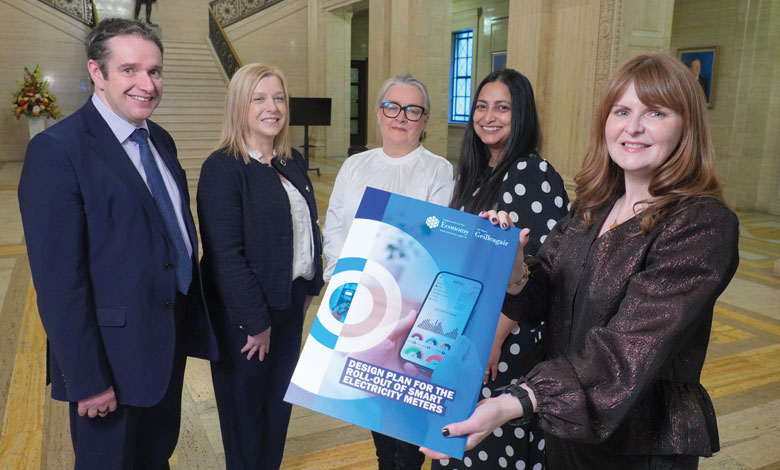
At the end of April 2026, I published the Design Plan for Smart Electricity Meters, setting out how smart meters will be introduced in a carefully planned, consumer-focused way here in the North.

Delivered by NIE Networks, smart meters will support consumers to better manage their electricity usage, helping to reduce electricity bills, as well as creating greater resilience in our local grid.
Futureproofing the electricity system, by increasing its capacity, is a key enabler of a decarbonised energy system and underpins our wider net zero ambitions.
NIE Networks’ ‘Big Network Rebuild’, being delivered through the Utility Regulator approved £2.3 billion investment, is a significant development to enable the renewables that will deliver a lower and more stable cost for consumers.
We need a strong, smart, flexible, modern grid with sufficient storage and to meet as much of the demand for electricity from our own local resources.
My department established and chairs the Grid Development Monitoring Group, which is driving progress on key transmission and distribution projects, providing a focus on the needed new infrastructure and stretching the operating envelope to enable more renewable capacity onto the system.
We are also supporting SONI in the delivery of its dispatch down reduction plan, which is reducing costs for electricity consumers by utilising more of our available renewable electricity capacity.
This is a critical part of my plan to secure more locally produced renewable energy at a stable energy price, insulating households and businesses from global energy cost shocks.
The Renewable Electricity Price Guarantee (REPG) scheme will position our region as a competitive and attractive destination for renewables investment. Having published the Final Scheme Design in 2025, I am progressing the Primary Bill, and once in law, it will be used over the next 25 years to underpin stable renewable energy prices for consumers.
It will enable auctions to take place at the right time, securing the best technologies and capacity at a fair price for consumers.
In addition, grid-scale battery energy storage is an important piece of the jigsaw for cost-effective security of electricity supply, and I intend to outline energy storage policy by the end of this year.
Engagement
Crucially, the transition to a decarbonised energy system must be fair, and we must ensure consumers are engaged and protected throughout the journey.
Delivering a vibrant, healthy, green economy is a moral obligation, but it is also one of the greatest economic opportunities of many generations. I want people to see and feel the benefits of change, and to have confidence that the transition will be fair, properly supported, and focused on lowering bills over the long term.
Conclusion
Taken together, this work represents just some of the multi-layered and complex jigsaw of energy policy that my department is developing and bringing forward with our partners across the Executive.
I will continue to bring people together to remove barriers, make decisions at pace, and keep a relentless focus on benefits for consumers.
My goal for the rest of this mandate is to accelerate progress on laying the foundations for lasting price stability, sustainable investment, and an economy powered by reliable, and affordable clean energy.
That is the prize, and it is within our reach.