Assessing the AI pulse
Artificial intelligence is transforming our world. It raises immense possibilities for new discoveries, and brings the potential for increased productivity in the economy and the public sector. However, it also raises significant concerns and poses a range of considerable risks, writes Stephen Farry, professor of strategic policy at Ulster University.
In order for the rollout and adoption of AI to be sustainable, policymakers must ensure that the views of the wider public are understood and taken into account.
In November 2025, the Ulster University Strategic Policy Unit commissioned the first comprehensive opinion poll in Northern Ireland on public engagement, skills, and attitudes towards artificial intelligence. This was conducted by LucidTalk and received 1,970 responses.
The poll shows that there is considerable awareness of AI, with 83 per cent at least somewhat aware. People are already using or willing to use AI for a wide range of activities.
However, levels of AI training are very low at 10 per cent. There is strong evidence of an AI digital divide. Men are using AI more frequently than women, whilst women express greater caution. There are significant socioeconomic differences, with people from the ABC1 category using and having more confidence in AI.
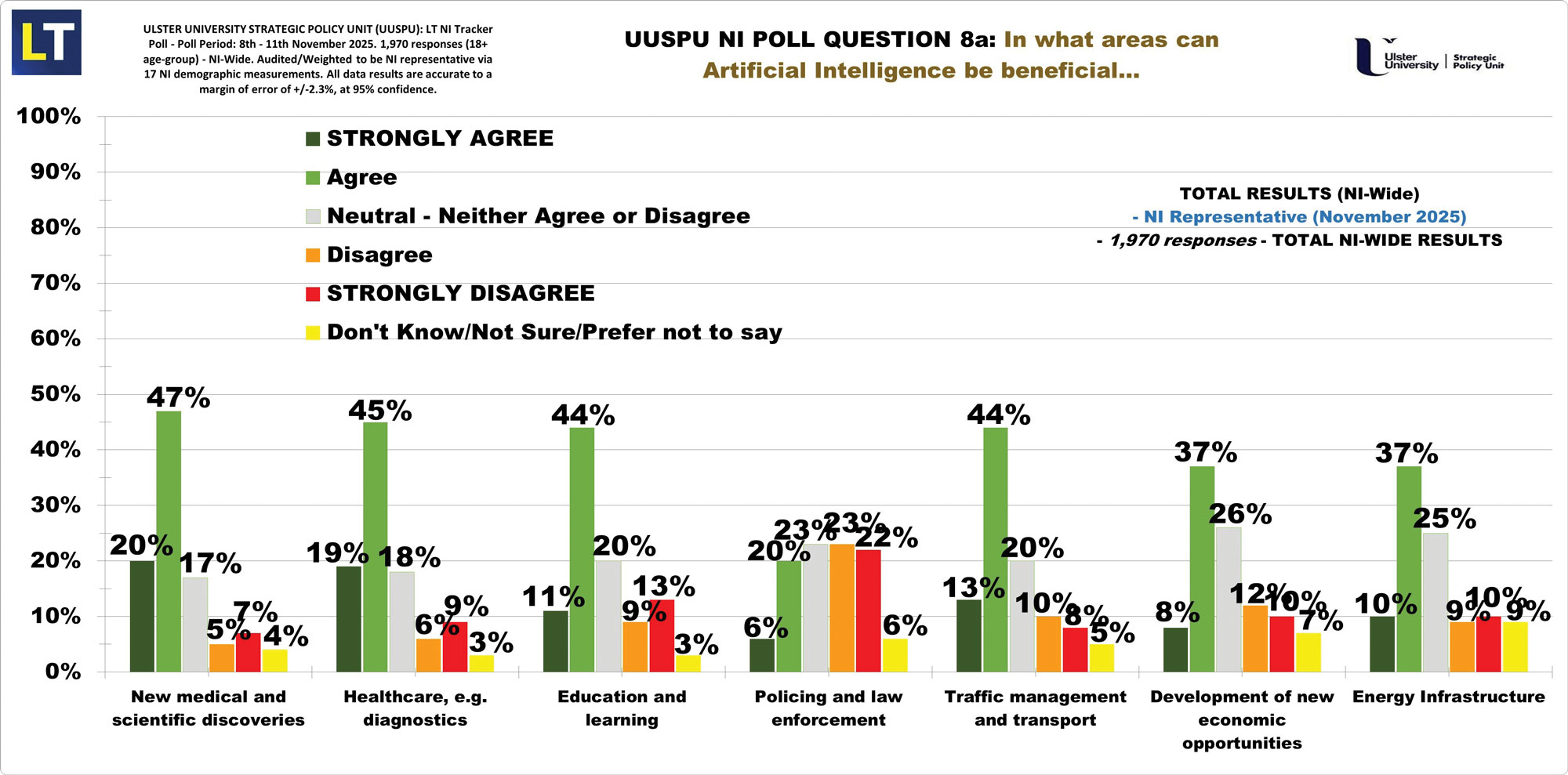
Respondents display significant recognition that AI can be beneficial, with the public identifying medical discoveries and health provision as the applications with which they are most comfortable, with clear support also for education, energy infrastructure, the environment, and transport. Perhaps unsurprisingly, the area with least support was policing.
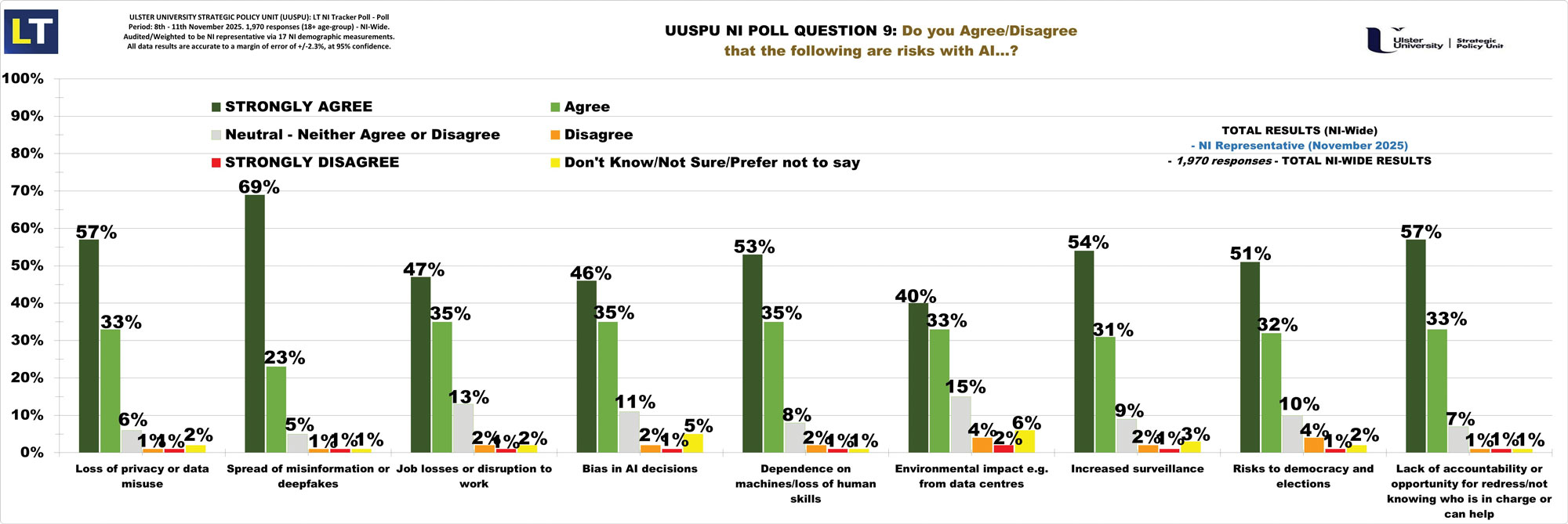
Whilst there is a clear understanding of many of the potential benefits of AI, views around actual or perceived risks were much clearly expressed. Respondents leant towards the ‘agree’ option regarding benefits but with respect to risks, leant towards the ‘strongly agree’ option.
Some of the main concerns related to deepfakes and misinformation, disruption to or loss of jobs, environmental impacts, data security, and maintaining human control. There are significant issues of trust both in terms of the accuracy of results and ethical use.
With a fundamental transformation of our economy and society underway, effective and rapid, and often anticipatory, policy interventions are required. Given that we could be facing a radically changed landscape within a small number of years, it is perhaps surprising that AI is not higher on the political and policy agenda.
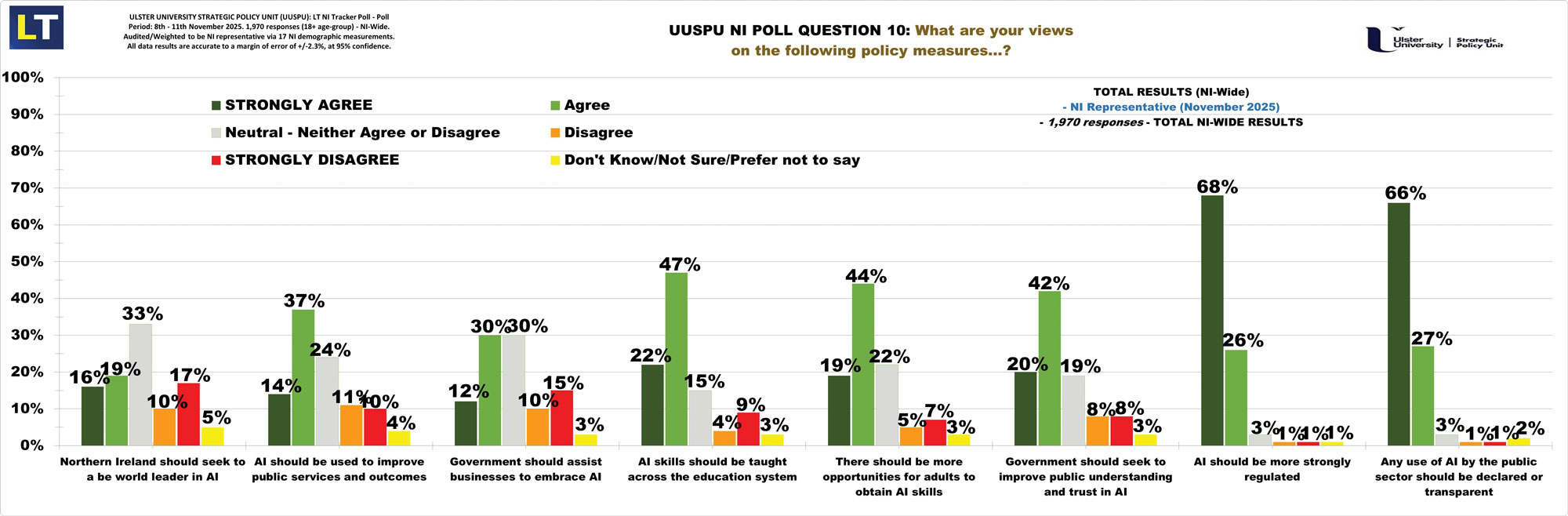
The poll demonstrates a clear need to build and sustain trust in the use of AI including through an ethical governance framework, including transparency and safeguards such as retention of ultimate human control.
Trust will likely be helped by growing evidence of tangible benefits from AI being realised to improve lives.
A delicate balance needs to be found between innovation and regulation. However, in terms of public opinion, there is overwhelming support for strong regulation.
There was clear support for the provision of AI skilling opportunities across a broad front, including the education system. A focus on skills will be crucial to ensuring inclusivity and mitigation of the risk of the economic gains of AI being overly concentrated in a few hands.
Almost all advanced economies have AI strategies. Here in Northern Ireland, the Executive has been developing an AI Strategy for the public sector under the aegis of the Chief Scientific and Technological Adviser, Helen McCarthy.
This will be fundamental building block, but it will not be the overarching approach being taken elsewhere. Therefore, corresponding policies are needed from other departments such as the Department for the Economy dealing with skills, jobs, and energy implication and the Department of Education covering how we teach young people to adapt and flourish in this new world.
The results of the poll and an accompanying report are available at: www.ulster.ac.uk/spu
Stephen Farry is a Professor of Strategic Policy in Practice at Ulster University and former Member of Parliament (MP) for North Down.