Sinn Féin ard fheis: ‘Building Ireland’s future’
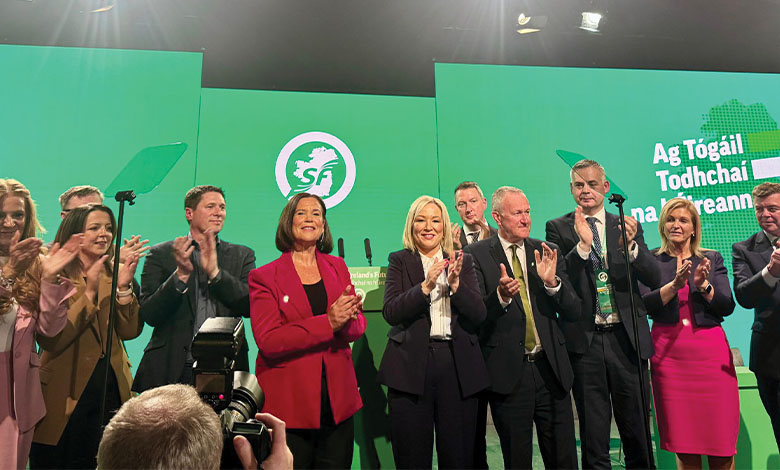
At Sinn Féin’s ard fheis, First Minister Michelle O’Neill MLA told delegates that “the time to build Ireland’s future is now”. Gareth Hamill attended the ard fheis and reports.
The 2026 ard fheis was the first north of the border since 2019 and took place one year prior to scheduled Assembly and local elections, as well as the May 2026 Dáil byelections.
The ard fheis took place on 24 and 25 April 2026 in the International Convention Centre in Belfast, with this year’s theme being ‘Building Ireland’s Future’.
Sinn Féin’s vice president and First Minister Michelle O’Neill MLA began her speech to delegates with an admission that the first Sinn Féin-led Executive has been underwhelming: “Progress in the Executive has been slower than I would like, and I understand people’s frustration out there, because I feel that frustration too.”
O’Neill accused her political rivals in the Executive of hampering progress, saying “there are quite simply some who do not want to work together,” adding that the “DUP want to drag society backwards”.
To improve the governance of Northern Ireland, O’Neill acknowledged the need for reform, saying: “I am giving a commitment that we will look at proposals to reform the institutions.”
Turning towards infrastructure, O’Neill focused on the currently halted development of the A5 carriageway, which she said “remains an absolute priority”, adding that “we will leave no stone unturned in making sure the A5 gets built”.
She also reaffirmed her party’s commitment to building Casement Park and said that “work is ongoing to prepare for the building of the new stadium”.
O’Neill also called for a public inquiry into the murder of Seán Brown and said: “Sinn Féin will continue to challenge the British Government as it continues to deny access to truth for families.”
O’Neill spoke about the importance of upcoming Dáil byelections as well as next year’s council and Assembly elections, saying they are “the tipping point where we can send a clear demand for constitutional change”.
The First Minister turned her attention to elections in Scotland and Wales, which took place two weeks after the ard fheis, and extended her support to the eventually victorious nationalist parties Plaid Cymru and the SNP, adding that, “there is a possibility that there could be three nationalist, pro-independence, and pro self-determination first ministers”. This, O’Neill says, would show that “their union is cracking at the seams”.
O’Neill concluded by speaking about Irish unity, saying: “Partition has failed all the people of Ireland; orange, green, nationalist, unionist, or other. It is time to end partition and start the new chapter.”
Leader’s address
Party leader Mary Lou McDonald TD echoed O’Neill’s calls for a public inquiry into the murder of Seán Brown, the building of Casement Park and the A5, and a change to the UK Government’s Legacy Act to better serve victims of all communities.
In line with the ard fheis theme of ‘Building Ireland’s Future’, McDonald spoke heavily about Irish unity.
The Sinn Féin President believes that unity referendums could be achieved by 2030, adding that preparations must begin now to make this a reality.
McDonald said that her party “will bring forward legislation before the summer, compelling the Irish Government to publish a green paper, a detailed discussion on the process of Irish unity”.
There was also an attempt by McDonald to reach across the political aisle and offer reassurance to members of other communities.
“We respect and value Protestant, unionist, loyalist people, this is your home and we want to build Ireland’s future with you to work constructively together. The leadership of unionism must work also for progress. Divisive, rejectionist, sectarian politics must be consigned to history. It has no place in our future.”
McDonald finished her address by showing strong support for the First Minister, saying: “Next year’s Assembly election is an opportunity to return Michelle O’Neill as First Minister here. Let us make that happen.”
The two then embraced on stage and received a chorus of enthusiastic cheers and applause from the 700 delegates in attendance.
International speakers
Cuban Ambassador to the UK Ismara Vargas Walter and Palestinian activist Arab Barghouti also addressed delegates. Walter spoke about the effect US blockades are having on her country and thanked the party for its solidarity with Cuba.
Barghouti spoke about the imprisonment of his father, Marwan Barghouti, and Israel’s occupation of Palestine. Marwan Barghouti, who has been referred to as ‘the Nelson Mandela of Palestine’, has been imprisoned for 24 years and was also considered to be the leading candidate to replace Yasser Arafat as the President of Palestine.
Arab Barghouti also thanked Sinn Féin for its “unwavering support for justice, freedom, and dignity” and told delegates: “The day will come when you will visit a free Palestine.”
While both speakers were warmly received with standing ovations, Barghouti’s words appeared to resonate more with the crowd, who erupted into chants of “free, free Palestine” following his address.
Analysis
While there was a strong sense of optimism at the ard fheis, recent polls in Northern Ireland are less positive.
An April 2026 poll shows Sinn Féin winning 24 per cent of first-preference votes, a five-year low, and a sizeable drop from the 29 per cent it achieved at the 2022 Assembly elections.
Worryingly for O’Neill, the same poll also found that she has lost significant support and is now the fourth most popular local party leader.
O’Neill’s approval rating is 34 per cent, a 6 per cent decrease from 2025 polling and the biggest drop of any local party leader in that time period. The poll puts her significantly behind the SDLP’s Claire Hanna MP, the most popular leader with 50 per cent favourability.
Perhaps more concerning for O’Neill is the fact that among nationalists, the SDLP leader has moved ahead of the First Minister, with 63 per cent support compared to 62 per cent.
Although Sinn Féin remains the largest party in Northern Ireland, these recent polls will worry party members ahead of next year’s council and Assembly elections amid rumours of unionist unity to try and gain the title of First Minister for unionism. However, this will nevertheless prove an uphill task for unionists as the SDLP continues to lag far behind Sinn Féin in support among nationalists.
Sinn Féin has entered election mode, accusing the DUP of being “anti-Irish”, and recently attacking the SDLP for a motion calling for the introduction of ‘joint first ministers’ as a replacement for the titles of First Minister and deputy First Minister. It is through this that the party will be hoping to energise nationalist voters and retain O’Neill’s title as formal head of government.