Ulster Unionist Party: ‘Stronger together’
At its annual conference in south Belfast on 26 September 2026, it was clear that the Ulster Unionist Party is cautiously optimistic. While it has a leader with unenthusiastic backing among its MLAs, the prospect of turning back the tide against the DUP has enthused most grassroots members into believing in Jon Burrows’ leadership of the party. Joshua Murray was in attendance and reports.
Jon Burrows MLA has shown both his ability to lead, ignore critics, and energise since he became UUP leader in January 2026, despite having never been elected to the Assembly.
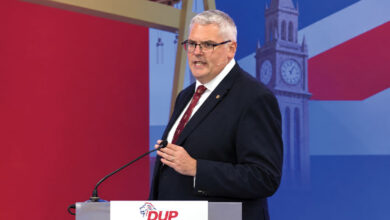
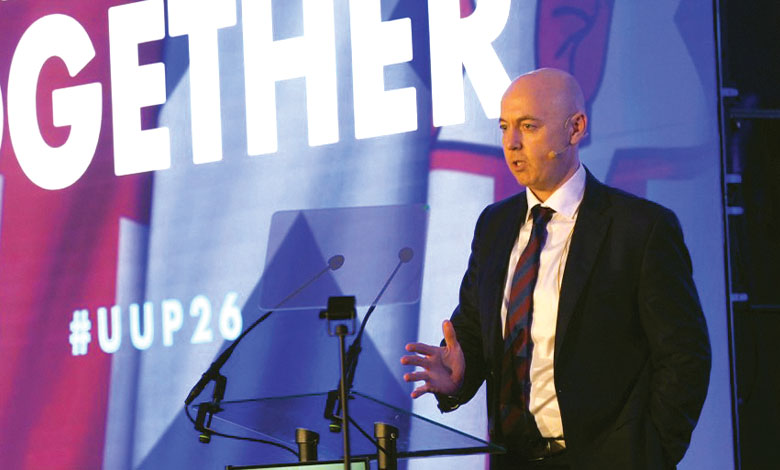
After a day of little mention by any senior elected representatives, the insurgent leader later strode into the hall at the Crowne Plaza Hotel to the tune of Queen’s ‘Don’t Stop Me Now’ to enthusiastic cheers from the roughly 150 grassroots members in attendance, before beginning his speech with a stand-up routine comparing his entrance with the ABBA tribute witnessed at the DUP conference one-week prior.
He then said: “The DUP would know a good tribute act; they have been a tribute act to us since 1971.”
This was followed by: “There will be no more jokes at their expense; I don’t want ‘big Gav’ [Gavin Robinson] telling me to tighten my nuts.”
This confident entrance underscores the state of the Ulster Unionist Party. This is by far the greatest chance the party has since the Good Friday Agreement to turn the tide back on its long-term decline to the DUP.
With the DUP in a state of flux amid Drumcree and the fallout of the Jeffrey Donaldson scandal, the door is open for both the UUP and Traditional Unionist Voice (TUV) to emerge as the new leader of unionism.
With TUV leader Jim Allister having possibly missed the mark, after he accused British intelligence services of leveraging Donaldson’s past against him to secure passage of the Windsor Framework (an allegation described by the Northern Ireland Office as “nonsense”), Burrows has emerged through the middle with an appeal to unionists who oppose the kind of radical politics espoused by the TUV and feel revulsion at the Jeffrey Donaldson scandal.
Burrows has not been afraid to make enemies, with Doug Beattie and Alan Chambers both deselected (Beattie is no longer even a member of the UUP), and former Health Minister Mike Nesbitt resigning from the Executive in part over a fallout with the UUP leader.
Beneath the bravado, however, Burrows is largely proving to be an ideological fellow traveller of his two predecessors, espousing a form of unionism which is not particularly hostile to Irish culture and which is generally socially liberal.
‘On the cusp of something big’
The UUP’s conference theme was ‘stronger together’, a theme also used by Hillary Clinton’s ill-fated 2016 presidential campaign which ended with her shock defeat to Donald Trump.
The potential parallels are stark, and speaking long before his leader at the conference, it was party grandee and former MEP Jim Nicholson who best summarised the state of the Ulster Unionist Party, when he told delegates, “I believe we are on the cusp of something big”, before adding: “We have a great ability to mess things up so let’s not do it this time.”
The day itself was overshadowed by the Drumcree dispute, with delegates eagerly awaiting the outcome in the Court of Appeal in Belfast over Garvaghy Road residents’ attempt to overturn the Parades Commission decision to allow the Orange Order to march there for the first time in 29 years; a decision which has since been overturned by the Secretary of State Chris Bryant.
A UUP member and Orange Order member who was opposed to the march taking place told agendaNi that the Orange Order intended to use the Parades Commission decision as a stalking horse to re-open contentious parades routes which have traditionally been blocked.
Burrows’ speech script was circulated to media in attendance before he took to the stage, with a notable block not published and instead containing ‘DRUMCREE’.
When it came to his speech, Burrows sought to weave the web between long-term strategy and not alienating unionist voters by saying: “I don’t think the role of politicians is to inflame; our job is to encourage calm heads and respect for the law.”
He later added: “The Parades Commission is flawed and the commissioners should be replaced. However, whatever determination they make, it should be respected lawfully and peacefully.”
Notably, he also remarked: “Northern Ireland has come a long way. We need to find resolutions to problems without living in the past.”
Strategic unionism
The rest of Burrows’ speech was essentially a call for strategic cooperation within unionism and a call for Alliance voters to abandon Naomi Long’s party and vote for him.
He said that pro-union voters should not vote for Alliance, accusing the party of having “drifted towards outright nationalism”, adding: “They vote with Sinn Féin more often than any other party in Stormont; even the SDLP.”
He also said that Long’s leadership of the Department of Justice is “catastrophic,” adding: “We need leadership and reform of our justice system, not an endless cop-out of operational independence and faux outrage when you are asked tough questions.”
On unionist cooperation, he committed to “playing our part in expanding unionist representation at Westminster”. “Under proportional representation, turnout and transfers matter and leaders need to promote both, but we need to collectively accept that we haven’t motivated our people to vote in the same numbers as nationalism.
“At Westminster, the arithmetic is different. It would be unforgivable not to make a serious effort to win back Lagan Valley, or to let East Londonderry slip to Sinn Féin.”
Despite this, Burrows acknowledged that unionism has made a series of strategic errors and laid the blame firmly at the door of the DUP. Burrows said unionism “must be honest with itself” and that “the thinking has not been long term enough”.
“When Sinn Féin and the DUP agreed to cut the Assembly seats from 108 members to 90, that reduction did not help unionist representation,” he says.
“Of the 18 seats lost, 16 were held by unionist parties. Sinn Féin lost just one seat and gained a lot more power. Unionists were left unable to carry a vote in the Assembly on their own.”
He added there were “botched” post-Brexit negotiations and “false claims” on the Safeguarding the Union deal, which “damaged trust”.
Burrows also reiterated his well-known catchphrase of the need to “evangelise for the union”, and challenged Sinn Féin Vice President Michelle O’Neill to a head-to-head debate on the constitutional future of Northern Ireland.
Making his case for remaining in the UK, he said: “We benefit from living under the UK security umbrella. We are a member of NATO, we are protected by the RAF and the Royal Navy. The cables that run between America and Ireland… protected by the UK. People depend on them for their business, their lives, their communications, and when our police need support, they can call on mutual aid from police services across the UK. An Garda Síochána cannot.”
Burrows also joined in the broad calls for reform of the institutions in Stormont, although his vision for this was somewhat cherry-picked from what has been proposed by Alliance and the SDLP, which have been leading the calls for reform. He said: “I want a Stormont that is more accountable, that delivers more, and we need, in my view, a proper opposition.”
He added: “We support equalising the titles of First Minister and deputy First Minister so we don’t have this daft rat race at every election for a title that is actually the same anyway. We do believe we can retain the cross-community protections, and we must. But this is the only unionist party that both wants to reform Stormont and retain those vital cross-community protections.”