The future of the Petition of Concern
Established as a safeguard to protect political minorities, the Petition of Concern has become a controversial feature of power-sharing. Despite reforms intended to reduce its use and abuse, recent deployments have reignited questions about further reform.
The Petition of Concern was established under the Good Friday Agreement to ensure significant Assembly decisions had the support of both nationalist and unionist communities.
Introduced under Section 42 of the Northern Ireland Act 1998, it allows at least 30 MLAs to require any matter being voted on by the Assembly to receive cross-community support rather than a simple majority.
This requires either parallel consent, a majority of MLAs and a majority of both unionists and nationalists voting, or a weighted majority of 60 per cent overall support, including at least 40 per cent of both designations.
The original intention was for petitions to concern human rights and equality matters, with the agreement envisaging it triggering a special committee to examine whether measures were compatible with equality requirements, including the European Convention on Human Rights.
However, this committee was never established and, after limited use during the Assembly’s first years, the petition became a means of requiring cross-community support for a wide range of matters, allowing parties to effectively block legislation on political grounds.
Use and abuse
During the first Assembly term, from 1998 to 2003, only seven petitions were tabled, which all required multiple parties’ support, as none had over 30 MLAs.
These concerned minority rights issues, including the display of the union flag and Easter lilies at Stormont, although one petition did relate to a motion of no confidence in then-Education Minister Martin McGuiness.
Following the election of 36 DUP MLAs in 2007, enabling the party to trigger a petition independently, usage grew significantly. A further 33 were tabled between 2007 and 2011, with the DUP signing 20 and the SDLP and Sinn Féin supporting the other 13.
There was also increased politicisation of the mechanism, with several petitions tabled related to matters unrelated to minority rights such as the Planning Bill.
Petition usage exploded between 2011 and 2016, with it tabled 118 times. The DUP, the only party with more than 30 seats, signed 86 and introduced 82 of these, while SDLP and Sinn Féin MLAs combined signed the next most, with 29 each.
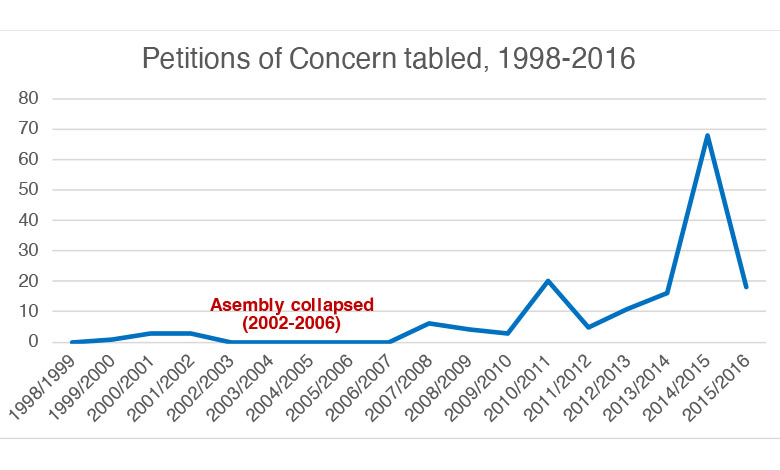
Petitions were largely political, with 49 DUP petitions tabled against the Welfare Reform Bill and the mechanism used five times to defeat marriage equality motions.
One particularly controversial deployment came in January 2017, when the DUP blocked Sinn Féin’s motion of no confidence in then-Speaker Robin Newton. This followed his decision to allow then-First Minister Arlene Foster to make a ministerial statement during the Renewable Heat Incentive scandal without Sinn Féin’s permission.
This increasingly political usage fuelled calls for reform of the petition as Stormont entered three years of collapse.
Reform had previously been considered with the 2015 Stormont House Agreement committing the Executive parties to changing the petition.
This was realised through the New Decade, New Approach deal which restored the Executive in 2020.
Introduced in 2022, the reforms require a petition to have support from multiple parties, ensuring no party can trigger one independently.
Other reforms included:
- 14-day consideration period before petition confirmation;
- cannot be used to stop consideration of Assembly members’ behaviour;
- requirement for a justifying statement; and
- the Speaker and the deputy speakers cannot sign.
Additionally, the parties committed to using petitions “only in the most exceptional circumstances and as a last resort”.
Further reform?
Despite these reforms, recent deployments have reignited accusations of abuse and prompted questions about whether the reforms have gone far enough.
In November 2026, the DUP, supported by the UUP and TUV, tabled a petition against Sinn Féin MLA Pat Sheehan’s Irish-medium Education (Workforce Plan) Bill which would require the Department of Education to prepare a sector workforce plan.
DUP leader Gavin Robinson MP said his party wanted to “ensure the arrogance of Sinn Féin is kept in check”, using the “mechanisms at our disposal to thwart their agenda”.
First Minister Michelle O’Neill MLA said: “It is blatant sectarianism and anti-Irish bigotry.”
Other recent deployments include the opposition from the DUP, TUV, and four UUP MLAs to Justice Bill amendments proposing increasing the age of criminal responsibility for most offences from 10 to 14.
A long-time critic of the mechanism and advocate of reform, Alliance published its proposals for further reform in May 2026. It proposed restricting petitions to matters concerning national identity, the legacy of ‘the Troubles’, or the Good Friday Agreement’s constitutional structures.
The SDLP has been critical of abuse of petitions and have previously called for its use to be aligned with the intentions of the Good Friday Agreement.
While the UUP has criticised the petition’s misuse, it has not publicly supported reform. At its party’s conference in September 2026, Jon Burrows MLA said: “We do believe we can retain the cross-community protections, and we must.”
The Committee on Procedures’ report on petitions of concern, published in November 2026, examined the question of further reform.
Among its recommendations were new procedures allowing an ad hoc committee to examine a petition during the 14-day consideration period and report on its compliance with equality requirements. It also proposed measures to prevent multiple petitions being used at successive stages of legislation to create repeated 14-day delays.
These measures were supported by the SDLP, Alliance, and Sinn Féin MLAs in the committee, while UUP and DUP members opposed proposed ad hoc committees and the usage of multiple petitions.
The proposed ad hoc committee provision failed to secure cross-community support in the Assembly, despite receiving 45 votes in favour and 30 against, as all unionist MLAs voted against it. The proposal to prevent successive petitions at the consideration stage also failed as it did not achieve cross-community support.