Promoting Ulster Scots and the Ulster British tradition
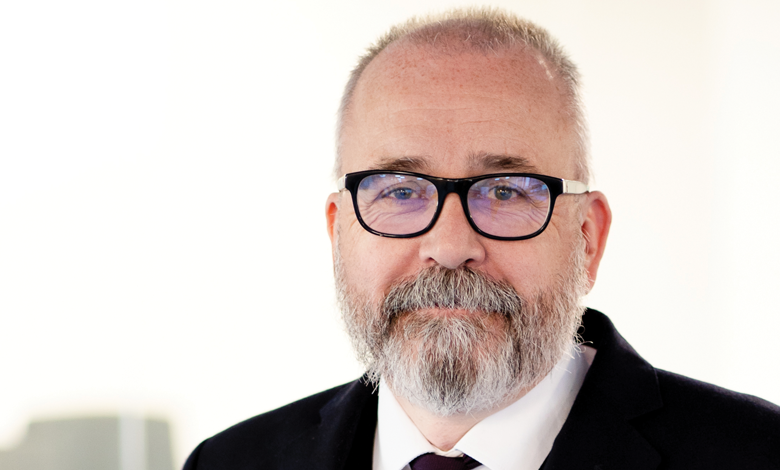
Commissioner for the Ulster Scots and the Ulster British tradition Lee Reynolds talks to Ciaran Brennan about reviving the language, addressing apprehension towards the Ulster British tradition, and the funding shortages impeding his duties.
Reynolds began working as Commissioner for the Ulster Scots and the Ulster British tradition in November 2025. The commissioner’s principal aim is to “enhance and develop the language, arts, and literature” of Ulster Scots and the Ulster British tradition.
The role was given statutory footing under the Identity and Language (Northern Ireland) Act 2022 which came into force in May 2023. Reynolds has the following responsibilities as commissioner:
- to promote awareness of Ulster Scots services provided by public authorities to the public in Northern Ireland;
- to provide or publish advice, support, and guidance to public authorities to develop and encourage Ulster Scots language, arts, and literature; and
- to investigate complaints from the public into whether a public body has shown due regard to the published guidance.
“The Ulster Scots revival model is a three-legged stool: it is culture, it is heritage, it is language.”
Ulster Scots
Reynolds is critical of how Ulster Scots policy replicates Irish language policy despite both being at different stages in their revival. Noting that core institutions are required for revival languages, he says these have been established for the Irish language, but not for Ulster Scots.
He says policymakers “are coming from a good place” as they are aiming to treat both cultures equally, but that this is not what Ulster Scots requires. Reynolds says: “I do not need a cut and paste; I do not need a photocopy. I need a policy that comes from the same conversation.”
Regarding education, he indicates that his long-term aim is to make Ulster Scots a discrete subject. The commissioner says this requires “a lot of institution-building and a lot of hard work”, adding that the materials and teachers must be in place to ensure effective delivery of an Ulster Scots curriculum.
On Ulster Scots’ presence in modern education, Reynolds criticises what he calls “Schrödinger’s curriculum”. Explaining this, he says it is there for those who seek it, but that it is absent for those who do not.
He is also keen to outline that Ulster Scots pertains to culture and heritage; not just language. Reynolds says: “The Ulster Scots revival model is a three-legged stool: it is culture, it is heritage, it is language.
“It is about placing the language in the education system, in that broader identity context of culture, heritage, and language.”
Renolds says there is a “high degree of ignorance” around the origins, use, and value of Ulster Scots. He suggests that “there will always be deep-seeded prejudices that you cannot entirely overcome”.
Despite this, he remains optimistic: “There is a golden moment for education and Ulster Scots. We have the new educational duty, we have a new curriculum being developed, and we have potentially, on top of that, the strategy.”
The commissioner also notes that “a series of human rights commitments” regarding the language have been made. He says: “It is a case of education, persuasion, and also – I have news for people who do not like it – a series of promises have been made and, whether they like it or do not, it is my job to ensure those promises are kept.”
The Ulster British tradition
When discussing his work regarding the Ulster British tradition, Reynolds says: “Ulster British is in my title. Ulster British is in my explanatory paragraph, but it is not in my specific functions.
“I consider myself, in law, a commissioner for Ulster Scots and champion for Ulster British. I can produce guidance that there is a due regard [to Ulster-Scots] that public authorities will have to follow in Northern Ireland, but I can produce advice on Ulster British and that is it.
“I can detect a strong undercurrent of more of a comfort zone with public bodies around having a conversation around Ulster Scots. They get much more nervous when I mention the words Ulster British. That will be one of the things that I have to get people over.”
Reynolds says “there has been a degree of questioning and also a degree of snark” regarding what Ulster British means. To address this, he says he is developing a working definition for the Ulster British tradition. This is to go out to consultation before the end of 2026, and Reynolds says he intends “to interpret it broadly”. Reynolds says he aims to develop advice for the tradition which will undergo consultation as the same time as the Ulster Scots guidance.
Furthermore, the commissioner sets an aim to undertake a programme of research including analysing the celebration of Victory in Europe Day and the coronation. He intends to establish a continuous interchange of British cultural materials between museums in Northern Ireland and those in Great Britain. Reynolds says he will also go into partnership with the Orange Order to update its economic impact analysis.
When asked how he would promote the tradition to those who oppose it, Reynolds says: “It is an identity of 101 gateways. Pick your gateway, you will find one, and you will find a wealth of material behind that gate.”
During the development of Reynolds’ office, a 2023 Council of Europe report criticised the inclusion of Ulster British in the title. The fifth monitoring report on the UK’s compliance with the Council’s convention for the protection of national minorities says: “The naming of a commissioner for Ulster Scots as for the Ulster Scots and the Ulster British Tradition unnecessarily conflates this minority identity with a distinct political one.”
Responding to this, Reynolds says: “Ulster British is not a political identity. There is a cultural element there. There is a cultural identity around Britishness.
“That is a bit of a subtext that is almost equating Ulster Britishness as something to do with politics, as something to do with sectarianism. That is where some of this feeds through to, ‘this seems a little bit dangerous’, and it is not. That is something I am going to have to push through.
“The linguistic, literary, and artistic legacy in the UK is not getting the recognition that it deserves.
“There is a wealth there that we have sort of disconnected ourselves from or not managed to pass on to the next generation.”
Frustrations
Reynolds has engaged extensively with relevant stakeholders since taking office. Part of this engagement has been with the Department for Communities (DfC) on the development of an Ulster Scots strategy.
He says it was on course to be an effective document, but has become “worse, less strategic, less visionary” in recent times. The commissioner says he aims to rectify this and “get it over the line with the Executive”.
“It is a new organisation with limited resources, and we now have a substantive problem with where the strategy is at,” he says. “It is part of my duties, but it is taking up more time than I had hoped.”
Outlining further difficulties in the delivery of his responsibilities he says: “The primary frustrations have been, one: getting a budget and two: that being substantially lower than what we were expecting. The next steps of the work are going to have to be delayed a bit to make it work.”
The commissioner says he is persevering through the budgetary constraints but has written to the Executive Office to say he does not believe he will fulfil his duties in current conditions.
Reynolds says he will be able to produce guidance on Ulster Scots, but that it will be delayed. However, he says he “almost definitely” cannot fulfil his statutory duty of investigating complaints due to the lack of resources.
Reynolds’ office was established alongside the Office of the Irish language Commissioner and the Office of Identity and Cultural Expression. Tracing the significance of their formation, Reynolds says they are aimed at starting a new conversation about identity in Northern Ireland.
This is why the lack of resources is a huge source of frustration for Reynolds: He says: “The conversation about identity in the last 20, 25 years has not progressed significantly well. Identity has continued to dog Northern Ireland society and has caused harms.
“I would have hoped that the new conversation would have been appropriately invested in and taken seriously.”