Health inequalities deteriorating

Healthy life expectancy has declined significantly throughout the most economically deprived areas in Northern Ireland.
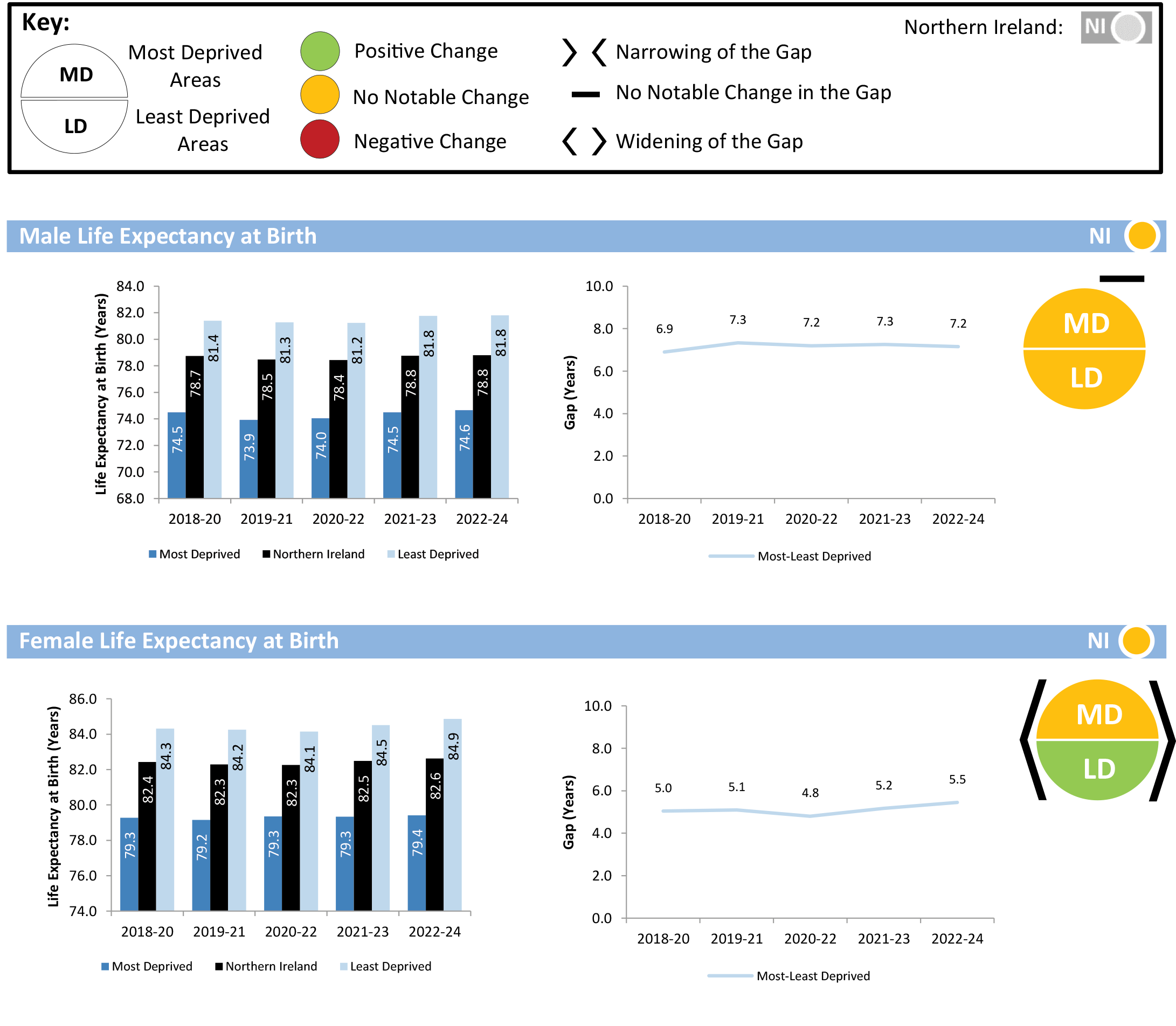
The Health Inequalities Annual Report 2026, published in March 2026, finds that the most-least deprived gap in female life expectancy widened by 0.5 years, from 5 years between 2018 and 2020 to 5.5 years between 2022 and 2024. While there was no significant change in the deprivation gap for male life expectancy over the analysed period, it remained high at 7.2 years between 2022 and 2024.
The rate of people self-assessed as in good or very good general health decreased over the last five years in all areas and the most-least deprived gap widened. The inequality gap for male healthy life expectancy also widened to 14.9 years over the analysed period due to a decrease of 4.5 years in the most deprived areas.
Female healthy life expectancy has decreased by 1.9 years in Northern Ireland. There were no observed changes in the most or least deprived areas, but the inequality gap between the most and least deprived areas nonetheless remains high, at 14.6 years.
Large inequality gaps continue to highlight markedly higher rates of premature mortality in the most deprived areas, with the gap between the most and least deprived areas widening over the period for five of the eight indicators analysed. Gaps widened for avoidable and preventable mortality where death rates increased for Northern Ireland and in its most deprived areas.
For the respiratory mortality of people under the age of 75, there was a narrowing of the gap due to an observed improvement in the most deprived areas. Despite this improvement, the inequality gap remains the highest of all premature mortality indicators where the rate in the most deprived areas was around three-and-a-half times the rate in the least deprived areas.
Large inequality gaps continue to exist for mental health indicators. The inequality gap in the suicide rate widened over the analysed period with the rate in the most deprived areas now treble the rate in the least deprived areas.
Alcohol and drug related indicators continue to show some of the largest health inequalities monitored in Northern Ireland. The deprivation gap for drug misuse deaths widened over the analysed period and showed the largest inequality gap, with mortality in the most deprived areas almost six times that of the least deprived.
In 2024/25, the percentage of primary one pupils affected by obesity in the most deprived areas was 73 per cent higher than the rate in the least deprived areas. For year eight pupils, the most-least deprived gap was wider at 87 per cent.
In 2024/25, the most-least deprived inequality gap for dental extractions for all ages narrowed. However, the rate in the most deprived areas was still more than double that in the least deprived areas. With the exception of dental registration rates, inequality gaps widened over the analysed period for the remaining dental indicators.
Regional variation
Examining regional variation, the report states that male and female life expectancies were lowest in the Belfast local government district (LGD) (76.5 years and 80.5 years respectively). Male life expectancy was highest in Lisburn and Castlereagh LGD (80.5 years), and female life expectancy was highest in Lisburn and Castlereagh, and Fermanagh and Omagh LGDs (83.8 years).
The largest inequality gap in male life expectancy was seen in Mid and East Antrim LGD where the gap between the 20 per cent most deprived areas and the LGD average stood at 6.6 years. The largest gap for females was seen within the Belfast Trust area (4.7 years).
Similar to the regional picture, deprivation related inequality was most prominent in indicators relating to alcohol, drugs, self-harm, smoking during pregnancy, and teenage births, which were among the largest inequality gaps for the majority of trusts and LGDs.
Drug misuse mortality was the largest inequality gap in Belfast, northern, and western HSC trusts, where the rates in their most deprived areas were almost two-and-a-half times (132 per cent, 124 per cent, and 130 per cent) their respective trust averages. Drug-related admissions was the largest inequality gap in the Southern Trust, while the teenage birth rate showed the largest gap in the South Eastern Trust.
With the exception of Lisburn and Castlereagh LGD, drug related admissions was among the top five inequality gaps within all eleven LGDs. In the Mid and East Antrim LGD, the rate of drug related admissions within the 20 per cent most deprived areas, was two-and-a-half times (inequality gap of 149 per cent) the LGD average.
Large inequality gaps for alcohol related admissions also exist in the majority of trusts and LGDs. The rates in the respective most deprived areas for the Belfast Trust, Southern Trust, Western Trust, Armagh City, Banbridge and Craigavon LGD, Belfast LGD, Derry City and Strabane LGD, Lisburn and Castlereagh LGD, and Mid and East Antrim LGD were around double the trust/LGD average.
Alcohol-specific mortality showed the largest inequality gap (97 per cent) in the Causeway Coast and Glens LGD, where the death rate in the most deprived areas was around double the LGD average.