Alleviating flood risk
The Department for Infrastructure (DfI) has established a number of tidal flood alleviation schemes in light of flood risks in many of Northern Ireland’s towns and cities.
Flood alleviation schemes have varied through the region by design, with some involving nature-based solutions while others involved man-made infrastructure and dams.
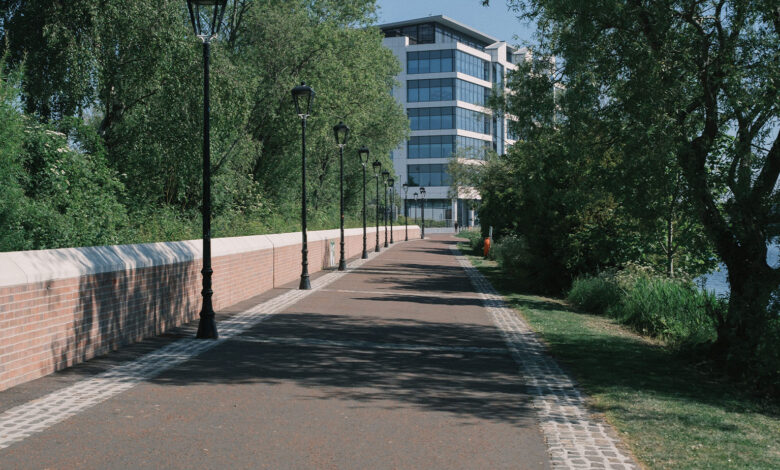
The most advanced and visible intervention remains the Belfast Tidal Flood Alleviation Scheme. Completed in December 2024 at a cost of £33 million, the scheme now provides protection to more than 3,000 properties along an 8.5km stretch of the River Lagan.
As previously outlined by agendaNi, Belfast has long been identified as the most at-risk location for tidal flooding in Northern Ireland, with parts of the city centre lying one to two metres below projected extreme tide levels.
Over its lifetime, the Belfast scheme is expected to prevent up to £168 million in direct damages and a further £87 million in wider economic losses.
In Downpatrick, one of the areas worst affected by the unprecedented flooding of autumn 2023, a scheme is moving through the critical business case stage.
A feasibility study completed in 2025 has identified viable options capable of protecting over 100 properties, with modelling suggesting significant avoided damages and improved understanding of the town’s complex fluvial dynamics.
In Newry, work is underway on the second phase of a wider programme of three interconnected flood alleviation schemes. Ongoing activity centres on development of an outline business case and environmental screening. While earlier feasibility work has already been undertaken, the project remains in its appraisal phase, with a draft business case also anticipated in 2026.
Elsewhere, Newcastle, County Down provides an example of how completed schemes are already being tested in real-world conditions. Flood defences along the Shimna and Burren rivers have demonstrably reduced the impact of river flooding during recent severe weather events.
However, flooding in nearby areas such as Tullybrannigan, which are driven by separate catchments and surface water systems, have highlighted the limitations of single-scheme interventions and the need for continuous investigation and adaptation.
This layered understanding of flood risk is also shaping newer approaches, particularly in locations like Eglinton, County Derry. There, a pilot project involving leaky dams has been deployed upstream to slow water flow and reduce downstream pressure.
While relatively small in scale compared to traditional hard infrastructure, such nature-based solutions are being used to complement larger schemes and provide interim protection while longer-term proposals are developed.
In Portadown, County Armagh, DfI is aiming to deliver a scheme that will reduce the impact of fluvial flooding from the River Bann and some of its tributaries on properties in the Portadown area in the event of a 1 per cent annual exceedance probability flood with allowances for climate change as per the current departmental guidance.
The design stage of the Portadown Flood Alleviation Scheme has been completed, and the procurement process has commenced. Subject to the project maintaining its viability, it is anticipated that a contractor for the first phase of the works will be appointed by the autumn or winter of 2026.
DfI states: “Flood risk management remains a key priority for DfI, through both the development of flood alleviation schemes, as well as working with communities right across the North to boost our climate resilience. Flood risk management is a complicated and multi-faceted area of work, which is why it is important that, when necessary, we carry out the detailed background and investigative work necessary to get it right.”