Burnham’s baptism of fire
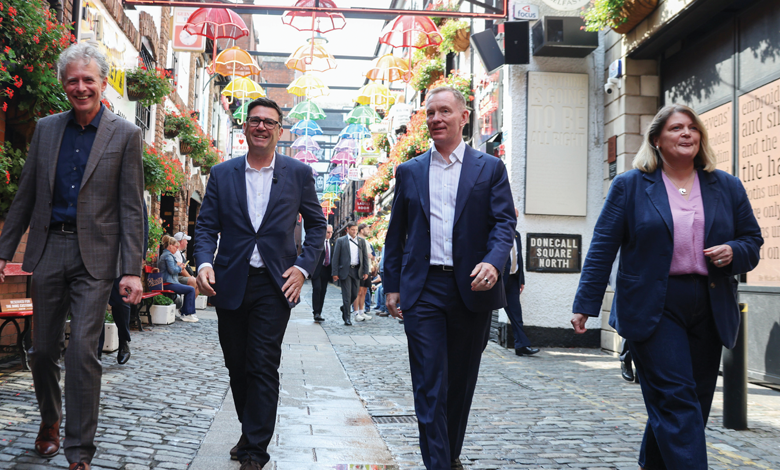
The new Prime Minister, Andy Burnham MP, has enjoyed a fairly successful start to his premiership in Britain, but his first visit to Northern Ireland was a baptism of fire as clumsy remarks on a border poll led to a row with nationalists.
On 27 August 2026, Andy Burnham MP visited Northern Ireland for the first time since he became Prime Minister in early July. Burnham’s inaugural visit to the region took place 39 days after he entered Downing Street, the second longest wait for a visit to Northern Ireland by a peacetime UK prime minister (second to Rishi Sunak MP, who visited after 51 days).
What was meant to be a routine visit descended into a significant row, after Burnham clumsily stated to reporters that calling a border poll was “off the table”, a remark which was widely interpreted by nationalists as meaning that the British Government would not meet its Good Friday Agreement obligations in the event of majority support for unification in Northern Ireland.
The Prime Minister told reporters: “I will take a collaborative approach, but some issues will be off the table and that [calling a border poll] is one issue that will be off the table because we’ve got to focus on bringing people together as best we can.”
He later cited the 2016 EU referendum and the 2014 vote on Scottish independence. “What we find is that the risks that come from those situations take a long time to heal and it sets you right back, and you can’t focus on what’s right in front of us here and now.”
He added: “A decade since the Brexit referendum I think we’ve had too much division, too much arguing, too much backward-looking.”
The process for calling a border poll is set out in the Northern Ireland Act 1998: “Subject to paragraph 3, the Secretary of State shall exercise the power under paragraph 1 if at any time it appears likely to him that a majority of those voting would express a wish that Northern Ireland should cease to be part of the United Kingdom and form part of a united Ireland.”
These vague criteria have prompted questions as to what would drive the Secretary of State to make such a decision. In an interview with agendaNi in March 2025, Fleur Anderson, then a junior minister at the Northern Ireland Office, stated that opinion polls would form the basis of such a decision, with polls being more important than election results in the UK Government’s decision-making process.
“It would be based on the opinion polls of the general public rather than number of politicians,” Anderson said at the time. Although the NIO subsequently distanced itself from Anderson’s remarks and then removed her from her position, the remarks raised questions as to whether additional internal criteria to the wording of the Northern Ireland Act is being used by the NIO which is not shared with the public.
Sinn Féin leader Mary Lou McDonald TD, who met Burnham following the remarks, says her party’s delegation had a “very frank and very forthright” meeting with Burnham following his remarks in which he ruled out a border poll.
“We have put it to him very strongly that burying his head in the sand is not a plan, not a strategy, not wise, and not acceptable to us,” she said.
SDLP leader Claire Hanna MP has criticised both Burnham’s remarks and Sinn Féin’s response to them: “The society we want to build is inclusive and tolerant, and that means engaging with people across the community, building consensus and trust, and demonstrating that a new Ireland can be about building something genuinely new together.
“Over-the-top outrage about clumsy language from UK politicians doesn’t get us closer to that.”
“I will take a collaborative approach, but some issues will be off the table and that [calling a border poll] is one issue that will be off the table.”
Andy Burnham MP, Prime Minister
Downing Street later clarified Burnham’s position, stating: “The Prime Minister said as we approached the 30th anniversary of the Good Friday Agreement, his commitment to every part of it including the principle of consent remained unwavering.”
Despite this, unionists have strongly welcomed Burnham’s initial remarks. DUP leader Gavin Robinson says: “It’s particularly encouraging to hear his comments today, putting to bed the nonsense that has been mentioned over many months now around a border poll.”
Ulster Unionist Party leader Jon Burrows MLA described Burnham’s remarks as “a hard reality check for Sinn Féin”, and also said that “a border poll is no closer today than when the Good Friday Agreement was signed”.
The latest opinion polling on Irish unification, by the University of Liverpool, says that 35.8 per cent of people in Northern Ireland would vote in favour of a united Ireland, while 49.7 per cent would vote to stay in the UK.
While polls suggest unification falls short of majority support, they also demonstrate a significant increase in support since the Brexit referendum, with some post-Brexit opinion polls recording pluralities in favour. In 2015, one year before the Brexit referendum, support for Irish unification was shown as being 13 per cent in Northern Ireland.
Budgetary challenges
The border poll furore distracted what was meant to be the Prime Minister’s main exercise, namely wagging the finger at local politicians over failure to agree a budget, overseeing significant department overspends, and failure to consider revenue raising measures.
According to the Fiscal Council, Executive departments face a potential overspend of up to £1.6 billion over the current financial year. The four-party Executive has failed to agree a budget five months into the financial year, meaning that public services are currently operating under contingency arrangements.
Speaking ahead of meeting the local parties, Burnham said he wanted to have “an honest exchange” with political leaders.
“There are things that we would say if we can work together, have a look at where possible savings can be made or where things can be done differently, it’s right and proper that I ask for those assurances.”
Burnham’s visit followed remarks by the new Secretary of State, Chris Bryant MP on 24 August 2026, in which he described the Executive’s failure to agree a budget as “shocking”.
First Minister Michelle O’Neill MLA said that there is a need for a “fair budget settlement that actually works for public services”, adding: “The reality is that we are so underfunded… Have been for years.”