Will Stormont be reformed?
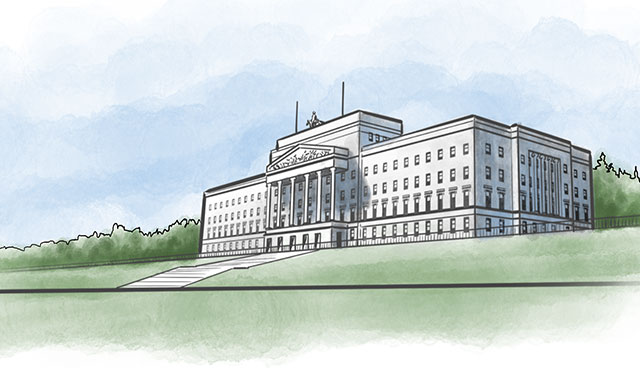
With four of the five main parties supporting reform of Stormont, there is increasing consensus that institutional change is needed, but the form this should take is less clear, meaning that prospects for reform are uncertain.
Stormont’s current arrangements are the product of several reforms since the Good Friday Agreement, with significant changes made since 1998 to the working of the Assembly and Executive.
The 2006 St Andrews Agreement brought the first major reform, replacing the joint election of the First Minister (FM) and deputy First Minister (dFM) with a system where the largest party from each community designation nominates the FM and dFM.
In 2010, the Justice Minister role was created, which was to be selected through a cross-community vote.
Further reforms were introduced in 2016, including a reduction in the number of MLAs from 108 to 90 and Executive departments from 12 to nine, as well as establishing an Official Opposition.
Despite these reforms, the Executive has spent significant periods not functioning, being suspended six times since 1999, with the most recent collapse lasting from February 2022 to February 2024.
These repeated periods of instability alongside poor legislative performance mean that four of the five main parties now support reform, although there is no consensus on what changes should be made.
Potential reforms
Think-thank Pivotal’s report, Improving the institutions: Suggested reforms to the Northern Ireland Assembly and Executive proposes eight institutional reforms to increase scrutiny, tackle logjams, and encourage collaboration.
One of its recommendations, changing how the Speaker is elected, is already supported by Sinn Féin, Alliance, and the SDLP. The proposal would change the current cross-community vote to a two-thirds majority, making it more difficult for a single party to prevent the Assembly from functioning.
Another reform, selecting the Justice Minister through D’Hondt rather than a cross-community vote is also backed by Sinn Féin, Alliance, and the SDLP.
The report includes more changes to the D’Hondt process, including running it once for ministerial posts and committee and deputy chairs and setting a seat threshold for parties entitled to an Executive seat.
Two of the report’s reforms aim to make better use of MLAs’ time and increase the efficiency of the legislative process.
Firstly, it proposes establishing ad hoc ‘bill committees’ after the second stage of legislation to question witnesses, conduct line-by-line scrutiny, and propose amendments before reporting to the relevant statutory committee.
Secondly, it recommends restricting the number of non-binding private members’ motions, such as those on non-devolved issues like foreign policy, freeing up Assembly time for legislation and scrutiny of matters within its remit.
The report identifies three reforms which could be agreed before the upcoming Assembly election and implemented at the beginning of the next mandate; increased resourcing of the Official Opposition, enforcing the three-meeting rule on Executive business, and prioritising the Programme for Government, budget, and legislative programme.
Potential for reform
As the largest party, Sinn Féin’s recent move towards advocating for institutional reform means there is now more political momentum behind reform than there has been for some time.
The party published its list of proposals in June 2026 including removing the ability to block appointments and selecting the Justice Minister through D’Hondt. This recent support for reform is interesting as it came after Sinn Féin became the largest party in the Assembly for the first time, in 2022.
This position gives the party an incentive to support changing rules which allow a smaller party to obstruct the operations of government.
Despite its new support for reform, Sinn Féin and DUP both criticised the SDLP’s nonbinding motion in March 2026 to equalise the titles of the FM and dFM, which was supported by Alliance and the UUP.
However, while holding the office of dFM, Sinn Féin consistently used the phrase ‘joint first ministers’ and in 2015 former dFM Martin McGuinness proposed a formal change to the titles.
Sinn Féin’s recent support for reform brings the party more in line with longstanding champions of change, Alliance and the SDLP.
As a party designated as ‘other’, Alliance has consistently advocated for governmental structures that reflect a more diverse population and limit the use of cross-community measures which can restrict government formation and legislative progress.
In May 2026, Alliance became the first party to publish detailed reform proposals which include using D’Hondt to select the Justice Minister.
Assembly reform: Positions by party
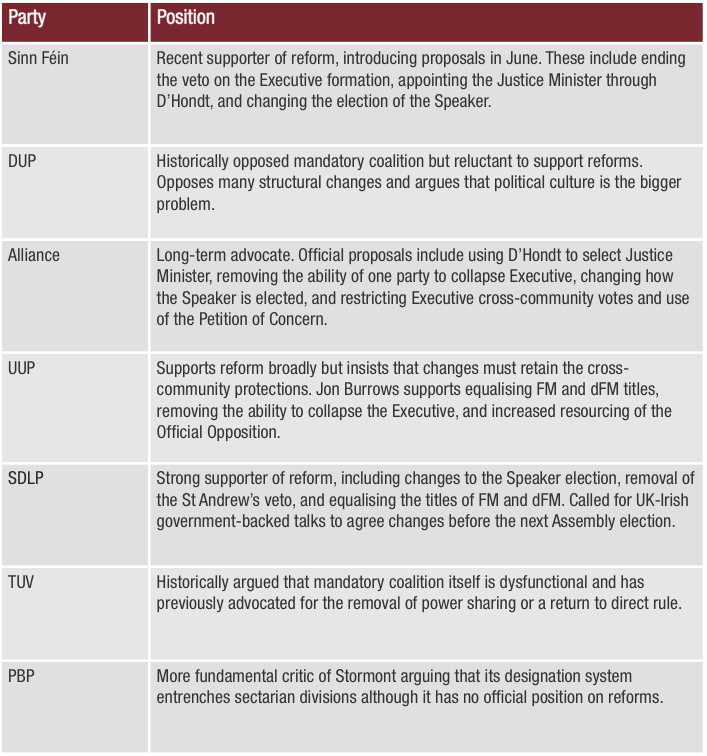
Alongside Alliance, the SDLP has been the party most consistently supportive of reform.
It has repeatedly called for the removal of the ‘St Andrews veto’ that requires significant or controversial matters outside the PfG to be approved by the entire Executive.
The SDLP has increased its calls for reform in recent months and in May 2026, leader Claire Hanna MP called for UK-Irish government-backed talks to agree changes before the next Assembly election.
While broadly supportive of proposals such as equalising the dFM and FM’s titles and increasing support for the Opposition, the UUP is cautious about the effect of reform on the cross-community protections such as the single-party veto.
The DUP remains the only party which has not pledged support for reforms. Responding to Sinn Féin’s proposals, leader Gavin Robinson MP said he wanted to see “reform of the heart”.
The party has historically supported reform of the institutions through the guise of ‘opposition to mandatory coalition’ with Sinn Féin. Despite this, the DUP has not supported measures which would effectively lead to this from either the Alliance Party or the SDLP.
The Assembly’s two smaller parties, People Before Profit and the TUV, have also been critical of Stormont’s institutions, although neither party has an official position on proposed reforms.
The TUV has historically argued that mandatory coalition itself is dysfunctional and has previously advocated for the removal of power sharing or a return to direct rule.
PBP is a fundamental critic of Stormont, arguing that its designation system entrenches sectarian divisions, but does not support increased Westminster rule.
Despite this broad recognition among parties that institutional reform is needed, the lack of consensus on its from means change is unlikely to occur soon.