Happy tin Brexiversary
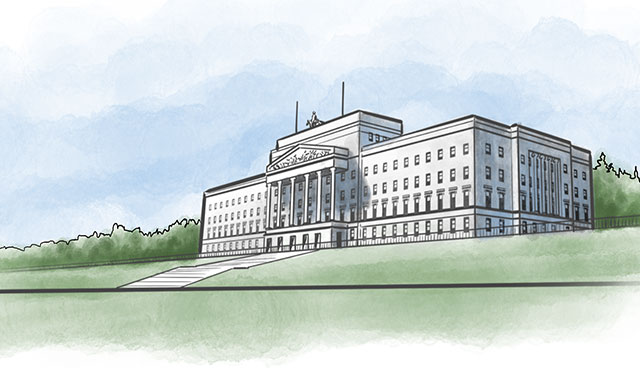
June 2026 marked 10 years since the UK voted to leave the EU. The subsequent decade has been one marked by economic and political stagnation in the UK, trade realignment in Northern Ireland, diplomatic victory for the Republic of Ireland, and the betrayal of unionism. Joshua Murray writes.
When the result of the referendum became clear in the early hours of 24 June 2016, the immediate concern for people here was what Brexit would mean for the island of Ireland and, more specifically, the border. The UK’s narrow 52-48 vote in favour to leave overshadowed an endorsement of ‘remain’ in Northern Ireland by a 56-44 margin.
An agendaNi editorial from June 2016 reads: “We can look forward to years of turmoil with undoubtedly more surprises in the future. Brexit is truly a leap in the dark.”
That morning, David Cameron resigned as the British Prime Minister and the Tories swiftly slung the hapless Theresa May into Downing Street. Initially delaying the triggering of Article 50 of the Lisbon Treaty – the legal mechanism through which an EU member state may leave – May made an unusually bold decision to take advantage of then-Labour leader Jeremy Corbyn’s unpopularity and aim to win the Tories a landslide victory.
Along comes June 2017, and the British people deliver another shock, as Corbyn’s surprisingly effective ground campaigning was complemented by a disastrous Tory campaign. An election which was meant to deliver May a landslide resulted instead in her losing her majority.
Only at this stage did Northern Ireland enter the fray, as May relied on the DUP’s (at the time) 10 MPs to keep her party above water in parliament. In return, £1 billion extra in funding was allocated to Northern Ireland. This was despite the fact that there was no sitting Executive at the time following the collapse of early 2017.
May faced the unenviable task of spearheading radical constitutional change, leading a party which saw her as a spent force and being propped up by – in British terms – a fringe party which was significantly to the right of her.
As her attempted Brexit deals, including the Backstop, repeatedly failed to pass Parliament, the ground shifted and Alexander Boris de Pfeffel Johnson was waiting in the wings.
Johnson, who enjoyed a colourful political career to that point, had served as Mayor of London and had been, up until the time of the referendum, pro-EU. According to BBC Newsnight, Johnson had prepared two articles for his weekly column in The Telegraph, with one being pro-remain and one being pro-leave.
After cynically endorsing ‘leave’ in a bid to shore up his bid to succeed Cameron, Johnson was reportedly surprised at the referendum result and opted not to stand for the Tory leadership in 2016.
As May floundered, Johnson set on a path of wooing right-wing Tory backbenchers and Northern Ireland unionists. At the DUP conference in 2018, Johnson claimed with a straight face that an Irish Sea border would happen “over my dead body”. After ousting May, Johnson, still very much breathing, unveiled his “oven-ready” Brexit deal, which included an Irish Sea border.
Johnson then capitalised on a fractured UK political environment and called a snap election in 2019, consigning the DUP to a footnote on House of Commons benches and removing Northern Ireland from its brief role of being at the heart of the British government.
The years since have been mired by repeated renegotiation on the sea border, a collapse of the Executive by the DUP in 2022, before it returned in 2024 after the passage of the Windsor Framework.
Within unionism, the debate on the legitimacy of the Windsor Framework is live as it was negotiated and propagated almost entirely by the now disgraced Jeffrey Donaldson.
Anglo-Irish relations
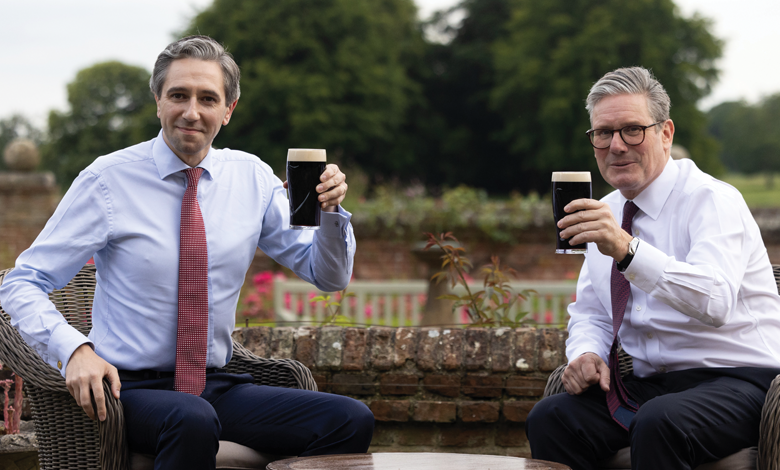
Andy Burnham is the seventh person to have resided in 10 Downing Street since the Brexit vote. Since Labour’s return to power in Britain in 2024, a diplomatic priority in London has been a “re-set” in Anglo-Irish relations. It was notable that, upon his election in 2024, the first foreign leader Keir Starmer invited was then-Taoiseach Simon Harris TD, who he brought to Chequers for a pint of Guinness stout. Controversies abound, including legacy, but Labour’s time in office has seen a significant improvement in relations east and west.
Before this, relations had become arguably the most fraught since the end of the ‘Troubles’. Upon the British referendum result, the EU appointed political heavyweights Michel Barnier for the Commission and ardent Anglophobe Guy Verhofstadt for the European Parliament, ready for the diplomatic resistance against the UK.
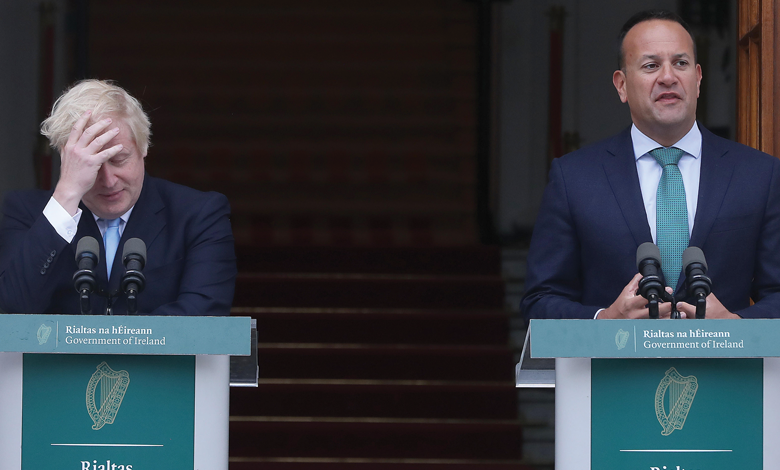
The EU set out the avoidance of a hard border in Ireland as one of its three priorities and helped the Irish Government secure the ‘Kenny text’, a formal agreement between the UK and Ireland that, in the event of Irish unification, Northern Ireland will immediately be granted EU membership. Kenny was succeeded by Leo Varadkar in 2017. The ‘Brexit Taoiseach’ stated in July 2026 that securing a Brexit deal was his priority, and that this meant ensuring there was no hard border on the island of Ireland.
In addition, Ireland secured powerful allies including the then-Speaker of the US House of Representatives, Nancy Pelosi, while Britain flailed. Pelosi warned in 2019 that there was “no chance” of a US-UK trade deal passing Congress if a hard border were established on the island of Ireland.
In the end, the UK caved and was forced to accept a trade barrier between Britain and Northern Ireland in order to ensure that the goal of the EU and Ireland in avoiding a hard border was met.
The issue abounds today and remains a source of great controversy within unionism. No amount of renegotiation can hide the fact that Brexit has caused a deep chasm in the union between Northern Ireland and Britain. Ironically, it was Varadkar himself who best summarised the situation: “They’re all the same thing by the way: the backstop, the Protocol, and Windsor Framework… The exact same thing.”
For Ireland, it has been a diplomatic triumph which has averted disaster on this island, while Britain’s decision has contributed to the instability which manifests itself both in the economy and in politics.