Ambitions to extend STEM qualifications

Published in October 2025, the Skills Action Plan is aiming to oversee the number of STEM graduates from 24 per cent to 27 per cent by 2030.
The Skills Action Plan was published amid a Skills Barometer finding that there is “an undersupply of labour at all levels”.
The Skills Strategy for Northern Ireland, under whose aegis the action plan is managed, sets out three objectives for 2030:
- Increase the proportion of individuals leaving Northern Ireland higher education institutions with first degrees and postgraduate qualifications in narrow STEM subjects from a baseline of 24 per cent in 2019/20 to 27 per cent by 2029/30;
- Increase the proportion of the working age population with qualifications at level 2 and above (i.e. at least 5 GCSEs at grades A* to C or equivalent) from a baseline of 77.3 per cent in 2020 to 85-90 per cent by 2030; and
- Increase the proportion of the working age population with qualifications at level 3 and above (i.e. at least A Levels (2 or more advanced level passes) or equivalent) from a baseline of 57.2 per cent in 2020 to 70-75 per cent by 2030.
The action plan sets out the key agreed actions that the Department will focus on to ensure that “everyone has a pathway to enhance their existing skills and contribute to the Minister’s Economic Vision”.
The action plan states that a key part of the approach has been to identify opportunities to collaborate with industry and education partners to develop new ways of working.
The plan states: “The initial phase of this approach will be to develop the necessary plans and actions to deliver the improvements. This includes our Careers Action Plan and Apprenticeship Action Plan, as well as a suite of sectoral skills action plans to support local businesses secure the talent they need.”
On maximising output from current initiatives and programmes, the action plan says that “we will enhance our education and training system to ensure that it delivers high-quality, accessible, and relevant skills”.
It adds: “By investing in our universities, further education colleges, and apprenticeships, we will ensure that people have the knowledge and capabilities required to succeed in a rapidly changing labour market.”
The plan also commits to building an “inclusive, forward-looking skills ecosystem that empowers individuals and supports economic transformation”. “By fostering innovation, expanding opportunities, and tackling barriers to participation, we will create a system that enables everyone – regardless of background – to reach their full potential.”
Create
The action plan states that the key to delivery is through the Skills Council, which it asserts is “an enabler to help to reduce the fragmentation and create a more connected skills ecosystem”.
The plan commits to “review and Skills Council and its sub-groups” to ensure that these bodies “continue to reflect stakeholder voices, and support priority sectors and the evolving economic and social environment”.
Skills Action plan: Key objectives
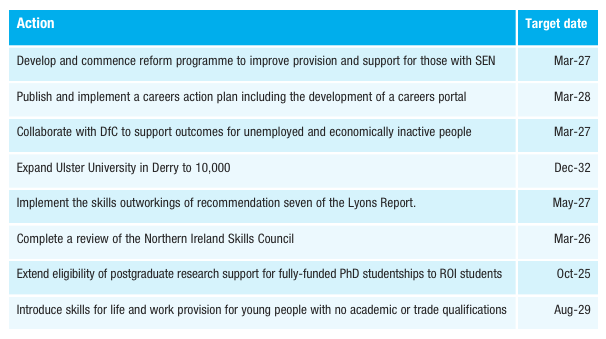
The action plan outlines that there will be a “sectoral approach” to skills development and delivery. “We have demonstrated how this partnership approach can work through the development of the Digital Skills and Green Skills action plans and the longstanding Sectoral Partnerships which develop and refresh our Apprenticeship Frameworks,” the document states.
A sectoral approach will also help maximise opportunities from City and Growth deals and the new Investment Zone proposals.
Analysis
The action plan is broadly unspecific and contains very broad objectives, the success of which will be challenging to measure.
Perhaps the most important detail in the 22-page document pertains to funding. “Achieving the necessary goals and targets set out in this plan will be conditional on securing the necessary funds,” the report states.
Given that revenue-raising measures have largely been ruled out, the Department outlines that it will explore access to funding through “alternative” options, including the Irish Government’s Shared Island Fund and the Enhanced Investment Zones.
The action plan will fall short of raising hopes for the new skills revolution which is needed to meet Northern Ireland’s needs on future housing demand, climate change, and the energy transition. Until the funding challenge is solved, it remains difficult to envision any kind of transformation to Northern Ireland’s skills supply.