Addressing digital skills inequalities
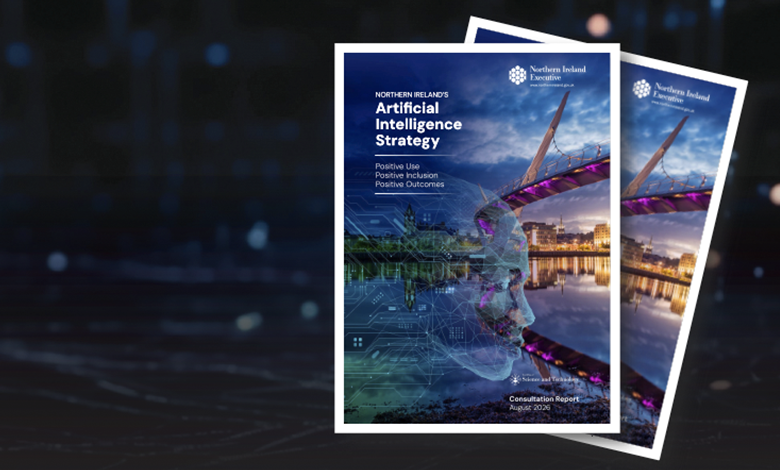
The Executive’s draft Artificial Intelligence Strategy, published in August 2026, is aiming to reduce skills inequalities among generations as well as introduce region-wide guidance for use of AI in schools.
In an aspirational but vague document, the draft strategy sets out aspirations for the AI sector in Northern Ireland through seven recommended actions:
- audit educational provision across the region to identify gaps, including gender-based gaps, as noted in the survey conducted by the Strategic Policy Unit at Ulster University, and develop an integrated strategy to future-proof our skills landscape;
- develop region-wide guidance for use of AI in schools;
- scope out the AI needs and opportunities for the community and voluntary sector through engagement with NICVA, and develop a business case for mechanisms to support, for example, through Artificial Intelligence Collaboration Centre (AICC), FE, or HE, although it should be noted that supporting the most marginalised often requires direct provision through community and voluntary groups;
- roll out a public awareness campaign promoting access to freely available basic skills training;
- integrate a basic AI training module/session into new staff inductions across sectors;
- support further integration of AI use into teacher training provision; and
- create mechanisms for mentorship, best-practice sharing, and peer advocacy for organisational leaders to develop confidence in AI transformation.
The draft strategy states that the skills agenda for AI needs to begin earlier “at school level”. The document adds: “This requires support for teachers to understand not only how they can use AI in their own practice (e.g. AI assistance with administrative or grading tasks, or in accessing data-driven insights into student performance and outcomes), but also how they can train pupils to integrate AI into their learning.
“That requires consistent, region-wide guidelines and responsibilities and policies for both teachers and pupils on responsible and ethical use on approved tools, and on e-safety and data use.”
The draft action plan also says that there is a need for both investment and advocacy support to extend and upscale projects such as Ulster University’s Trailblazing NI Report on GenAI in Education or the PG Cert (Education) in Digital Skills recently launched by Stranmillis University College.
On basic skills, the document outlines support for an AI Skills Surge Programme which combines a public awareness campaign with access to basic training to “ensure that all citizens are AI-capable”.
On intermediate skills, the draft strategy states that a higher level of skills will be required for transformation within organisations. To deliver this, the report outlines generic proposals for combining general training such as that offered by the AICC with a conscious focus on capacity building through ‘train the trainer’ programmes that “increase competence and confidence in the use of AI to enhance all business processes”.
On advanced skills, the action plan outlines: “There is a need for both advanced technical skills e.g. for innovation and research in industry or universities, and advanced skills in AI transformation and delivery strategy.”
The draft plan calls for an audit of Northern Ireland’s current higher education provision which is “grounded in in horizon scanning for future skills needs”.
The document speculates that that the outcome of such an audit “may be additional provision in a particular specialist area such as data analytics, and/or an increase in cross-functional degrees such as joint or major/minor degree pathways combining AI with any discipline”.
“If every profession is going to be transformed by AI, graduates who combine expertise in AI with other disciplines will be at a premium. However, linking in with the needs of industry will be key.”
The draft Artificial Intelligence Strategy is currently out for consultation, for which submissions remain open until 7 October 2026.