Reforming the education curriculum
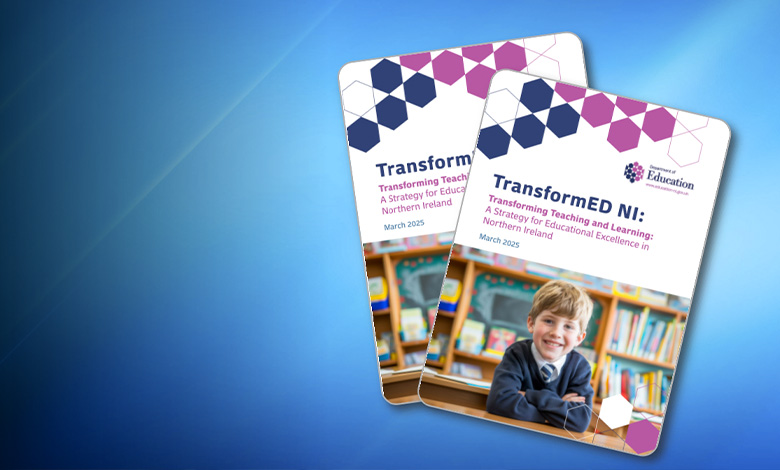
Top of the agenda of Education Minister Paul Givan MLA is reforming the education curriculum, with the objective of a “knowledge rich” curriculum being introduced by 2028/29 outlined in TransformED.
Following the landmark Independent Review of Education published in mid-2025, the Department of Education (DE) is aiming to create a “knowledge-rich” model designed to improve standards and modernise qualifications.
Working from the review, the Department is working on a suite of reform pillars and structural changes.
Knowledge-rich curriculum
The core of the reform is a move away from the highly flexible, skills-based framework of the 2007 Northern Ireland Curriculum toward a more structured, “knowledge-rich” approach.
- The Taskforce Advisory Committee: Established in late-2025, this body oversees subject working groups composed of teachers, academics, and industry experts. Its goal is to define a “minimum entitlement” of core knowledge for every pupil.
- Subject coherence: Rather than broad ‘areas of learning’, the new framework emphasises traditional subject disciplines. This is intended to ensure that students across different schools have a consistent foundation of facts and concepts, facilitating smoother transitions between key stages.
- Literacy and numeracy: There is a renewed mandate that Mathematics and English (or Irish in Irish-medium schools) remain central and mandatory through to age 16, with increased instructional hours recommended at Key Stage 3.
New primary assessment framework
One of the most immediate changes is the introduction of a standardised assessment “escalator” in primary schools, which is set to commence later in 2026. This seeks to provide earlier intervention for children falling behind and to reduce the reliance on the unregulated primary seven ‘transfer test’.
Among this is the year one baseline check, which is a light-touch assessment to gauge developmental starting points. The year two phonics screen is modelled on successful international formats to ensure early reading fluency.
The framework also introduces annual standardised checks, with compulsory assessments in reading, literacy, and numeracy for years three through five, and again in year seven.
The broad aim of the framework is for the Department to acquire robust internal data. Through this, it aims to prove that the high-stakes private transfer tests are unnecessary, eventually moving toward a system where secondary placement is informed by a broader ‘pupil profile’.
“High-performing systems like Singapore and Estonia demonstrate the effectiveness of curricula which include specific knowledge and skills.”
Education Minister, Paul Givan MLA
Reform of qualifications (CCEA)
The Council for the Curriculum, Examinations and Assessment (CCEA) is currently redesigning Northern Ireland’s qualifications to ensure they remain comparable to the rest of the UK while addressing specific local needs.
Perhaps the most controversial change is the removal of the standalone AS Level qualification. By September 2030, A-Levels are shifting to a linear or three-unit modular model taught over two years.
The Department’s rationale is that the current ‘assessment heavy’ nature of AS and A2 exams was found to reduce teaching time. The new model aims to reclaim the first year of sixth form for deep learning rather than exam preparation.
In addition, new GCSE specifications are to be taught from September 2029. Key features include:
- Reduced coursework: A significant reduction in controlled assessments to lower teacher workload and mitigate the risks associated with AI-generated work.
- Modernised content: Updating subjects like digital technology, geography, and history to reflect contemporary global challenges.
- Learning for life and work (LLW): This subject is being comprehensively reconfigured into a more practical ‘life skills’ suite, focusing on financial literacy, mental health, and digital safety.
Implementation
The reforms are to follow a phased rollout:
- 2025/2026: Formation of subject groups and publication of the new Assessment Policy Framework.
- 2026/2027: Select schools will trial the new primary assessments and ‘knowledge rich’ modules for Key Stage 1.
- September 2028: The new curriculum framework becomes statutory for Primary 1 and Year 8 (first year of secondary school).
- September 2029: First teaching of the new GCSE specifications.
- September 2030: First teaching of the new A-Level specifications; final AS Level exams are phased out.
Speaking upon the publication of the Independent Review of Education, Education Minister Paul Givan MLA said: “Northern Ireland needs a new statutory curriculum framework. International comparisons with curricula such as in Scotland which shares a broad, non-specific framework, reveal similar challenges to Northern Ireland.
“Conversely, high-performing systems like Singapore and Estonia demonstrate the effectiveness of curricula which include specific knowledge and skills. They also demonstrate that a more specific curriculum framework does not necessarily mean an overly full curriculum.”