A blueprint for economic transformation

Writing in agendaNi, Jodie Carson, Professor of Practice in Strategic Policy at Ulster University, outlines her proposed framework for economic transformation, which she believes can help upend the siloed policymaking which holds back Northern Ireland’s economic development.
The siloed nature of policymaking in Northern Ireland is well understood, and the separation of inter-related issues such as health, skills, education, poverty, economic inactivity, productivity, infrastructure, and energy brings implications for local outcomes and the quality of life of our citizens.
Consider, for example, Northern Ireland’s longstanding productivity challenge. Improving productivity requires businesses to invest, innovate and scale; yet their ability to do so depends upon access to skills, affordable finance and energy, infrastructure and an efficient planning system.
Skills availability, in turn, depends upon a healthy population and a sustainably funded higher and further education system capable of responding to rapidly changing labour market conditions – particularly in the context of AI.
Similar circularity pertains to many other policy areas and, ultimately, public services and underlying finances.
Yet, how do we capture these policy linkages and dependencies? It is with this in mind that Ulster University’s Strategic Policy Centre (UUSPU) published our latest report Unlocking NI’s Potential: A Framework for Economic Transformation.
The report incorporates an overarching approach that places the economy and productivity at the centre of driving improved socioeconomic outcomes and a more inclusive and sustainable future.
SPU’s framework is based around four key pillars, a foundation and a requisite intervention in relation to the sub-optimal incentive structure currently facing the Executive.
The first three of the four pillars are inter-related, with ‘Productivity’ (Pillar 2) being central to the framework, both contributing to and drawing from Pillar 1 ‘Public Sector Reform’ and Pillar 3 ‘Private Sector Growth’.
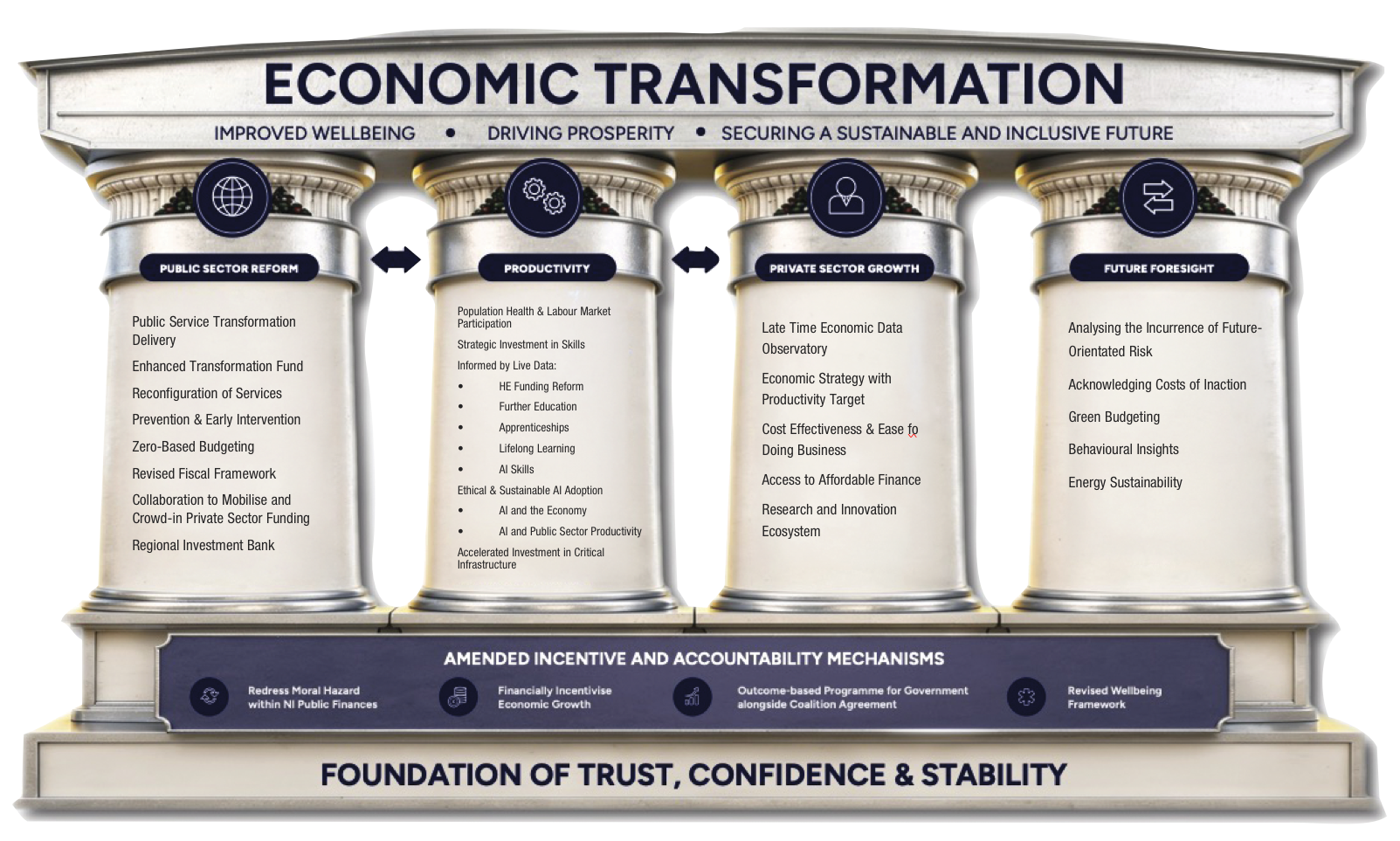
Pillar 4 ‘Future Foresight’ is intentionally depicted as standing alone, to represent the fact that it is currently largely overlooked within local policymaking and requires distinct focus or will remain neglected. Northern Ireland policymaking is understandably dominated by immediate pressures; however, demographic change, climate risk, technological disruption, energy security and changing skills requirements will determine future spending requirements and societal wellbeing.
Further, continued inaction in relation to pillar four risks destabilising any progress across other pillars and damaging the outlook for the economy and public finances.
Progress across each of the four pillars, however, is predicated upon ‘Trust, Confidence and Stability’, without which it will be impossible to engage the population, sustain the political institutions and engender meaningful and sustained policy changes in Northern Ireland – as such this is depicted as the Foundation of the model.
Equally important is the requirement for an amendment to the incentive structures facing the Executive, which are currently sub-optimal. Not only does the Executive currently not have any direct financial incentive to drive local economic growth or reduce welfare expenditure – since proceeds accrue to UK Treasury – but recent UK bailouts of Executive overspends have introduced perverse incentives.
Moral hazard has been introduced into Northern Ireland public finances; whereby the risks and costs of Executive overspends are borne by a third party, the Treasury, and this should be addressed to drive different decision-making by the Executive.
As we approach a new electoral cycle and a new Programme for Government, there is an opportunity for fresh thinking regarding the policy ecosystem.
Economic transformation will not be delivered via any singular intervention or department.
SPU’s report is intended to contribute to this recognition and provide a basis for more joined-up policymaking and an Executive that is incentivised in a way that encourages collaboration and a focus on sustainable and inclusive economic growth.
The report contains 33 recommendations spanning public sector transformation, productivity enhancement, private sector growth and future-focused policymaking.
The report can be accessed by scanning the QR code below: