Towards a circular economy
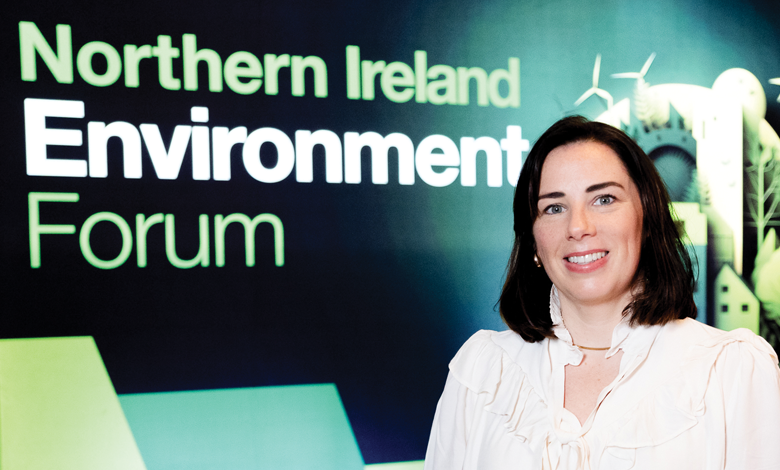
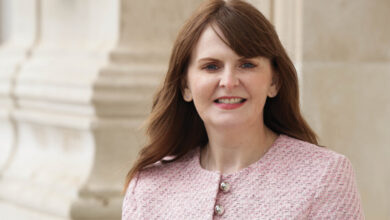
Heidi Redmond, Circular Economy Adviser at the Strategic Investment Board – seconded to the Department for the Economy (DfE) – outlines what DfE aims to do through the forthcoming Circular Economy Strategy, including its ambition to halve Northern Ireland’s material footprint by 2050.
Arguing for a shift to a circular economy, Redmond calls the linear economy “inherently wasteful”. She says: “This pattern of extraction and processing of materials is responsible for over half of our global greenhouse gas (GHG) emissions, is a big driver of biodiversity loss and comes with a human cost too.”
She says the circular economy model “turns all of that on its head” by reducing demand for virgin materials and ensuring products “stay in use at their highest value for as long as possible”. The Circularity Gap Report (CGR), published in June 2022, finds that two-thirds of Northern Ireland’s raw materials are imported and that Northern Ireland has a circularity gap of 92 per cent.
“That reliance comes at a cost. It exposes our businesses to rapid hikes in prices and disruptions in supply chains,” says Redmond.
The CGR finds that the region’s materials footprint, the amount of virgin material society uses, is double what is considered environmentally sustainable. The Circular Economy Strategy sets a target to halve the material footprint by 2050. The aim of the target is to put resource use on par with our carbon reduction targets.
The CGR finds that Northern Ireland’s carbon footprint stands at over nine tonnes per person, double the global average but similar to other high-income countries. Redmond says: “We are using too much, we are wasting too much, and we are far too reliant on materials coming from elsewhere and that is exactly why the circular approach is essential for us.”
Redmond says an often-raised concern is that environmental action comes at the expense of economic growth. However, since 2001, the regions’ GHG emissions and carbon footprint have decreased while the economy has grown. Redmond says this shows “that a relative decoupling is possible”.
She states that it also presents economic opportunities for businesses, adding: “That is why lots of the Fortune 100 companies are adopting the circular business models, with the introduction of remanufactured lines or take-back schemes.
“Unless we look at how we produce stuff and how we consume things, the pressure on the environment is going to continue to mount.”
“They are not doing it just because it is good for the planet. They are doing it because it is improving their resilience and resource productivity, and it is lowering the supply chain risk.”
Policy goals
The strategy is based on five policy goals, the first of which is investment in innovation, skills, and R&D. Redmond says DfE has been working with the Advanced Manufacturing Innovation Centre (AMIC), led by Queen’s University, along with CIRCULÉIRE in the South to scope out “innovation-focused initiatives”.
The adviser says the transition to a circular economy must be appropriately planned and resourced. She indicates that the Green Skills Action Plan, published by DfE in May 2025, will be utilised to ensure the workforce is equipped for the transition.
The second policy goal of the strategy is to maximise the value of resources locally. Redmond pins this as “one of the strongest environmental and economic arguments for circularity”.
She says the normalisation of reuse and repair amongst citizens is central to this. The adviser says the Northern Ireland Resources Network has been “instrumental” in delivering on this. At an industrial level, it means investing in local reprocessing infrastructure as well as creating platforms and hubs, so businesses know what materials are available.
The third policy goal is to design out waste. Redmond says most environmental impacts of products are determined at the design stage. DfE is focussing on transitioning from waste management to waste prevention. Public procurement will be key the achieving this, says Redmond, who adds that it can be used “to shape markets and change behaviours”.
Redmond identifies the Republic as “a leader in this space”, pointing to its €20 million circular computing contract which will see 15,000 remanufactured laptops being supplied to the Irish Government in the coming years. She says that the North can learn from this example.
Policy goal four is to collaborate for system change. Redmond says: “The circular economy is fundamentally about systems change and that will require collaboration across government, business, communities and academia.”
She identifies education as essential, stating that a circular schools programme by the Northern Ireland Resources Network has been instrumental. Under a waste prevention programme by the Department for Agriculture, Environment and Rural Affairs (DAERA), this will be expanded to create circular communities and circular councils programmes.
Redmond identifies clusters and networks as key to collaboration, stating they enable industries “to address shared challenges”. The adviser says there are many existing clusters and networks that can be utilised, including a circular bioeconomy cluster in the Republic and a clean tech cluster in the North.
“These will be instrumental in driving that systems change by building capacity and enabling collaboration across sectors and disciplines,” she says.
Policy goal five is to create the right enabling conditions with funding and a regulatory framework that supports circularity. Redmond asserts that businesses must be helped to manage the costs and risks associated with adopting more circular business models.
She identifies forthcoming circular economy measures including the introduction of Extended Producer Responsibility schemes, a deposit return scheme, and eco-design for sustainable products regulations which will make digital product passports essential for a lot of products. The latter is European legislation which will impact businesses manufacturing and producing goods to sell in the EU.
While the focus is on material footprint at present, additional targets are likely to be brought forward in the future, alongside a monitoring framework with social, economic, and environmental indicators to help measure change across the system.
Concluding, Redmond says: “An economist once said that striving for net zero without embracing circularity is like trying to empty a bathtub without turning off the tap.
“Unless we look at how we produce stuff and how we consume things, the pressure on the environment is going to continue to mount. The circular economy is about trying to turn off the tap.”