Conflict legacy must inform economic policymaking

 Anne Devlin, research officer at the Economic and Social Research Institute, outlines the significant economic challenges arising from ‘the Troubles’ which persist today.
The local economy continues to face significant challenges with persistently high levels of economic inactivity, low productivity, disproportionate early school leaving, high levels of NEET, a reliance on public sector employment, and higher levels of benefit receipt.
We also face a range of social and health issues which are likely to be related to the poor economic performance such as lower life expectancy, longer waiting lists, higher levels of disability, and a greater reliance on social security.
Taken together, these issues are often interconnected and mutually reinforcing, creating barriers to both economic growth and improved societal wellbeing.
For a long time, the relative weakness of the research base on local issues did not reflect the pressing issues the economy faced nor was it a reflection of the capabilities of researchers.
The incentives within research bodies particularly higher education institutions did not encourage research on Northern Ireland. One benefit of Brexit has been an increased interest in the region and there has been a significant uptick in research published on its issues.
However, despite the growing evidence base locally, there remain several important areas that are either difficult to study formally due to data limitations and methodological challenges, avoided because they raise uncomfortable questions, or neglected because they do not have direct and clear policy relevance.
As part of my PhD studies, I examined disability rates in Northern Ireland in greater detail than had been done previously, this included a study of how conflict exposure may impact disability benefit recipiency later in life.
To my knowledge, this was among the first studies within the field of economics to explore this relationship. By contrast, researchers in other disciplines have long been recognised for their contributions to understanding the legacy of the conflict.
Researchers in medicine have conducted important work on conflict-related injuries, while those in mental health have, for decades, examined the impact of the conflict on psychological wellbeing and its consequences.
In my initial study of disability in Northern Ireland, we look at disability rates by various measures and compare to England finding that personal characteristics (age, gender, educational attainment etc.), health, and the local labour market play some role in determining disability rates.
However, for Disability Living Allowance (DLA), which at its peak in 2016 was about twice as high proportionally in Northern Ireland than in England, there remained a significant differential could not be explained.
We surmise that this could be due to differences in the social stigma attached to social security receipt, differences in health or other personal characteristics we do not pick up in our data, on average higher levels of deprivation in Northern Ireland compared to England, a weaker labour market which is hard to fully capture given our low levels of unemployment but high levels of economc inactivity, or a legacy of the conflict.
I went on then to explore the latter in more detail with a view to quantifying the relationship between conflict exposure and DLA receipt looking at how those who reported in a survey of being impacted by the conflict personally differed to those who did not report the same level of exposure.
Those who were in prison, who were physically injured, who had a friend or relative killed, or who witnessed rioting were more likely to consider themselves as having been impacted by the conflict.
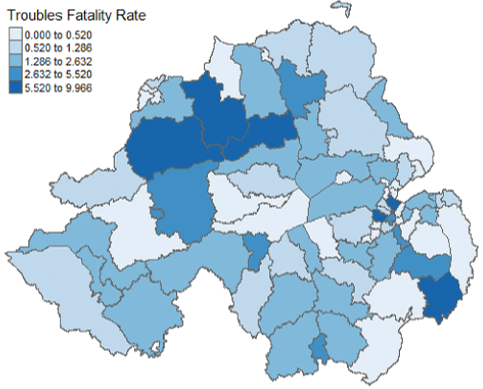
Potential biases in the reporting of conflict exposure were corrected for using the Sutton (2002) Index of Deaths conflict-related fatality rate geo-coded by Declan French at Queen’s University Belfast (Figure 1).
Overall, those aged 50-64 who reported greater exposure to the conflict were between 21 and 33 percentage points more likely to be in receipt of DLA than their peers who did not face the same exposure depending on the specification used. Those who reported that their community was impacted by the conflict also had elevated probabilities of being in receipt of DLA.
We also examined the prevalence of medical conditions and found that, unsurprisingly, individuals impacted to a greater extent by the conflict were more likely to report mental health conditions than those impacted to a lesser degree.
There was also tentative evidence of a relationship between conflict exposure and cancer. While this lies outside my own area of expertise, there is a substantial body of medical research demonstrating how adverse childhood experiences, trauma, and chronic stress can contribute to poorer physical health outcomes across the life course.
Figure 1: Conflict-related fatalities per 1,000 of population at DEA level, 1969-1998
These findings suggest that the legacy of the conflict may extend beyond its immediate social and psychological impacts, with significant implications for long-term health and wellbeing. It is also plausible that the legacy of the conflict affects individuals across multiple dimensions of their lives outside of health and disability.
These findings, while focused on disability and health outcomes, have far-reaching implications. Higher rates of disability are associated with increased expenditure on social security, health, and social care services, while also contributing to lower levels of labour force participation. This is particularly significant in the context of a tight labour market and a rapidly ageing population, both of which place increasing pressure on public finances and service provision.
While the study discussed here focuses on individuals who were directly exposed to the conflict, there is substantial evidence of the intergenerational transmission of conflict-related trauma. As a result, the consequences of conflict exposure may not be confined to those who lived through the conflict but may also affect subsequent generations.
This may be especially relevant where disability arises from mental health conditions, given the complex ways in which trauma, family circumstances, and social disadvantage can be transmitted across generations. Consequently, the long-term economic and social costs of the conflict may extend far beyond those who experienced it firsthand and continue to shape outcomes many decades after the violence ended.
As we continue to lament the state of the health service, the NEET rate, low levels of labour force participation, and rising levels of disability it is a clear omission to do so without considering the historical context of this place. Social and economic outcomes do not emerge in a vacuum. The 30-year conflict continues to shape the lives of many people, directly and indirectly, and its legacy remains embedded within communities across the region.
As such, the legacy of the conflict should receive far greater attention in policymaking across health, disability, employment, and social inclusion. However, effective policymaking may be tricky as the mechanisms underlying this relationship are not yet fully understood.
On one level, the effects may operate through trauma, stress, and their well-documented consequences for physical and mental health. However, the impact may also be place-based. The conflict may have constrained opportunities, dampened aspirations, and limited economic development in the areas most affected by violence.
Deprivation and conflict exposure are intertwined in a complex and interconnected web of disadvantage that cannot easily be disentangled. Recognising and addressing these long-term effects should form an important part of any policymaking.