Prioritising all-island railway projects
The Rail Project Prioritisation Strategy outlines how to best deliver the recommendations of the All-Island Strategic Rail Review, including which should be progressed first, which can be delivered in the short term, and which will require investment over the medium to long term.
The strategy, published in December 2025, emphasises the importance of improving connectivity between Belfast, Derry, and Dublin, and restoring rail access to areas in Northern Ireland that have been without services for decades. Projects are prioritised based on how they meet the strategic objectives and delivery needs of the review.
Strategic objectives include supporting decarbonisation of rail services; providing transport user benefits; increasing accessibility through strategic corridors including the EU Trans-European Transport Network (TEN-T), airports, and ports; and improving regional and rural connectivity.
Projects
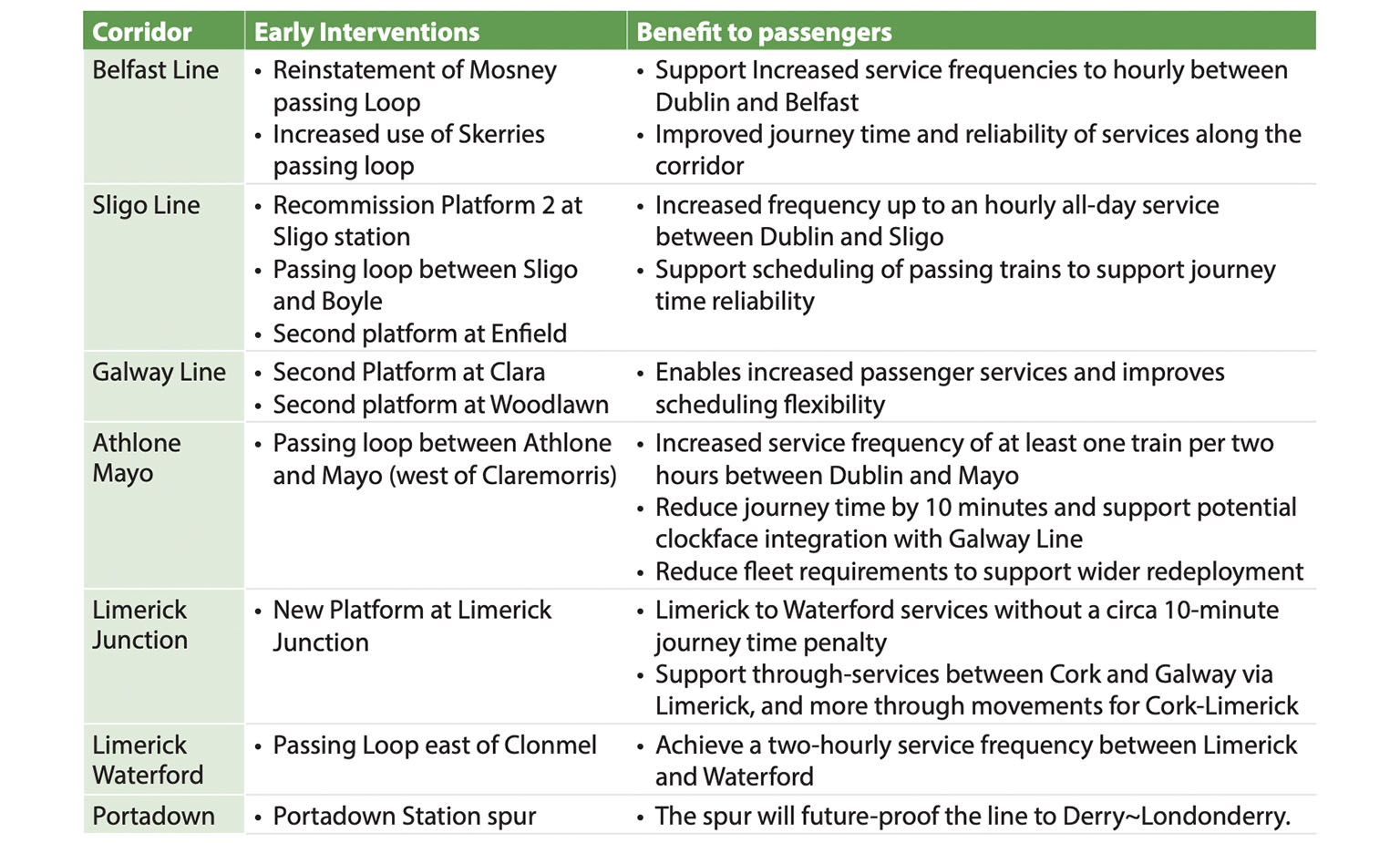
Two strands of projects are outlined in the strategy: early interventions and major projects. Early interventions are incremental projects identified for completion by 2030. These are schemes which are not envisaged to require a railway order or significant land acquisition.
Work on these projects will begin in 2026 for full delivery by 2030. Major projects will need to undergo detailed feasibility studies, secure necessary approvals, and acquire funding before proceeding. These are due to be completed by 2045.
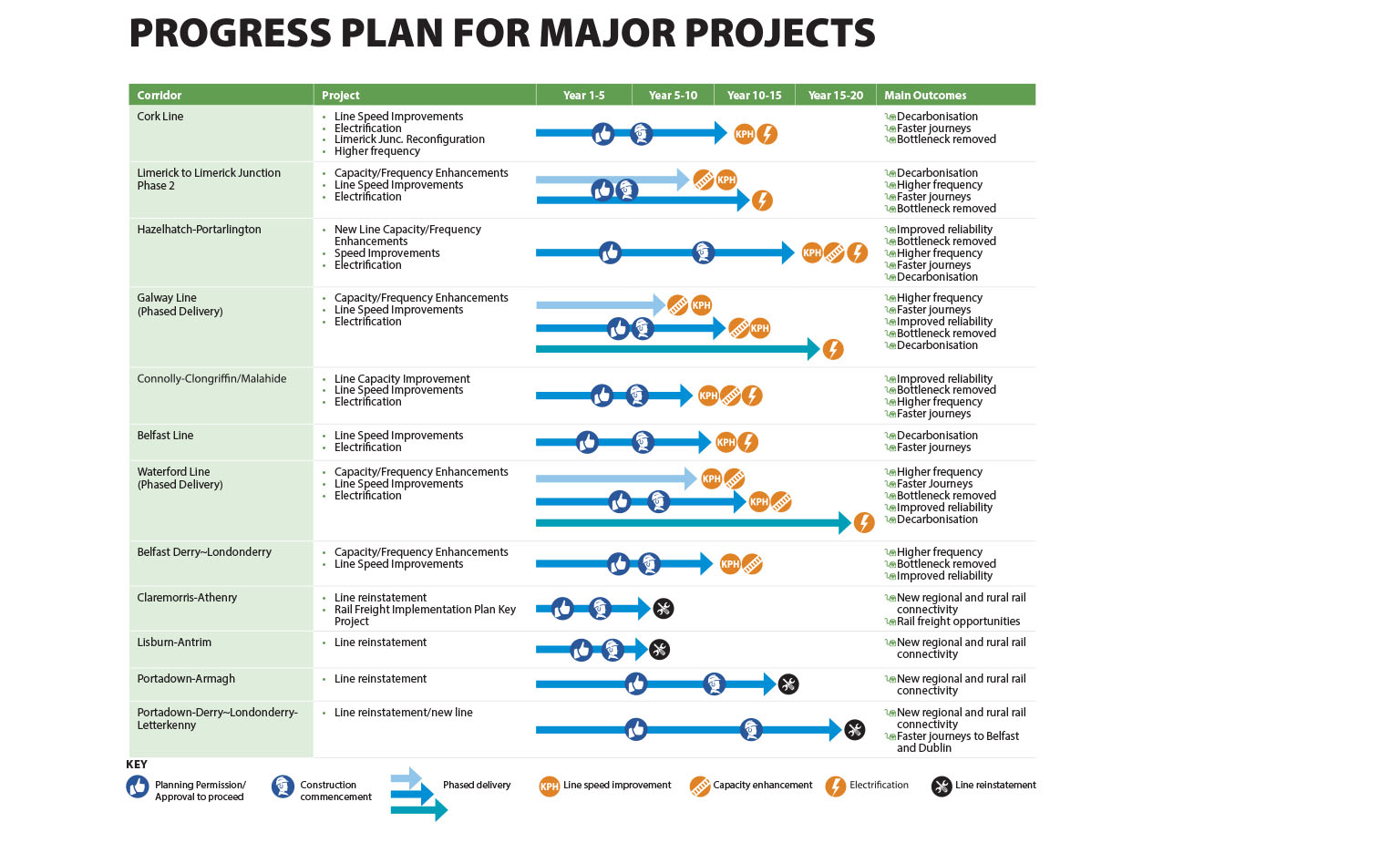
Under the strategy, the Belfast-Derry corridor would be upgraded. This is significant as current journey times on the corridor are long and frequency is limited. Delivery of this project would remove bottlenecks, improve reliability, and increase frequency.
One major project aims to deliver line speed improvements and capacity or frequency enhancements on the Belfast-Derry corridor in years 10 to 15. The strategy states that project approval could be secured by year five, and construction could begin shortly after.
The Belfast-Dublin corridor is the island’s busiest cross-border rail route and is key for mobility and trade between both jurisdictions. Early interventions for the corridor include reinstatement of the Mosney passing loop and increased use of the Skerries passing loop. This is envisaged to enable hourly services on the corridor, reduce journey times, and increase service reliability.
As part of major projects for the corridor, it would be electrified during years 10 to 15 with line speed improvements to be delivered during this period. It is intended that it would receive approval in years one to five, with construction to commence in years five to 10. Delivery of this project would support the review’s decarbonisation objectives and reduce journey times.
Another major project is the reinstatement of the Lisburn-Antrim line in years five to 10. Approval could be granted in years one to five, with construction to commence shortly after. This would deliver new regional and rural rail connectivity, improve flexibility and resilience, and enable a rail connection to Belfast International Airport in the long term.
Under major projects, Armagh City would be reconnected to the rail network for the first time since the 1950s with the reinstatement of the Portadown-Armagh line. At present, Armagh is the only city on the island without a railway station.
It is envisaged that the line would be reinstated between years 15 and 20. The strategy indicates that approval could be secured in years five to 10, with construction to commence in years 10 to 15.
Additionally, the strategy sets an aim to deliver a reinstated and partially new corridor from Portadown to Derry via Letterkenny. This would increase connectivity to the northwest and reduce journey times between Belfast and Dublin. Under early interventions for Portadown station, a new spur would be provide to future-proof the route for onward services towards Derry.
Projects in the Republic
In the Republic, enhancement projects are currently being delivered including the delivery of Dart+ in the Greater Dublin Area, and redevelopment of Ceannt Station in Galway and Colbert Station in Limerick.
Under major projects, multiple corridors are to be electrified along with the delivery of capacity or frequency enhancements and line speed improvements. This includes the Cork line, Limerick-Limerick Junction, Hazelhatch-Portarlington, the Galway line, Connolly-Clongriffin/Malahide, and the Waterford line.
Improvements to the Hazelhatch-Portarlington line west of Dublin is critical due to current capacity constraints on the corridor which can impede services across the national network.
Additionally, the strategy sets an aim to reinstate the Claremorris-Athenry line. This is significant as it would partially restore the western rail corridor. Reinstatement of the line would enable new passenger services between west and south while supporting the development of rail freight in tandem with port connectivity.
Early interventions under the strategy include the provision of a second platform at Enfield on the Sligo line, and at both Clara and Woodlawn on the Galway line. Passing loops are to be delivered on the Sligo line, the Athlone-Mayo line, and the Limerick-Waterford line. Additionally, platform two at Sligo station is to be recommissioned and a new platform is to be provided at Limerick junction.
Outcomes
Delivery of these projects would significantly reduce journey times on critical corridors throughout the national rail network. Around 750km of the network would be electrified which could lead to a 55 per cent decrease in CO2 emissions across intercity and regional services.
Enhanced frequency of services would support balanced growth. Line reopenings would increase rail accessibility and increase network flexibility and resilience. Bottlenecks would also be removed which would increase growth capacity and enable faster, more reliable, and more regular services.
The delivery of an additional 250km in rail connectivity could open opportunities for economic development and freight. This would also ensure greater connectivity between cities and unlock access to Belfast International Airport. The strategy also states that strengthening the EU TEN-T Core rail network will ensure public transport will bring cities, towns, ports, and airports closer together.
 Commentary
Infrastructure Minister Liz Kimmins MLA says: “The publication of this strategy provides a way forward for connecting communities who have been without rail, particularly in the northwest, alongside increasing frequency and improving services for those along existing lines. This will help strengthen economic and social ties across the island.”
Stephen Bradley, from the Into the West rail lobby group for counties Derry, Tyrone, Fermanagh and Donegal says: “There are currently 54 railway stations in Northern Ireland, only three of which (5 per cent) are located in the west of the Bann.
“The All-Island Strategic Rail Review was an opportunity to address this appalling east-west imbalance but the Rail Project Prioritisation Strategy will only worsen it.”
Bradley welcomes the acknowledgement of the need for a fast rail line between the north-west and Dublin and Belfast, and the return of rail to Tyrone’s major towns. However, he also asserts that four of the five major projects for Northern Ireland contained in the strategy are “located in the east and revolve largely around the needs of Belfast”.
“Transport in Northern Ireland always prioritises the needs of Belfast and places closest to it,” continues Bradley. “If this prioritisation strategy is a case study in how to address regional balance, we may as well pull the shutters down on Northern Ireland’s three western counties.”
When asked to what extent the strategy will improve regional imbalance and support decarbonisation, Bradley says: “In short, it will not. The 20-mile reopened Antrim-Lisburn line alone is likely to add five new railway stations to the Northern Ireland network.
“The 65-mile reopened Derry-Portadown line will add only three. So even if everything in the Rail Project Prioritisation Strategy is delivered, it will add more new stations in the east of Northern Ireland than the entire total that will exist in the west of Northern Ireland as a result.”
Bradley indicates that this has a knock-on impact on decarbonisation outcomes as poor public transport provision in the west will mean people have “no real alternative but to drive”.
He identifies “money, timescale, and willingness” as three potential barriers to progress for projects contained in the strategy. Some projects are due for delivery by 2045 which Bradley says is “well beyond the political and civil services lifespan of current key decision-makers”.
“You will find little or no belief in the west of Northern Ireland that those in power in either Stormont or the civil service take the issue of regional balance seriously and intend to do anything substantive to address it,” he says.
“So the biggest barrier is a lack of will. The content of this Rail Project Prioritisation Strategy does not inspire belief that the will to genuinely address and reverse Northern Ireland’s appalling regional imbalance exists.”