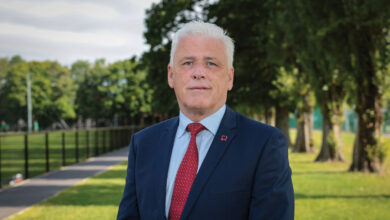
Health Minister Mike Nesbitt MLA: Resetting the health system
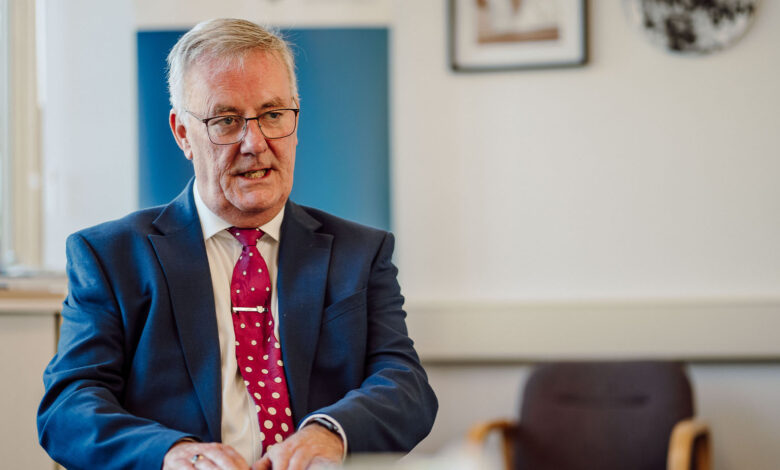
Health Minister Mike Nesbitt MLA talks to Joshua Murray about transformation, health inequalities, and the challenges of delivering reform in an era of tight budgets.
Seventeen months into his tenure as Minister of Health, Mike Nesbitt MLA is in reflective but determined form. Sitting down after a morning of departmental briefings, he talks about his central mission: transforming or as he prefers to describe it, “resetting” Northern Ireland’s health and social care system.
“The overarching priority is transformation, or as we are calling it now, reset,” he says. “Over recent years, the proportion of the Executive budget going to health has risen from 46 per cent to over 50 per cent. That is not a sustainable direction of travel.”
Nesbitt outlines that the healthcare model in Northern Ireland must shift away from firefighting in acute hospitals and towards what he calls a “neighbourhood model” of care that prioritises prevention and early intervention.
“At the moment, the big emphasis in public discourse is on queues in emergency departments and ambulances waiting outside. I want to shift left into prevention where possible and early intervention when people begin to get sick.
“If you took a blank map of Northern Ireland and there was no health service, everyone would agree we need one. The real debate is whether it is about keeping healthy people healthy or curing the sick, and the answer has to be both.”
Health inequalities
The Minister’s focus on prevention is closely tied to what he describes as one of the “most shocking” aspects of his departmental brief: persistent health inequalities. “Two babies could be born today in Belfast a mile apart, one in an area of deep deprivation, the other in an affluent area like Malone Road. The difference in their healthy life expectancy is 14 years,” he says.
“We are a quarter of the way into the 21st century, a first-world country, yet we have never really taken a bite out of that gap. If anything, it tends to get a little worse year-on-year.”
Nesbitt notes that only 20 per cent of health outcomes are determined by healthcare interventions, with the remainder driven by social and economic conditions, environment, and personal behaviours. “It is 40 per cent socioeconomic, 10 per cent environment, and 30 per cent behaviour, for example, smoking, alcohol, substance use. So, we need the whole Executive to tackle this. The same Executive collaboration is required on education underachievement and economic inactivity.”
The Health Minister says he has already begun discussions with colleagues in the Executive to build cross-departmental accountability for health outcomes. “If I can show we are making a difference on my 20 per cent, I will be going back to the Executive and asking them to divvy up on their 40 and 10. Equally, it is not just them helping me; I can help them too. Healthier children do better at school, and tackling poor physical and mental health helps reduce economic inactivity.”
Mental health
Nesbitt outlines his credentials for shaping mental health policy, describing a long-standing commitment to the issue. “I am the MLA who put mental health on the agenda back in about 2012,” he recalls, referencing his previous work as Victims Commissioner.
“One of the biggest toxic legacies of what we euphemistically call ‘the Troubles’ is poor mental health at individual, family, and community levels. The areas that suffered most then are the areas that have the worst mental health today.”
The Minister and his department have faced criticism over what has been characterised as the “abandonment of 80 per cent of the priorities” contained within the 10-year mental health strategy. Nesbitt disputes the suggestion that this represents a lack of commitment, instead describing it as a pragmatic response to an unprecedented financial position.
“I understand the frustration, but we are operating under extreme budgetary pressure,” he says. “Our financial situation is unprecedented. We cannot deliver the £1.2 billion investment required over the 10-year period. That is the reality.”
He stresses that this does not signal a retreat from the strategy’s ambitions. “Even if we cannot fund every programme immediately, we can ensure mental health remains at the centre of decision-making across the Executive,” he insists.
The Minister adds that he remains committed to maintaining the strategic direction established under his predecessor, Robin Swann MP. “Robin did important work in bringing forward the strategy and appointing a Mental Health Champion,” he says. “The challenge now is ensuring that, even within limited resources, we continue to make progress on improving access, outcomes, and public awareness around mental health.”
Learning from Covid-19
Asked to reflect on the pandemic, the Minister prefers to focus on the positives. “The big learning out of Covid was that health and social care is not particularly built for speed,” he admits. “Covid made us faster, more flexible, more responsive. It made us think more imaginatively about how to work, and I want to see that continue.”
Nesbitt believes that Covid-era adaptability must now fuel the long-term transformation agenda. “We cannot continue to demand more and more of the Executive budget. If you spend only on waiting lists, they will go down while the money lasts and straight back up when it runs out. The reset piece is about changing that cycle.”
“One of the biggest toxic legacies of what we euphemistically call ‘the Troubles’ is poor mental health at individual, family, and community levels.”
Mike Nesbitt, Health Minister
Funding and the ‘shift left’
Despite repeatedly describing the current model as unsustainable, Nesbitt rejects the idea that health is overfunded. “It is underfunded in terms of how we deliver health and social care at the moment. If we keep doing what we are doing, we will continue letting people wait until they become very sick, which is more expensive and less effective.”
His goal is to redirect resources towards primary care and prevention. “If you turn that tide and get in early, you release funding back into community pharmacy, primary care, and the neighbourhood model.”
Vaccination is one practical example. “Uptake is dropping, and that worries me,” he says. “There are issues around accessibility, but also vaccine hesitancy post-Covid. We may never fully meet demand for healthcare, so we must also look at demand and encouraging people to protect their own health for their own benefit.”
Digitalisation
Turning to digital transformation, Nesbitt identifies significant progress in the Encompass programme, a new electronic patient record system. “We are actually ahead of the game,” he says. “It is now rolled out across all the geographic trusts. If you move hospitals, you are no longer travelling with a file of papers; the receiving team can access your records immediately. That is huge for personal care.”
Beyond convenience, he sees vast public health potential. “Our ability to analyse data will let us identify problems specific to regions; urban or rural, north-west or south-east; and respond appropriately. That is where I see the real promise.”
Principles
On the question of whether care homes should operate for profit, Nesbitt says: “As a matter of principle, no. It should be within the health and social care system,” he says, though he concedes that removing existing private providers “is not something that will happen in my mandate”.
On nurses’ pay, he is candid. “People are never paid enough. The 3.6 per cent awarded this year is not really a rise once inflation is factored in.”
He outlines plans for a more proactive approach in 2026: “Next year, I intend to give all healthcare workers an upfront pay lift on 1 April as a sign of good faith, then adjust once the independent pay recommendations come out.”
However, he stresses that retention is about more than wages. “Career progression is a big issue. Many nurses start as a band five and finish their careers as a band five. We need to work with the Royal College to change that.”
Implementing Bengoa
Nesbitt insists that the recommendations from Rafael Bengoa’s landmark 2016 report are being implemented, even if the pace frustrates some. “People say Bengoa is sitting on a shelf, but we are seeing real transformation with mega clinics on Saturdays, day procedure centres, and elective care hubs. We are creating a network of hospitals that function as centres of excellence.”
Explaining why implementation is a matter of urgency, the Minister says: “I do not expect to be in post beyond May 2027, the Permanent Secretary is also interim. That means you have two people at the top of the Department who are in a rush to reset how health and social care are delivered.”
Misinformation
Nesbitt turns to what he calls one of the “eternal challenges” of modern public health: misinformation. “Everybody can go online, everyone can misinform. The lie is halfway around the world before the truth has its shoes on,” he says. “Countering that gets harder every year because the ability to disinform keeps getting easier.”
He dismisses anti-vaccine conspiracy theories such as those promoted by US Health Secretary Robert F Kennedy Jr and US President Donald Trump: “I fundamentally disagree with that kind of thinking,” he says. “We need to stay rooted in evidence.”
Urgency and optimism
As the interview concludes, Nesbitt’s tone is pragmatic but hopeful. “We cannot keep doing what we have always done and expect a different result,” he reflects. “The health service has to change direction toward prevention, early intervention, and collaboration.”
With less than two years before the next election, he acknowledges the clock is ticking but insists the Department is moving with purpose. “I want to make the Health Minister’s job more attractive for whoever comes next. That means leaving behind a system that is more sustainable, more community-focused, and more joined-up.”