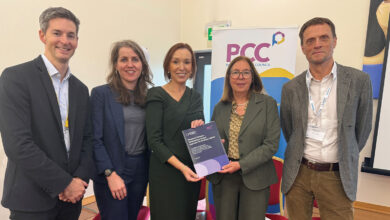
Protect Life 2 Action Plan published

In October 2025, the Department of Health (DoH) and the Public Health Agency (PHA) published the Protect Life 2 Action Plan 2025-2027, setting out Northern Ireland’s renewed framework for suicide prevention and self-harm reduction.
The plan builds on the original Protect Life 2 Strategy (2019-2024), retaining its key objectives while introducing a revised baseline and target. The suicide rate for 2021-2023 is recorded at 13.3 deaths per 100,000 (age standardised), with a new target aiming to reduce this to 12.0 deaths per 100,000 by 2027.
While the strategy recognises that “every suicide is preventable,” it states that realistic, measurable progress must be achieved through coordinated policy delivery.
Whole-of-government approach
The plan’s first theme, ‘whole of government and society approach’, seeks to strengthen coordination across government departments and agencies. The Department of Health, Department for Communities, Department of Education, Department for Infrastructure, and others are tasked with aligning activity through the Regional Protect Life Implementation Group (RPLIG). Actions include:
- facilitating networks for people bereaved by suicide to inform service delivery;
- promoting adherence to PHA quality standards for suicide prevention services; and
- linking suicide and self-harm prevention to broader government strategies on health, education, and social policy.
The plan emphasises that suicide prevention requires a cross-departmental and societal response, addressing underlying determinants such as poverty, social isolation, and unemployment.
Awareness and prevention
Theme two focuses on strengthening awareness and prevention. The PHA will lead the development of public information campaigns aligned with the Mental Health Strategy 2021-2031, and implement local, place-based initiatives to promote help-seeking behaviour.
Capacity-building through training and education programmes will be expanded across sectors, while collaboration with the Samaritans and the Safeguarding Board for Northern Ireland will promote responsible media reporting and safe online communication.
Efforts to restrict access to means of suicide include work with stakeholders to improve safety at high-risk locations and engagement with professional groups to promote safer prescribing practices in healthcare settings.
Compassionate responses to crisis
Under theme three, ‘supporting compassionate responses to suicide’, the plan outlines measures to improve early intervention and post-crisis support. Key actions include:
- provision of 24/7 crisis helpline and de-escalation services;
- embedding safety planning across all sectors; and
- strengthening postvention support for families and communities affected by suicide.
The plan notes that up to half of those bereaved through suicide experience moderate to chronic trauma in the following years, underscoring the importance of early and consistent support.
A regional community response protocol will be maintained to coordinate multi-agency support following suspected suicides. The Department of Health and Health and Social Care trusts will also prioritise reducing suicide incidence among people in contact with mental health services.
Addressing self-harm
Theme four, ‘supporting compassionate responses to self-harm’, commits to improving community-based responses and early intervention for individuals who self-harm, particularly those with repeated incidents. Evidence from the Northern Ireland Registry of Self-Harm identifies self-harm as one of the strongest predictors of suicide, reinforcing the need for tailored support pathways and continuity of care between emergency and community services.
Research and evidence
The fifth theme, ‘research, evidence and planning’, focuses on data, surveillance, and evaluation. The Department of Health and NISRA will conduct ongoing monitoring to identify trends and emerging methods of suicide, informing preventive measures.
Research priorities will include data linkage between health and social care systems, longitudinal analysis of suicide trends, and continued participation in the National Confidential Inquiry on Suicide and Homicide (NCISH). Findings are to be used to refine interventions and strengthen patient safety across mental health settings.
Delivery and governance
Implementation is to be coordinated through the Regional Protect Life Implementation Group, with the PHA acting as lead delivery coordinator. Each theme identifies lead agencies responsible for delivery, including the Department of Health, PHA, NISRA, and the Strategic Planning and Performance Group (SPPG).
Progress will be measured through regular reporting and evaluation, with an emphasis on evidence-based outcomes and cross-departmental accountability.
Mental health context
Northern Ireland continues to experience the highest prevalence of mental ill-health across the UK, with rates estimated to be 25 per cent higher than in England. Regional and social inequalities remain significant. Adults living in the most deprived areas are twice as likely to experience poor mental health compared to those in the least deprived areas.
Factors contributing to this disparity include post-conflict trauma, socioeconomic deprivation, housing and employment instability, and intergenerational disadvantage. Research by the Commission for Victims and Survivors estimates that over 200,000 people in Northern Ireland live with conflict-related mental health conditions.
Suicide rates remain disproportionately high among men aged between 25 and 54 and in deprived urban areas such as north and west Belfast, Derry, and parts of the north coast. These trends underline the need for targeted interventions addressing both social and clinical risk.
The plan highlights the need for sustainable funding to support voluntary, community, and statutory partners delivering suicide prevention services. Priorities for investment include crisis support, local awareness initiatives, data infrastructure, and research.
The Department of Health states that continued progress will depend on “coordinated action across all sectors and sustained commitment to addressing inequality and disadvantage”.
Health Minister Mike Nesbitt MLA says: “I believe every suicide is preventable, right up to the point of completion, and each of us must take every step possible to ensure anyone experiencing a crisis can access the urgent support they require. I welcome the publishing of these plans today, which include over 80 measures aimed at saving lives, providing early intervention and offering support to those who need it.
“Suicide affects all sectors of society, and requires a whole of government approach. It was therefore essential that we had support from right across the Executive. I also want to acknowledge the contributions from bereaved families during this review, whose advocacy and support has turned personal tragedy into a benefit for others.”