Following a successful legal challenge, the beleaguered A5 road upgrade scheme continues to languish in limbo, writes Clayton Taylor.
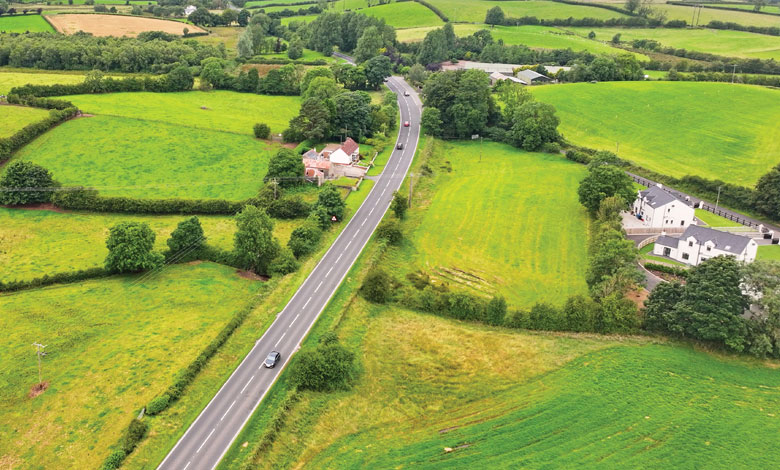
First proposed in 2006, the A5 Western Transport Corridor is a planned 58-mile, high quality dual carriageway from Newbuildings, just outside Derry, to Aughnacloy via Strabane, Omagh, and Ballygawley. Costs have increased from £560 million in 2007 to £2.1 billion as of October 2024. The Irish Government has committed to providing €600 million (£514 million) toward the scheme.
Since 2006, 57 people have been killed and over 1,200 have been injured on the current A5 alongside an average of 69 accidents per year. It has been described by the pro-upgrade group Enough is Enough as “the most dangerous road in Ireland”.
In comparison, around 40 deaths and an average of 39 accidents per year have been recorded on the Belfast-Newry A1 since 2003.
In his judgment on 23 June 2025, judge Gerry McAlinden ruled that the Department for Infrastructure’s decision to proceed with the upgrade was “irrational” and was in breach of section 52 of the Climate Change Act (NI) 2022 (CCA) by failing to provide evidence showing that the A5 would be consistent with climate targets, instead making “aspirational assumptions”.
The court also heard the Department “failed to address the human rights issues raised” by the Planning Appeals Commission (PAC) regarding Article 8 of the European Convention on Human Rights (ECHR).
The Department is to appeal the judgment, with Infrastructure Minister Liz Kimmins MLA saying her officials had been “working day and night” to assure the appeal was robust. It is estimated that the appeal process may take up to 12 months.
In October 2024, then-Infrastructure Minister John O’Dowd MLA announced that the Strabane to Ballygawley section of the A5 scheme would begin construction in Early 2025. The Alternative A5 subsequently issued a legal challenge to the scheme.
The Climate Change Act
The CCA sets a target of net zero emissions in Northern Ireland by 2050.
Section 52 of the CCA requires that all Executive departments “exercise there own functions, so far as is possible to do so, in a manner that is consistent of that [net zero by 2050] objective”.
Following a public inquiry, the Planning Appeals Commission released a report containing recommendations to DfI regarding section 52. The report concluded that the scheme “would have a large adverse effect on climate”, and that it would be unlawful for DfI to proceed with any part of the scheme “unless it can demonstrate that such a decision would not prevent statutory targets being met”.
The PAC recommended that DfI only announce the intention to proceed with the scheme when it is “satisfied that the construction and operation of the scheme will not prevent emissions targets specified in… the CCA from being met”.
It further recommended that the Department “refrain from announcing a decision to proceed… until DAERA have published carbon budgets… and a climate action (CAP) plan for 2023-2027”.
O’Dowd announced the decision to proceed with the scheme, DAERA had yet to publish the carbon budgets or a draft carbon action plan.
A requirement of the CCA, carbon budgets cap the amount of greenhouse gases that can be emitted over a given period. Published in December 2024, the 2023-27 carbon budget mandates a 33 per cent average annual reduction in emissions compared to the 1990 baseline. This increases to 48 per cent for 2028-33 and 62 per cent for 2033-2037.
A draft Climate Action Plan, which outlines 52 policies and proposals designed to reduce emissions across various sectors, including transport, was published by DAERA in June 2025.
In his ruling, McAlinden said: “Nothing was forthcoming from DAERA to indicate that prior to the DfI making its decision, it had provided DfI with any form of evidence or evidence-based assurance that, even in the absence of a finalised CAP, it was formulating and coordinating plans, strategies, and policies that would accommodate the construction and operation of the road and at the same time would map out a realistic and achievable pathway for Northern Ireland to achieve net zero by 2050, meeting the interval targets on the way and staying within the then proposed carbon budgets.”
McAlinden added: “This evidential lacuna renders the DfI decision non-compliant with the duty imposed by section 52 and it renders the decision irrational as it is a decision which was taken in the absence of an adequate evidential base.”
In June 2025, The Irish News reported that, between December 2023 and May 2024, officials from DEARA and DfI met on seven separate occasions to discuss the recommendations of the PAC regarding climate commitments.
When pressed by agendaNi, DfI refused to confirm if the Department had advance sight of either the carbon budgets or the CAP before these documents were published by DAERA in December 2024, and June 2025 respectively. Instead, DfI reiterated that “the Department was in regular communications with DAERA, sharing information on policies and proposals prior to the Minister’s announcement on his decision to proceed with the A5 project between south of Strabane and New Buildings”.
The judge, in his ruling, stated that the CCA did not prevent the A5 or any other road scheme from being completed, explaining that section 52 “clearly rules out the construction of such a major project in the absence of robust planning, synchronisation and co-ordination between all Northern Ireland government departments, ensuring the project fits into the plans, strategies and policies which map out a realistic and achievable pathway to achieving net zero by 2050”.
To allow the A5 scheme to commence, McAlinden says that any future scheme “needs to be able to produce cogent evidence that its decision has been made following careful planning, synchronisation, and coordination between all Northern Ireland government departments, the result of which demonstrates that the project fits into strategies… which map out a realistic and achievable pathway for Northern Ireland to achieve net zero by 2050… staying within the carbon budgets that have now been set”.
Reacting to the ruling, Daniel McCrossan MLA admonished DfI, saying: “I cannot understand how despite several meetings with DAERA, the Department for Infrastructure and the previous Minister still failed to adequately address [the recommendations of the PAC].
“There can be no repeat of this incompetence during this appeal process.”
The Alternative A5 Alliance
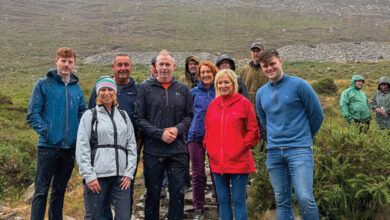
This is the third successful legal challenge brought by the Alternative A5 Alliance (AA5A); a campaign group opposed to the scheme which instead advocates upgrading the existing road. The group is made up of farmers, landowners, and other residents within the vicinity of the project.
In a rare interview, John Hamilton Hassard, a member of the group, told MyTyrone in February 2022 that the AA5A represents a “cross-section of society”, insisting members are “not bogeymen”.
19 years of setbacks and sorrow
The A5 project has been beset by delays. In 2013, after a legal challenge issued by the AA5A, the High Court ruled that the Department of Regional Development (precursor to DfI) failed to carry out “appropriate assessment under the Habitats Directive”, regarding potential significant effects on special areas of conservation.
In 2018, a further legal challenge issued by the AA5A was upheld. The group alleged that the decision taken by then-DfI Permanent Secretary Peter May to proceed with the scheme during a period of power sharing collapse, in the absence of ministerial and Executive approval, was unlawful.
At £2.1 billion, the A5 scheme is the most expensive transportation project in Northern Ireland’s history, costing approximately £36.2 million per mile.