Chris Hazzard MP: The impact of Labour’s farm tax

The confirmation in the British Government’s budget in November 2025 that it will progress with its controversial Farm Inheritance Tax has landed like a hammer blow on our local farming community, writes South Down MP Chris Hazzard.
By capping Agricultural Property Relief and Business Property Relief at £1 million, the British Government claims it is tackling tax avoidance, yet, here in the north of Ireland its proposals would dismantle family farms, fracture rural communities, and summon the spectre of land dispossession once more.
In England, where large estates and diversified wealth dominate, the impact of these proposed changes will be easily absorbed. In the north of Ireland, where farms are overwhelmingly family-owned and asset rich but cash poor, the consequences are existential.
Land values here are far higher than across much of England, meaning small family farms on mountainous land in the Mournes, the Sperrins, and the Glens of Antrim, far from the wealthy elites, will be the collateral damage in Labour’s war on Jeremy Clarkson and James Dyson.
Stormont’s Department for Agriculture, Environment and Rural Affairs (DAERA) estimates that half of all farms in the north of Ireland, covering 80 per cent of farmed land, would be hit.
Families inheriting land will face crippling bills, forcing sales of livestock, machinery, or the land itself simply to meet tax demands. This is not a tax on wealth; it is a tax on survival.
“By ignoring local realities and dismissing widespread opposition, Westminster is imposing a tax on tragedy.”
Chris Hazzard MP
History
The injustice is sharpened by history. Farming in Ireland cannot be separated from the long shadow of colonial land relations. From Penal Laws to An Gorta Mór, British policy repeatedly dispossessed Irish communities, seized fertile land, and imposed colonial structures designed to weaken native society. The Land League of the 19th century fought bitterly against rack-renting and eviction, demanding security of tenure and fair rents. The scars of clearance and eviction remain.
For many families, holding onto land is not just a commercial pursuit but a cultural imperative against centuries of dispossession. Westminster’s current proposals echo this rotten legacy: once again, decisions made in London threaten to fracture Irish farming and rural communities.
What makes this policy even more galling is the absence of genuine consultation. Farmers’ bodies, including the Ulster Farmers’ Union (UFU) have warned that the scheme is “not fair, not workable, and not grounded in a proper understanding” of our local farming structure.
In the Stormont Assembly, the entire political spectrum has united in opposition against the proposals; with speakers from all parties’ highlighting the risks to family farm sustainability, mental health, and rural cohesion.
When such a broad spectrum of political thought unites, it signals a policy so destructive that it transcends entrenched political enmities. Yet again, Prime Minister Keir Starmer MP has managed to achieve what few thought possible.
Regardless, London remains unmoved, refusing to shape the policy to local realities. Once again, the indifference, and willingness to impose laws without regard for the devolved institutions, speaks to a political system that has long treated the North as an afterthought.
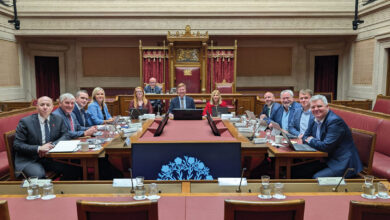
At a recent ‘Future of Family Farming’ event in Westminster, I joined with local farmers who had travelled to London to fight their corner, many of them now calling on the British Government to look to Dublin for a “sensible way forward”.
Indeed, the contrast could not be starker.
Under Capital Acquisitions Tax, Agricultural Relief in the south of Ireland reduces the taxable value of inherited agricultural property by 90 per cent, provided the recipient is an active farmer.
Thresholds are generous, €400,000 for parent-to-child transfers, ensuring family farms can pass through generations without crippling tax burdens. The scheme is designed to support genuine farming families, not penalise them.
It reflects a fundamentally different philosophy: that farming is a public good, not a taxable luxury. Whilst not perfect, it is a model of fairness and continuity; values absent from the British Government’s current proposals.
The broader consequences of London’s proposals are devastating. Food security will be undermined as farms are broken up and sold off.
Mental health, already a crisis in farming communities, will deteriorate further under the stress of losing family land. Rural cohesion will fray as farms, the anchors of rural life, are dismantled.
Historically, the policy risks reopening wounds that have never fully healed, reminding Irish farmers that Westminster still holds the power to decide their fate.
Labour’s Farm Inheritance Tax is more than a fiscal measure; it is a political and historical flashpoint.
By ignoring local realities and dismissing widespread opposition, Westminster is imposing a tax on tragedy.
It is time for the Labour Government to listen, not only to the farming families whose livelihoods are at stake, but also to the political leaders from across the spectrum who have spoken with rare unanimity against this reckless plan.
The message is clear: scrap these proposals, engage in genuine consultation, and adopt a fairer, more equitable approach that sustains family farms rather than dismantles them.
Anything less will be remembered as yet another chapter in the long history of London’s disregard for Ireland’s land and people.