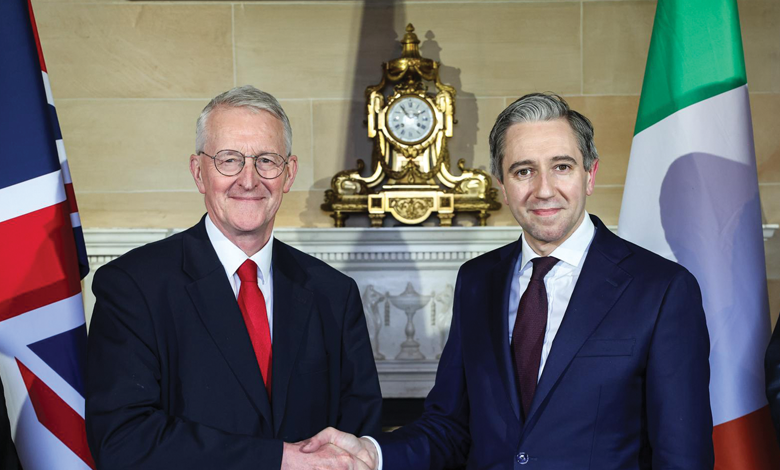
Two years after the UK Government’s Northern Ireland Troubles (Legacy and Reconciliation) Act 2023 provoked widespread criticism from unionists, nationalists, and the Irish Government, London and Dublin have jointly unveiled a new Joint Framework on the Legacy of the Troubles.
The Framework represents the most significant shift in post-conflict policy since the Stormont House Agreement in 2014 and is designed to restore compliance with human-rights law and rebuild confidence among victims’ families.
The 2023 Act, championed by then-UK Prime Minister Rishi Sunak MP, sought to “draw a line under the past” by establishing the Independent Commission for Reconciliation and Information Recovery (ICRIR) and offering conditional immunity to those who cooperated with it.
However, victims’ groups, political parties across Northern Ireland, and the Irish Government denounced the immunity scheme as an “amnesty in all but name”. In early 2025, the Belfast High Court ruled several provisions incompatible with the European Convention on Human Rights (ECHR), striking at the Act’s legal and moral foundations.
The Joint Framework, agreed in September 2025 between the UK and Irish governments, accepts that verdict. “The Legacy and Reconciliation Act 2023 is not fit for purpose,” the document states. The new plan aims to correct those flaws without discarding all prior work.
At the heart of the Framework lies the abolition of the immunity scheme. Under the new arrangements, individuals accused of ‘Troubles’-related offences can no longer obtain immunity in exchange for testimony. The policy reverses one of the most contentious features of the 2023 Act and re-aligns the UK’s approach with the ECHR’s requirement for effective investigations capable of leading to prosecution.
Another pillar of the 2023 legislation, the prohibition on new civil actions and inquests will also be lifted. Families will once again have the option of pursuing justice through the courts, a demand long voiced by victims’ advocates and human-rights organisations.
Legacy Commission
The ICRIR will be reconstituted and renamed as the Legacy Commission, designed to mark a fresh start both symbolically and structurally. Where the ICRIR model was heavily centralised under a single Commissioner for Investigations, the new body will have two co-directors, one from within Northern Ireland’s policing background and one from outside, addressing concerns about conflicts of interest.
A newly created Oversight Board, including international expertise, will supervise the Commission’s work, while a statutory Victims and Survivors Advisory Group will provide formal representation for those most affected by ‘the Troubles’.
The Commission’s mandate will include criminal investigations capable of leading to prosecutions when evidential thresholds are met, and fact-finding inquiries when they are not. The Framework explicitly rejects the notion of “assumed criminality” while reaffirming that justice must remain possible.
The Commission will also host a judge-led inquisitorial mechanism, modelled on the UK’s Inquiries Act 2005, to replace the defunct inquest system where appropriate. This mechanism will allow public hearings, next-of-kin participation, and legal representation, all of which were features largely absent from the 2023 Act.
Disclosure
The Framework also reforms the disclosure regime, which had drawn sharp criticism for allowing ministers to withhold information on vague “sensitivity” grounds. Under the new plan:
- information will no longer be deemed sensitive solely because of its source organisation;
- the Secretary of State’s power to guide the Commission on disclosure will be removed; and
- decisions to withhold information must follow a statutory public-interest test and be open to judicial review.
These changes bring the process closer to the standards of openness seen in major UK inquiries, addressing long-standing frustrations from families who felt excluded from the truth-recovery process.
Inquests and oversight
On inquests, the Framework outlines that nine existing inquests will resume, while a further 24 will undergo independent assessment by the Solicitor General to determine whether they should proceed through the coronial system or be referred to the new commission. The process is designed to ensure proportionality and avoid the protracted delays that characterised previous mechanisms.
An independent oversight board and scheduled performance reviews will monitor the Legacy Commission’s use of police powers, supplemented by existing UK police-conduct bodies; an explicit attempt to shore up credibility after years of mistrust between institutions and victims.
Cross-border cooperation
Politically, arguably the most significant reform is that the UK Government has ceded its unilateralism and established a formal role for the Irish Government. A dedicated unit within An Garda Síochána will coordinate cross-border investigations and serve as a single point of contact for families.
The Irish Government also commits to legislating for “the fullest possible cooperation” with the Legacy Commission and to relaunching, on a pilot basis, the Independent Commission on Information Retrieval (ICIR), a confidential, non-prosecutorial mechanism allowing families to seek information about the deaths of loved ones.
The ICIR is to operate for three years, one preparatory, two pilot, before a joint review determines whether it should continue. Funding for the initiative will be shared, with the Irish Government contributing €25 million over three years to support victims’ participation and representation.
Reception
Sinn Féin has cautiously welcomed the reforms. However, First Minister Michelle O’Neill MLA has said it is “hard to pass judgement” until the party sees the legislation “in black and white”.
Sinn Féin president Mary Lou McDonald TD says that the “British state and its agencies have sought to pull a veil over collusion”, insisting: “There cannot be hiding places given to anyone.”
DUP leader Gavin Robinson MP says that the new proposals require “serious examination” and criticised the lack of prior consultation with victims and veterans. He also accused the Irish Government of failing for 25 years to provide answers to victims’ families and warned that for many, the proposals may be “too little, too late”.
Internationally, in a joint statement, US Ambassador to the United Kingdom, Warren Stephens and Ambassador to Ireland, Edward Walsh, said they hope the measures will “continue to promote healing and reconciliation” in Northern Ireland.
Secretary of State Hilary Benn MP says: “I believe that this framework, underpinned by new co-operation from both our governments, represents the best way forward to finally make progress on the unfinished business of the Good Friday Agreement.”
Tánaiste and Irish Minister for Foreign Affairs Simon Harris TD says that the Framework is an “opportunity to end the cycle of trauma and pain for another generation”. He adds: “I believe, in my heart of hearts, that this is our best, and last, opportunity.”