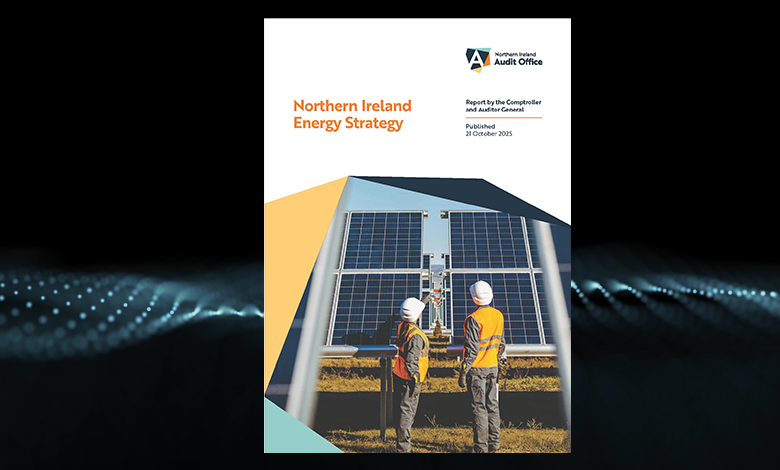
A report has asserted that there are fundamental weaknesses in planning, governance, and reporting within the Department for the Economy’s (DfE) implementation of Path to Net Zero Energy, the Executive’s 2022-2030 energy strategy.
The report, published in October 2025 by the Northern Ireland Audit Office, asserts that, despite widespread consultation and public expenditure totalling £107 million since 2020, limited progress has been made in delivering against the Strategy’s core objectives: improving energy efficiency, increasing renewable generation, and growing the low carbon economy.
The Strategy, published in December 2021, set out Northern Ireland’s pathway to achieving net zero carbon and affordable energy by 2050. It outlined three key targets for 2030:
- a 25 per cent reduction in energy use from buildings and industry (8,000 GWh of energy savings);
- at least 80 per cent of electricity consumption from renewables; and
- a doubling of the low carbon and renewable energy economy to £2 billion in turnover.
Underpinning these ambitions, the Department committed to publishing annual energy strategy action plans (ESAPs) and progress reports to demonstrate measurable change. However, the Audit Office finds that the relationship between the strategy’s targets and its annual actions has been “inconsistently cited and lacking precision”.
Limited progress
The Audit Office identifies “significant flaws” in the design of the ESAPs, citing unclear outcomes, missing actions, and a lack of measurable deliverables. Across four published action plans from 2022 to 2025, only 74 actions were identified, many of which were not time-bound or linked to specific targets.
In practice, this has meant that actions could be quietly dropped or repeated without transparent reporting. For example, a non-domestic energy efficiency scheme initially scheduled for launch in 2022 was omitted from the following year’s plan and reappeared only in 2024. The report also finds no evidence that incomplete actions were systematically carried forward, limiting accountability and clarity of delivery.
While the Department told auditors that the annual action plans served as a “shop window” for key initiatives rather than a full work programme, the Audit Office concludes that such an approach undermines the Strategy’s credibility. Without SMART (Specific, Measurable, Achievable, Relevant, Time-bound) objectives, it argues, performance measurement is not possible.
Governance and oversight
Governance arrangements were found to be complex and evolving. Since 2020, oversight of the Energy Strategy has transitioned through several boards and working groups, from the Energy Strategy Project Board to the Energy Strategy Programme Board (ESPB) and, more recently, the Energy Strategy Oversight Group (ESOG). Each was intended to monitor delivery and challenge performance, however, the report says that “despite the complex governance, there is no published assessment of whether actions have been met”.
The Department’s Energy Group, which employs 134 staff and costs £8.2 million annually, is responsible for strategy implementation. However, the Audit Office says that there are no interim milestones or defined timelines to measure the pace of progress, meaning that the Department cannot determine whether progress is sufficient to achieve its 2030 goals.
Data gaps and delayed reporting
The Audit Office further criticises the Department’s monitoring of progress, asserting that meaningful reporting against key targets did not begin until September 2024, nearly three years into the Strategy’s term. Until then, DfE reported only against broad “vision pillars” of net zero carbon and affordable energy rather than the Strategy’s three quantified targets.
When performance data was finally published in early 2025, it revealed significant shortfalls. There was one 1 per cent progress toward the 8,000 GWh energy savings target, a 35 per cent gap toward the renewable electricity target, and low carbon economy turnover of £1.58 billion, still below the £2 billion ambition.
These findings align with figures reported by agendaNi in March 2025, which highlighted that renewable generation had actually fallen for two consecutive years, with 44.5 per cent of electricity consumption derived from renewables between October 2023 and September 2024, down from 47.4 per cent the previous year.
Similarly, energy-related greenhouse gas emissions had fallen by only 34 per cent from 1990 levels, leaving a further 33 per cent reduction required by 2030.
Public consultation and feasibility concerns
The Audit Office also questions the Department’s reliance on repeated public consultations, warning of “consultation fatigue” and limited strategic coordination. It finds that many actions were delayed or re-scoped because feasibility assessments had not been completed prior to their inclusion in the Action Plans.
In one instance, the establishment of a ‘one-stop shop’ for consumer advice on energy efficiency was listed as a 2022 action, but following successive consultations, was deferred indefinitely. The report says that senior officials in individual departments sometimes discontinued previously agreed actions without oversight or approval from the ESOG, undermining accountability.
Limited value for money
With £107 million spent since 2020, including £85 million on specific energy-related projects such as the Green Innovation Challenge Fund and GeoEnergy NI, the Audit Office concludes that, given the absence of measurable progress, it is “not possible to confirm that expenditure represents good value for money”.
The report emphasises that while DfE has consulted widely and involved numerous stakeholders, “significant flaws in implementation” have prevented the Strategy from demonstrating tangible impact.
Committee on Climate Change
The Audit Office also highlights a governance gap regarding the Committee on Climate Change (CCC). Although DAERA coordinates Northern Ireland’s response to CCC advice, the ESOG, the body overseeing the Energy Strategy, has not formally considered or documented decisions relating to energy-related CCC recommendations. This, the report warns, risks “important recommendations not being given adequate consideration”.
Recommendations and next steps
To address these shortcomings, the Audit Office makes five key recommendations to the Department:
- undertake a strategic assessment to ensure all planned actions contribute directly to the three Energy Strategy targets, with measurable outcomes and timelines;
- conduct robust feasibility testing and streamline consultations before publishing annual action plans;
- review governance and performance reporting to focus on milestones and delivery pace;
- ensure ESOG reviews all CCC energy-related advice and incorporates accepted recommendations; and
- publish the five-year strategic update review, due in 2025, including implications of the Climate Change Act (NI) 2022.
Response
The Department has acknowledged the findings and committed to enhanced reporting in 2025, coinciding with the scheduled five-year review of the Strategy. That review will provide a critical opportunity to reset priorities, align actions with outcomes, and ensure that Northern Ireland’s energy transition keeps pace with statutory climate targets.
In response to the report, Economy Minister Caoimhe Archibald MLA acknowledged the shortcomings and pledged to implement the Audit Office’s five recommendations, including a strategic review and improved performance monitoring: “We have statutory targets to meet, and we are making good progress, but we will be reviewing all of that and publishing that report before the end of the year.”
Speaking to agendaNi, deputy First Minister Emma-Little Pengelly MLA said that there are “concerns about what those findings have been because, as I understand it, the cost thus far has been over £100 million”.
“It is over £100 million of investment for 1 per cent of an achievement. That does not, on the face of it, indicate value for money.”