Designing the network of the future

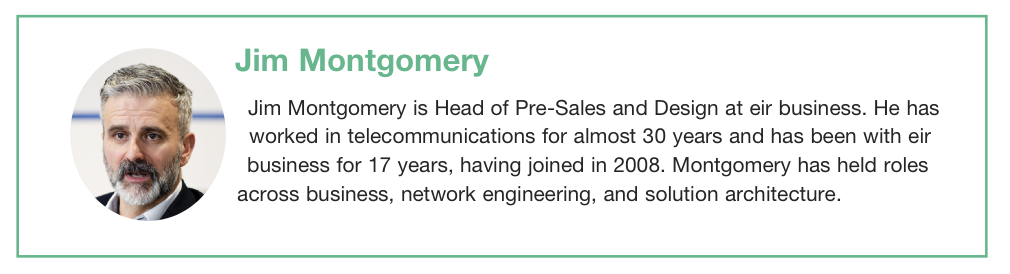
Jim Montgomery, Head of Pre-Sales and Design at eir business, speaks to Joshua Murray about the infrastructure, security, and policy foundations Northern Ireland will need to support a fully digital economy, and how fibre first and software defined networks are central to that ambition.
At the core of Montgomery’s thinking is a strong commitment to fibre-based infrastructure. From eir business’s perspective, fibre is the baseline for a modern digital economy. “At the minute, we provide ubiquitous, fibre-based broadband technologies to coverage across Northern Ireland,” he says, describing an approach that prioritises consistency and reach.
That approach has been applied most visibly in the public sector. Montgomery points to recent work with local councils as an example of how fibre can transform fragmented legacy systems. “We recently worked with the council networks on a full fibre network, where we enabled fibre connectivity to all council locations across Northern Ireland,” he explains.
The project went beyond replacing old lines, as councils were previously operating on “a legacy infrastructure of copper-based technologies with networks that were mismatched at different types of technologies”. As part of that work, all 11 local councils were brought “together into one single, secure, unified, automated platform,” highlighting how policy and delivery can align when objectives are clear.
Tackling digital inequality
Digital inequality remains a significant challenge for Northern Ireland, particularly the historic divide between urban and rural connectivity. Montgomery argues that sustained public investment has already begun to shift that balance. “Northern Ireland is ahead of the rest of UK in terms of fibre connectivity,” he says, pointing to initiatives such as Project Stratum.
From eir business’s standpoint, fibre coverage is no longer limited by geography, with 100 per cent fibre connectivity across the region. Montgomery explains that this is because the necessary infrastructure has been extended well beyond urban centres.
This, he argues, is fundamental to reducing inequality. “Somebody in Fermanagh, for instance, will be able to access similar speeds to users in Belfast today,” he says.
“We provide ubiquitous, fibre-based broadband technologies to coverage across Northern Ireland.”
Software-defined
While fibre provides the physical backbone, Montgomery asserts that the ways in which networks are managed is equally as important as how they are built. “The traditional way of doing networking prior to this software-defined era would have been a lot more complex,” he says. It also “provides a lot less automation” and “does not play into the modern requirements of a modern network”.
In this context, eir business has moved decisively toward software-defined architecture. “Everything we do now is software-defined,” Montgomery explains, “from software-defined WAN to software-defined data centres to software-defined LAN.” He argues that this shift fundamentally changes what organisations can expect from their networks.

“We put in a central platform which our customers can administer their entire network from,” he says, giving them “full visibility across their network which they did not have before”.
Software-defined networking also allows greater flexibility in how connectivity is delivered. “It allows us to use multiple access technologies, such as fibre-based technologies, 4G, satellite,” he says, helping to “enhance the resiliency of the network”. Rather than relying on a single connection, organisations can design networks that continue to operate even when one element fails.
Scale and security
Automation is another defining feature of software-defined networks, particularly when it comes to security. Montgomery contrasts modern approaches with older, labour-intensive models. Historically, networks were “managed by engineers by command line”, but centralised platforms now allow policy to be deployed at scale.
Automation also opens the door to smarter operations, as centralised platforms make it possible to “leverage tools like AI to streamline connectivity and that push out policy”, improving both efficiency and consistency across large networks.
Cyber resilience
Cybersecurity is woven through every aspect of Montgomery’s approach to network design. He argues that security must be embedded in all design. “Everything we do should have a mindset of security,” he says, describing what he calls a “secure by design” principle.
This approach recognises that no single control can provide complete protection. Instead, Montgomery advocates “technologies where we are not relying on one single factor to secure the network”. He outlines multiple layers, from “physical security” and “perimeter security” through to “network security” and “application security”.
The purpose of this layered model is resilience. “If any one of those layers is breached, the next layer of security should give an additional layer of resiliency. While there is no silver bullet to completely secure a customer, having that mindset of secure by design, principles of defence in depth allows customers to meet that cyber resilience requirements,” Montgomery says.
IoT and operational technology
As IoT and operational technologies become more widespread, Montgomery expects networks to grow in complexity. “The growth in this area is only going to get larger,” he says, predicting that operational technology “will be ubiquitous across all organisations” in the years ahead.
Asserting that a single, flat network is no longer appropriate, Montgomery says: “You have your corporate network, you have your IoT network, and that is all about ensuring that devices joining the network have the right security posture.”
Montgomery also emphasises the need for IoT devices to be “secured in the correct way”, with “the correct connectivity” and policies that “adhere to strict government guidelines in terms of compliancy frameworks”.

Networks
AI places especially demanding requirements on network infrastructure, and Montgomery believes these demands reinforce the case for fibre first design. “To support AI workloads in the modern era, we need to be building networks based on high capacity and ultra-low latency,” he says.
eir business designs solutions using a mix of approaches. In the fibre domain, Montgomery states that next generation broadband is already moving beyond the gigabit speeds most users are familiar with. “The next generation of broadband, we are going to be seeing multiple gigabits,” he says.
For higher end requirements, technologies such as DWDM come into play. “Today, we are running 400GB for our customers,” Montgomery explains, with “800GB and 1.6TB of bandwidth capabilities on the horizon”.
“These systems deliver extremely low latencies, making them well suited to data-intensive workloads.”
On dark fibre, he adds: “Dark fibre is effectively a piece of fibre between two key locations. From a latency perspective, it operates at the speed of light, and from a bandwidth capacity, it can take as much bandwidth as you throw at it.” For data centres and advanced AI use cases, Montgomery sees this as a critical capability.
All of this, he notes, aligns closely with public policy. “A fibre-centric approach also plays into the Executive’s investment in fibre first policy across Northern Ireland, which reinforces the link between infrastructure strategy and economic ambition.”
“Everything we do should have a mindset of security.”
Shared services
One area of growing importance is the ability for organisations to work across traditional boundaries. Montgomery describes efforts to enable “the ability for multiple agencies to communicate with other agencies”, with the aim of “driving efficiencies across the public sector”.
By moving toward shared platforms, he suggests that public bodies can “remove duplication” and support new digital services more effectively.
Regulation
Looking ahead, Montgomery sees regulation as a key enabler of secure digital growth. “Security is a big regulatory area,” he says, emphasising the importance of “adhering to all the government mandating frameworks coming down the line in terms of security and cyber resiliency”.
He also highlights the need for clarity around operational technology and IoT. “Those networks are secured and, when deploying devices, sensors within your network ensure they meet the regulatory compliance and security requirements before putting them on the network,” he says.
Concluding, Montgomery argues that there is no single blueprint for the network of the future. “There is no one-stop shop that fixes everything,” he says. “Instead, effective solutions come from listening. We like to listen to our customers to build a bespoke service that we know will meet their day-to-day needs while always looking to the future.”