Costing a united Ireland
In the public debate on a future united Ireland, the probable cost of unity to the Irish state has been a major point of contention, writes John Doyle, professor and Vice President for Research, Dublin City University.
On one side of this debate there are those who argue that the extent of the current subsidy (or subvention) from the UK Government to Northern Ireland, frequently quoted as between £10 billion and £14 billion, makes a united Ireland economically unfeasible. An alternative view argues that this frequently quoted figure grossly exaggerates the probable real cost of unity.
A recent report from Dublin City University (available to download on www.all-islandeconomy.com) contributes to this debate by deconstructing the UK subvention and analysing to what extent this expenditure would become the responsibility of a new Irish state. Based on this analysis, it models three likely scenarios for the fiscal position of the new state post reunification.
Deconstructing the subvention
The financial subvention from the UK state to Northern Ireland, is currently reported as £14 billion per annum. It is a public finance accounting convention that measures the difference between taxation raised in Northern Ireland and Northern Ireland’s allocated share of the UK Government’s total budget and is not a record of money actually spent in Northern Ireland or of monies spent to provide services for Northern Ireland.
This report updates previous work on the UK subvention with the latest (2023) accounts. It clarifies how the largest elements are calculated – including pensions, debt, defence, non-identifiable expenditure and tax, and analyses the extent to which they would transfer as a cost to a united Ireland.
The conclusion of the analysis suggests that the starting fiscal deficit for ‘Northern Ireland’ within a united Ireland would be £1.5 billion per annum.
Fiscal projection for the government finances of a united Ireland
On the basis of the adjusted subvention figure, the report goes on to explore the potential fiscal position of the first 10 years of a united Ireland.
To the deficit figure of £1.5 billion per annum (€1.75 billion) outlined above, the model used in the report provides for a €1 billion annual boost to public expenditure in Northern Ireland to provide much needed additional investment in health, welfare, education, and infrastructure.
The projections also assume a gradual implementation of a 48 per cent increase in public sector wages, over 15 years, which is what is required to bring wages into line with the Republic, at a year one cost of €152 million per annum, increasing by that amount annually over 15 years. While a shorter or a longer period of transition might ultimately be agreed, there is no realistic possibility that salaries would be increased by 48 per cent in year one. The cost of living in Northern Ireland, including housing would not increase instantly, and a 48 per cent pay rise would be highly inflationary in the regional economy.
This model also assumes that pensions would transfer gradually to Ireland in proportion to the number of years where tax and pension contributions are made to the Irish state, at an annually rising cost of €115 million.
Three scenarios
Three scenarios for public finances are analysed, following the pattern of economic growth in central Europe after those states joined the EU, and taking into account the trajectory of economic growth in both parts of the island in recent decades.
After allowing for inflation, Northern Ireland’s economy grew by just over 30 per cent, between 2000 and 2024, or an average of 1.3 per cent per annum. Using modified gross national income (GNI*) to exclude the distortions from multinational operations, the Republic’s economy grew by 71 per cent in real terms over the same period, an average of just over 3.2 per cent per annum.
The report argues that with Northern Ireland rejoining the EU and adopting the Republic’s higher public spending on education, infrastructure, and on R&D, a more competitive corporation tax policy, and a more equitable tax policy, there is no reason why it would remain so much poorer and so much less economically productive than other parts of the island. Economic convergence will take some time, but it will happen.
The cost of a united Ireland has been exaggerated firstly because what is called the UK subvention has been misunderstood and misinterpreted, and secondly because the potential for economic growth in an all-island economy, where Northern Ireland is once again inside the EU, has not received sufficient attention.
As referenced above, the inherited ‘subvention’ for Northern Ireland is £1.5 billion (€1.75 billion), based on 2023 data. Boosting public expenditure by €1 billion per annum, to provide necessary investment in health, education, infrastructure and welfare, while also allowing for the cost of gradually equalising public sector salaries and taking over pensions would see a full year-one cost of €3 billion.
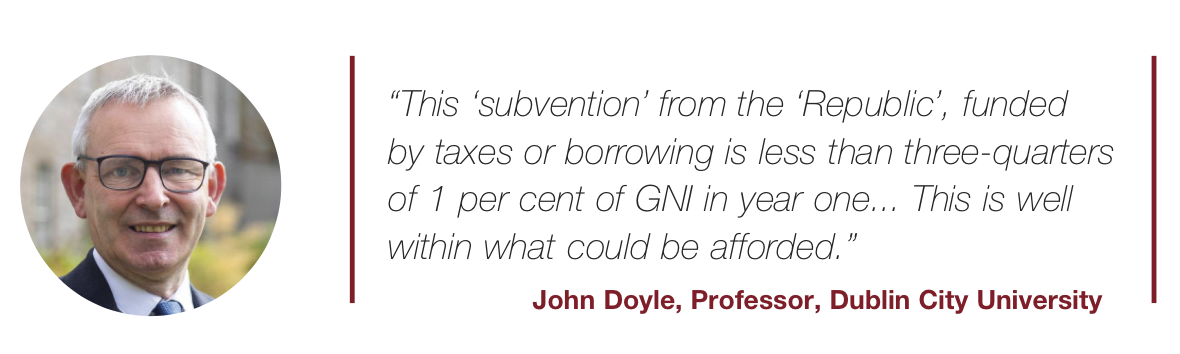
Each of the modelled scenarios would allow the North to absorb all the increased costs of gradually equalising salaries and pensions and to gradually raise sufficient tax through growth to cover the initial deficit. This ‘subvention’ from the ‘Republic’, funded by taxes or borrowing is less than three-quarters of 1 per cent of GNI* in year one, and will fall gradually as the overall economy of the island grows and end within five to nine years. This is well within what could be afforded.
For the Republic, the costs associated with unity have tended to be exaggerated and the benefits of an all-Ireland economy largely ignored. Without underestimating the difficulties of a process of unification, the aim of this report is to contribute to the discussion by demonstrating the range of possible costs and benefits of this project.
The three modelled scenarios, Path A, B, and C are as follows:Path A would replicate the performance of the most improved economies in Central Europe, where countries such as Latvia, Lithuania, Bulgaria, and Romania have maintained an average growth rate per capita, of approximately 3 per cent above EU averages from 2000 to 2023. The Republic of Ireland, by comparison, grew at 2.7 per cent above EU averages. This would see Northern Ireland’s GNI catch up with the Republic in approximately 25 years. If this growth rate was achieved, Northern Ireland would no longer have a financial deficit by year five and would run a fiscal surplus of over €6.7 billion per annum by year 10 of a united Ireland or have those resources available for improved public services and investment. Path B is a medium growth path compared to the recent Central European experience, maintaining an average growth rate per capita, of approximately 2 per cent above EU averages. This group included Croatia, Estonia, Poland, and Slovakia, and would see GNI* convergence with the Republic in approximately 40 years. With Northern Ireland achieving this growth rate the fiscal deficit would end by year six, and, by year 10, Northern Ireland would be contributing an annual surplus of €3.6 billion per annum to a united Ireland budget. Path C is a low growth path compared to the recent Central European experience, but even these countries with a weaker performance compared to their neighbours, still maintained an average growth rate per capita, of approximately 1 per cent above EU averages – a group including Czechia, Hungary, and Slovenia. In this case convergence would still take place, but over a very long period. If Northern Ireland achieved a 1 per cent per annum growth boost after unity, it would reach break-even in year nine. |