A CASE for a stronger greener economy
Einstein once said: “Never give up on what you really want to do. The person with big dreams is more powerful than the one with all the facts.” The natural extension being that the person with big dreams based on facts wins, writes David Rooney, Professor at Queen’s University Belfast.
Within the Centre for Advanced Sustainable Energy (CASE) we use the acronym DREAMS to represent many of Northern Ireland’s economic strengths. Digital and AI, Renewables, Economic/Fintech/Regtech, Agri-food, Manufacturing and Screen technologies all play a significant role. These have evolved from our ability to create, to build, to connect to each other through stories and through our deep connection to the land.
Going forward our CASE analysis shows that product and process innovations born at the nexus of these strengths offer immense potential for Northern Ireland and a resurgence of opportunity given global challenges including the drive to net zero emissions.
Flip the DREAMS over and we can use the same acronym to highlight the barriers – Demand led, Regulation and Planning, Economic uncertainty, Aversion to risk, Mission creep and Silos. Of these, demand led is a subtle and pervasive barrier to anticipatory investments, ultimately stifling agile growth. Mission creep distracts us with incremental successes and silos completely miss opportunity for additivity and connected value.
Of course, on the journey to a net zero and Circular economy there are many other misdirections and fallacies. We will only very briefly address three – the belief that net zero is a scam, the second that it is a luxury, and finally the belief that Northern Ireland is too small to make a difference. The first fallacy is a distraction as net zero is an inevitability. The second ignores a history of progress striving to provide society with a higher quality of life and the third is a myopic viewpoint of limited perspective ignoring Northern Ireland’s global leadership and economic potential. These fallacies have their champions but thankfully Northern Ireland remains committed to its moral and legal obligations to delivering its net zero targets.
When reflecting on this the opening line of Rudyard Kipling’s ‘If’ comes to mind. “If you can keep your head when all about you are losing theirs” and later “if you can dream and not make dreams your master”. Removing the noise, remembering our strengths and actively addressing the barriers is critical. Paraphrasing Jane Goodall we can summarise: “Only if we understand, will we care. Only if we care, will we act. Only if we act, will we succeed.” Remember, big dreams based on fact wins!
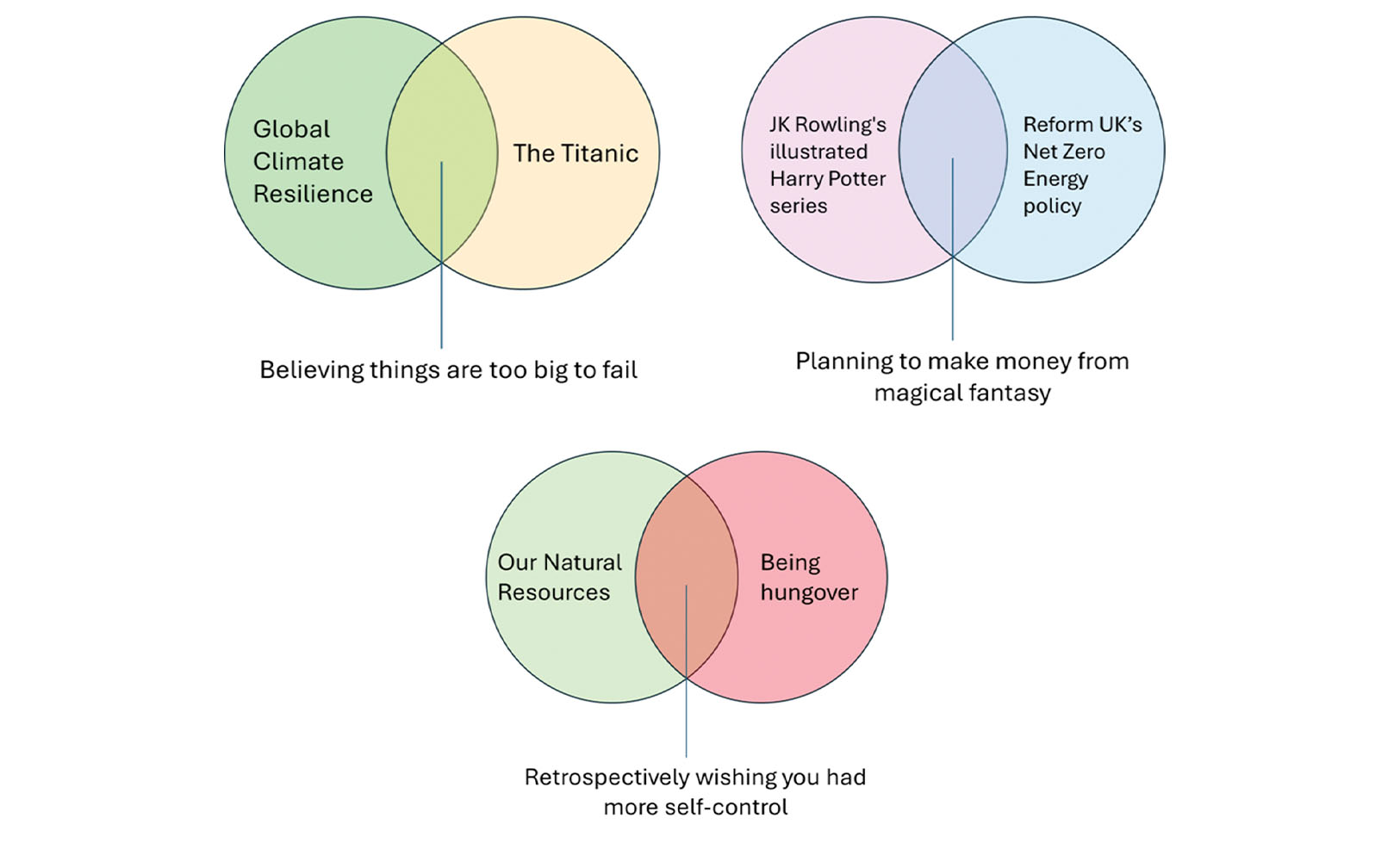
Edith Pritchett inspired Venn diagrams of Net Zero and related issues
For over a decade, CASE has worked with NI industry to help them succeed in developing renewable technologies. Our projects have successfully coupled advances across manufacturing, digital, sensing, marine and agri-technologies to deliver new products, services and concepts in support of renewable energy. But CASE also recognised that technologies alone were insufficient – the environment must enable success.
The Grant Thornton Competence Centre evaluation of CASE highlighted this function stating that the centre’s work was felt to be of strategic importance not just to companies, but also the renewables landscape in Northern Ireland. It was reported that “a key benefit of CASE that cannot be understated is its contribution to the policy and strategy landscape for renewables and sustainable energy in NI. Consultees [to the evaluation] reported that much of the awareness and profile-raising work undertaken by CASE benefitted their business by marketing NI’s potential to investors and international partners.” It was recognised that work led to a ‘step change’ in awareness of sustainable energy capability and an increased profile of Northern Ireland and domestic entrepreneurs in undertaking sustainable innovations, leading to FDI investment. Overall, it was clear that “CASE has become a ‘trusted voice’ in its respective field in Northern Ireland and its contribution and the policy voice should be reflected on by policymakers and funding stakeholders.”
Therefore, while CASE was originally established as a competence centre to support innovation in sustainable energy led by industry demand, it became a necessary voice and advocate for wider change. CASE continues to support the creation of a regional ecosystem which can address technological and social needs through a targeted portfolio of innovations aligned to renewables, net zero and the circular economy.
Much more is needed, and our analysis suggests that of the many factors necessary to underpin a successful future innovation ecosystem and service sustained growth in Northern Ireland’s green economy ambitions, six are key: vision, focus, funding, talent, infrastructure, and inclusion. Only some are missing but only by addressing them together, can Northern Ireland exploit its opportunity in a way which recognises the shared human and natural capital across the region.
Our work also recognises that this overarching ecosystem requirement cascades down to various societal actors, each having specific and varied needs which must be addressed so they can positively contribute to net zero and circular economy targets. In particular innovation complimented by policy is key to delivering solutions for SMEs, especially those in rural areas which are less likely to engage due to time and resource constraints. The decarbonisation pathway is needed for all, and the opportunities are there to be shared.
Investments are happening but there is a question of how these work in concert to deliver the wider ambition and legislated targets. Leadership is essential and if a goal is a dream with a deadline, then there is less than 25 years left of the 2050 target and a clear need for a CASE to support a stronger greener economy.