Emma Little-Pengelly MLA: ‘There is so much more that we can be’

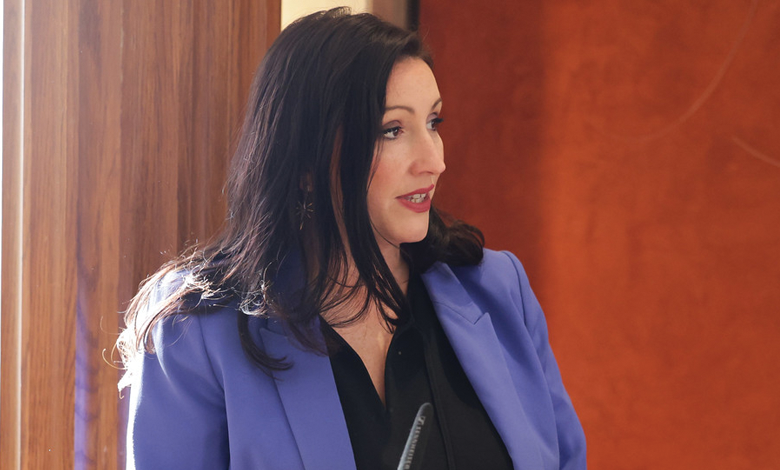
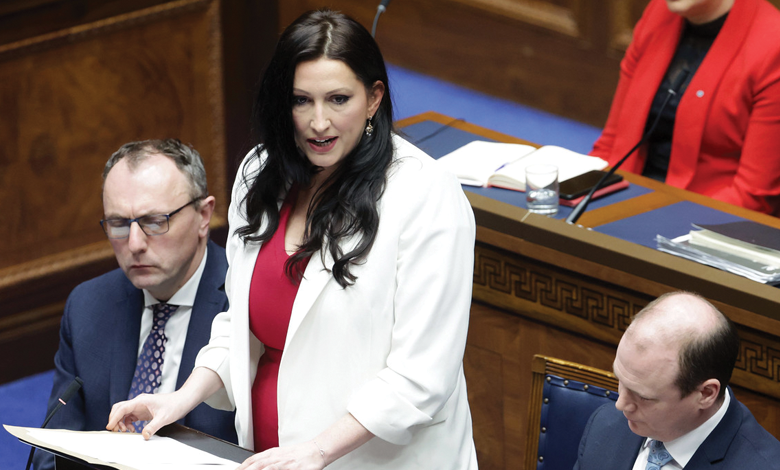
In February 2024, Emma Little-Pengelly MLA became the first unionist deputy First Minister. After 18 months in office, she meets Joshua Murray in her Stormont office to discuss the Executive’s delivery record, the state of unionism, and what drives her in politics.
Emma Little-Pengelly MLA has had a convoluted path to power. In and out of politics for the last 10 years, she lost her Assembly seat in 2017, before losing her seat in the Housing of Commons in 2019. A brief stint as a special adviser and a return to her legal career followed. Little-Pengelly was then co-opted into the Lagan Valley Assembly seat won by Jeffrey Donaldson in 2022.
The formation of the Executive was equally complex, with a deal negotiated by Donaldson forming the basis of the DUP’s return to office, just shortly before the former leader’s shock resignation over allegations of historical sexual abuse, which Donaldson is contesting in court.
The DUP itself, she concedes, has been through “an incredibly challenging time” following Donaldson’s resignation. But she is quick to praise the party’s new leader. “Gavin Robinson came in in those difficult circumstances and has done a fantastic job.
“He has given that very strong and confident leadership and really working with colleagues right across. People out there want to see unionists working better together.”
Delivery
Twenty months after its reformation, the Executive faces mounting evidence of structural weakness. A 2024 report by the Northern Ireland Affairs Committee concluded that years of ministerial absence had “delayed the introduction of new legislation and undermined the effective scrutiny of decision-making”. In sectors such as health and education, the pace of improvement remains slow, with approximately 26.3 per cent of the population on a waiting list for treatment.
Refusing to be drawn on the Executive’s inadequate delivery record, the deputy First Minister insists that she and her co-leader, Michelle O’Neill MLA, spearhead policy: “We have made clear, for example, that tackling health waiting lists is not just an issue for the Department of Health. They are the lead, but that is an issue that impacts right across government.”
Little-Pengelly insists that the Executive is determined to show visible delivery. “I think we have successfully done that in the Programme for Government, setting out our nine key priorities, and I think covering all of the key areas in terms of health, in terms of education, in relation to growing the economy,” she asserts.
For Little-Pengelly, one of the key instruments of that coordination is a newly-established ‘delivery unit’, which she says works “to identify learning internationally, to support departments in their initiatives, and to troubleshoot at times if that is required and requested”. It is one of the structural responses designed to address the Executive’s historic lack of progress, with only seven pieces of legislation having reached the statute books since the election three-and-a-half years ago.
She points to the Executive Office’s lead policy responsibilities, most notably the End Violence Against Women and Girls strategic framework for 2024-2031, which she says “was about policy development through a really good collaborative design process; probably the best co-production, co-design policy process that I have seen across the system, and I would argue, across the UK and Ireland”. The strategy, she adds, is “an organic one”, evolving with evidence and engagement. “There is already money on the ground. It is not just a strategic framework, but delivery plans.”
Little-Pengelly is keen to convey herself as a bridge between the DUP’s traditional conservatism and pragmatism. She presents herself as a technocrat who will enthuse decision-makers in the region, referring to data strategy as much as she does to civic renewal. “We have established the Office of the Chief Scientific and Technology Officer. That is all about gathering data, looking at the digital revolution, and seeing how we can use that in a better way not just in the practical things we do across departments, but in terms of policy development and looking at interventions.”
This kind of “data-driven, delivery-focused” thinking, she argues, is central to the Executive’s fresh mandate. “Tackling poverty is a challenge for all departments. Ending violence against women and girls is a challenge for all departments and growing the economy is a challenge for all departments.”
Energy and climate
When the conversation turns to energy, however, the deputy First Minister’s tone hardens. The Northern Ireland Audit Office’s finding that energy efficiency has improved by only 1 per cent since the Northern Ireland Energy Strategy was launched prompts concern. “On the face of it, that does not indicate value for money. It has been over £100 million of investment for one per cent of an achievement.
“We want to see energy security. I would like to see energy prices reducing for consumers, but also for business,” she says. “We in the DUP very much support having a mixed portfolio because shifting entirely away from traditional sources of energy has the risk of increasing energy costs significantly and also challenging energy security.”
On climate change itself, unlike some of her party colleagues, the deputy First Minister is a believer, but careful to avoid being perceived as being too liberal. “Of course, climate change is real. There is an impact, of course, on the actions that we do. People recognise that we are custodians of the environment.” However, Little-Pengelly insists that decarbonisation targets must be “balanced and realistic” and calls for the decarbonisation targets under the Climate Change (Northern Ireland) Act 2022 to be revised.
“We can go faster and deeper than anywhere else on the globe, but what it will do is be punitive to our farmers, punitive to our businesses, and it will increase energy bills for citizens. People do want to play their part. We need to do it in a much more realistic way which is affordable and balanced.”
Economy
On her economic vision for Northern Ireland, she says that the region “is a fantastic place to work and to live” but that she “also believe[s] that there is so much more that we can be”. “I do strongly believe that Northern Ireland can be one of the best small, open, agile economies in the world, but I also acknowledge that that will not happen by accident.”
Her optimism about Northern Ireland’s economic potential is tempered by realism about global challenges. “It has been quite a challenging international investment climate; there are a number of global conflicts, uncertainty around the tariff regime and the global investment market has been quite sluggish.
“The DUP has been very supportive of lowering corporation tax, and I think for a very good reason. We believe it is a real game changer to attract companies to Northern Ireland and to encourage those companies to grow.”
She recalls that the policy once united Peter Robinson and Martin McGuinness. “We really pursued that policy, got a great deal of consensus at the time,” she says.
“The [UK] Treasury view was that the cost of that should be borne by Northern Ireland in terms of the gap between what the mainland GB tax was and what Northern Ireland’s would be. The argument made by Peter Robinson and Martin McGuinness was that as we increase the tax base because of the incentivisation of this policy, that needs to be recognised by Treasury. That never got resolved.
“Corporation tax is still very firmly on the table because we need a big economic game-changer, and it is one of the policies that I believe really could bring that about.”
Unionism and devolution
As demonstrated by the “Stormont or Starmer” rhetoric at the DUP’s conference in September 2025, the party is attempting to use pro-devolutionism to directly distinguish itself from the TUV. “Decisions that impact people in Northern Ireland should be made closest to them,” she says. “For me, sitting here as deputy First Minister, my primary interest is championing Northern Ireland.”
Her argument is direct: “When you go back to a non-devolutionist position, you are pushing this back to UK Government, where those issues are not necessarily their primary concern.”
Little-Pengelly uses the prospect of Starmer’s direct rule as the biggest reason for the DUP’s journey to being explicitly pro-devolution.
Repeating the language from the party conference, she says that “it is Stormont or Starmer”, before rhetorically asking: “Do you want those decisions taken by Keir Starmer, or by politicians here who have Northern Ireland as the key priority?”
On the Good Friday Agreement itself, she characterises the DUP’s complex journey from opposition to part-time supporters as a “political reality”. Asked whether the DUP of 2025 supports the agreement, the deputy First Minister is coy. “It was voted on by people in Northern Ireland and the Republic of Ireland. It is the context in which we operate.”
However, Little-Pengelly stresses that the DUP’s opposition in 1998 “was not because we opposed peace but because we did not believe it was right that you would have a political party come into the Executive without decommissioning, or that you would have all of those prisoner releases”.
She prefers to describe the current settlement as “the Belfast-Good Friday Agreement as amended by, and improved by, the St Andrews process”.
Asked whether the current UK Government is “a friend to unionism”, Little-Pengelly replies, in contradiction with her ‘Stormont or Starmer’ dichotomy, with measured diplomacy. “This Labour government has been very upfront about being pro-union, pro the United Kingdom,” she says, quickly adding: “We would want the UK Government to work more closely with us to tackle big issues.
She continues: “They need to get a grip on the economy, on immigration, the Windsor Framework, and the continuing bureaucracy for businesses in Northern Ireland.
“The UK Government promised unfettered internal UK trade, but that is not what we are seeing,” she says. “When you speak to businesses, they are saying there is a lot of unnecessary bureaucracy and paperwork. Despite the fact that Great Britain and Northern Ireland are entirely within the same regulatory regime as the EU, there are still all these checks.”
Continuing to weave the web between the DUP’s unionism and technocratic civil servants, Little-Pengelly’s critique of the Windsor Framework is couched in the language of market integrity rather than sovereignty. “Northern Ireland does more trade with Great Britain than it does with the European Union, the Republic of Ireland, and the rest of the world put together, so we need to protect the integrity of the UK internal market.”
Unionism declared an enemy in the unlikely form of former Fine Gael leader and Taoiseach Leo Varadkar, however, the deputy First Minister praises the current head of government in the Republic. “I think with Micheál Martin, he understands the stranded approach much better,” she says, adding: “It makes sense to have positive and constructive relationships when we can, but we will also call out where there is overreach.
“I have engaged, I think, very constructively with Micheál Martin as Taoiseach. I have always made clear that the Belfast Good Friday Agreement sets down, in its stranded approach, the parameters of engagement.
“There are certain issues in which we engage with the Irish Government, but there are other issues which are entirely matters internal to Northern Ireland or the UK.”
Politics and worldview
For all her precision and political armour, Little-Pengelly speaks warmly when the interview turns to the people who shaped her career. “Whenever I came into politics, I worked initially for Dr Paisley, and then for Peter Robinson.
“I really cut my political teeth under Peter Robinson. He was a huge inspiration; very dedicated, passionate about what he believed in, passionate about standing up for Northern Ireland.
“He recognised that compromise was required, but compromise done in a way that did not fundamentally impact your core values. He was meticulous, very careful about detail because he recognised the importance of that in getting the nuts and bolts right. He was very good tactically and strategically as a political leader.”
Beyond unionism, her admiration lies with 1940s-era UK leaders. “When you look at Winston Churchill’s leadership through very difficult times, it is always easy to look back and think he did the right thing because we know the outcome, but at the time, he did not know. Those were incredibly courageous decisions.”
She also praises the post-war Labour government. “When you look at the creation of the NHS, the biggest period of social house building, these were policies probably perceived as fairly left at that time, and yet completely life-changing.”
Perhaps tellingly, she cannot name a current world leader she admires. “It is very challenging in the current political climate,” she says after a pause. “There is a lot of global instability. I admire anybody who steps forward in politics at a difficult time.”
Obfuscation, when utilised properly, can be an enormous strength in politics and it is a skill that the deputy First Minister seems to have mastered. Keen to avoid alienating anyone, whether unionists to the right of the DUP, liberals, the UK Government, the Irish Government or civil servants, she has positioned herself as one of the few unionists with the political capital and credibility to work alongside Sinn Féin in a devolved executive.
The Executive’s delivery record is poor by any standard, however, the deputy First Minister has shown that she is a political survivor: navigating internal party turbulence, realigning her standing after being co-opted rather than elected, and sustaining her role in a party where many have faltered. In a system where delivery is patchy and patience thin, Little-Pengelly’s decision to operate quietly, steadily, and without collapse may turn out to be the most politically shrewd move of all.