AI and the future of work
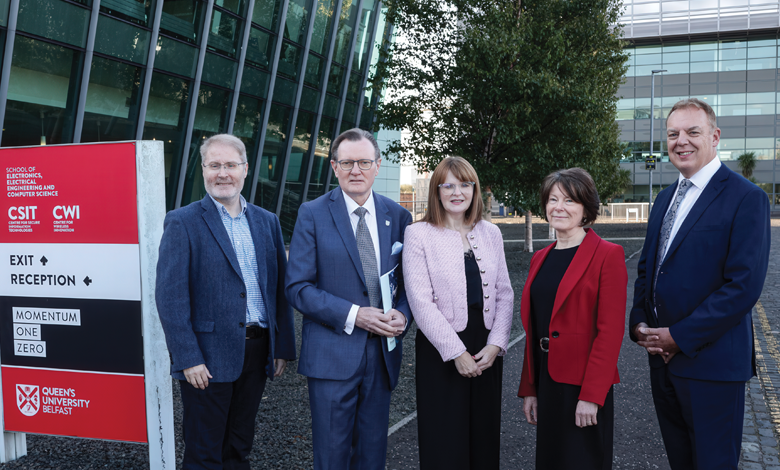
AI could contribute between £0.2 billion and £3.7 billion in incremental GVA by 2030 relative to 2023, a report has said.
AI and the Future of Work in Northern Ireland, published by Matrix in September 2025, outlines the impact cases of low, midpoint, and high level adoptions of AI to 2030 compared to 2023. Cautious adoption patterns and limited economic diffusion would contribute £0.2 billion. Meaningful but measured AI integration would contribute £1.2 billion. Accelerated implementation would contribute £3.7 billion.
AI and the Future of Work states that the impact on the economy will depend on both the pace of its adoption, and the skilling response. Variances in both of these factors lead to four potential scenarios:
- Titanic leap: Adoption is rapid and relevant capabilities are built.
- AI stampede: Adoption is rapid but the skills gap grows.
- Crafted catching up: Adoption is gradual and relevant capabilities are built.
- Slow-lane spiral: Adoption is gradual and the skills gap grows.
Challenges
The report identifies eight challenges to AI adoption. It states that existing support mechanisms focus on builders and implementers of AI tools rather than users. “This points to the need for order-of-magnitude expansion in both reach and resources,” the report says.
Matrix asserts that funding shortfalls will impede adoption while talent shortages may emerge due to rapid transformation of industry requirements. The report states that “compliance culture” in leadership teams “are slowing adoption rates”. Matrix adds that “a conservative business culture and risk aversion” could lead to organisations retreating from AI adoption if it presents challenges or fails to deliver immediate results.
Trust is identified as a challenge, requiring “proactive governance frameworks”. However, the report notes that “size and collaborative culture position [Northern Ireland] well to pioneer ethical AI development”. To ensure worker participation, the report states that stakeholders must place importance on consultation and job-quality safeguards. Matrix also asserts that the region’s position “at the interface between UK and EU regulations creates significant uncertainty about which AI act will apply”.
Recommendations
The report outlines a total of 10 recommendations for effective AI adoption. Various organisations are given responsibility for these actions including the Executive Office and the departments for the Economy, Education, and Finance.
The report asserts that scaled AI confidence and capability programme for public and private sector leaders should be launched. A target is set for between 2,000 and 3,000 businesses to participate in the programme in year one. Matrix suggests that full rollout of the programme be achieved within six months.
The report recommends delivery of a public and workforce engagement campaign, including establishment of a citizen’s assembly. A target of “70 per cent public awareness of AI opportunities and safeguards within two years” is set. The report suggests that the citizen assembly be established within three months, indicating that its first recommendations should be made within six months.
An ‘independent AI champion’ should also be established by the Executive Office within two months. It would be hosted by an independent body “with industry connections and credibility”. Targeted support for AI-drive enterprises (AIDEs), should also be created to enable their growth. A target is set to support 50-plus AIDEs to reach market within 12 months.
The report recommends the creation of new support programmes and upscaling of existing ones to enable businesses to integrate AI. A target is set to establish goals for AI adoption rates. Additionally, a sector-specific AI adoption pathway should be launched within three months, with all priority sectors covered within 12 months. Matrix also sets a target for public SME AI playbooks to be launched within six months.
An AI workforce impact observatory should be established to detect early signals of workforce disruption and trigger rapid response interventions. DfE is the suggested owner and the observatory should be established and operational within 12 months.
Matrix states that a dual market AI compliance support service should be established to support business operating across UK-EU markets to navigate dual regulatory obligations. Targets are set to support 200 business within the first year, and achieve an 80 per cent reduction in average compliance consultation costs. The service should be designed within four months, a pilot launched within eight months, and become fully operational within 12 months.
Matrix recommends creating a “flexible, industry-recognised AI skills certification accessible to all workers and businesses”. Targets are set for 5,000 workers to be certified in year one, growing to 15,000 by year three. The report recommends development of a curriculum within three months, and launch of pilot programmes within six months.
Creation of a skilling and reskilling programme for displaced and vulnerable workers is also recommended. Programme design should be completed within six months and the programme delivered within 12 months.
Matrix also recommends successful pilots in education be expanded to provide system-wide access and support. Targets are set to scale from current pilot institutions to 50 per cent coverage within 12 months, and full coverage within 18 months. An expansion plan should be designed within three months and rolled out over 18 months, with the Department of Education to publish a report within six months.
Upon publication of the report, Economy Minister Caoimhe Archibald MLA said: “AI is helping local businesses to turn the dial on their productivity; by improving efficiency, delivering better automation, and speeding up analytics. AI development is supporting the creation of new highly skilled, good jobs. It has been grasped by the energy sector, to ensure we stay ahead of the green transition. And, with my strong focus on regional balance, businesses right across the North are being supported to put in place the skills and supports needed to adapt and adopt to AI advancements.”