Sustainable public finances

After 18 months of financial “firefighting”, the recent UK Treasury spending review gives Finance Minister John O’Dowd MLA the fiscal stability and responsibility to deliver a multi-year budget. Speaking to agendaNi, Jodie Carson, Professor of Strategic Policy in Practice at Ulster University says this enables Executive departments to transform and transition towards long-term strategic planning.
Following Chancellor Rachel Reeves MP’s spending review in June 2025, the Executive has clarification on the resource and capital allocations available to them over the next three years. Finance Minister John O’Dowd MLA could present the first multi-year budget since 2010, providing an opportunity for long-term strategic decision-making.
According to Carson, the Executive has a golden opportunity to change trajectory. She says the Executive has been in “firefighting mode” in recent years, an unsustainable position with outcomes for public services requiring substantive improvement, and opportunities for reform being missed.
The cost of inaction is considerable with increasingly evident impacts being felt, particularly relating to wastewater infrastructure, as decades of underinvestment results in building projects across Northern Ireland stalling – stunting growth and development. The Lough Neagh blue-green algae crisis continues to worsen, as parties quarrel over measures required to restore its health.
Across the regional economy, low productivity persists with no clear plan to end stagnation, while the draft Anti-Poverty Strategy has been met with widespread criticism for its lack of depth and direction.
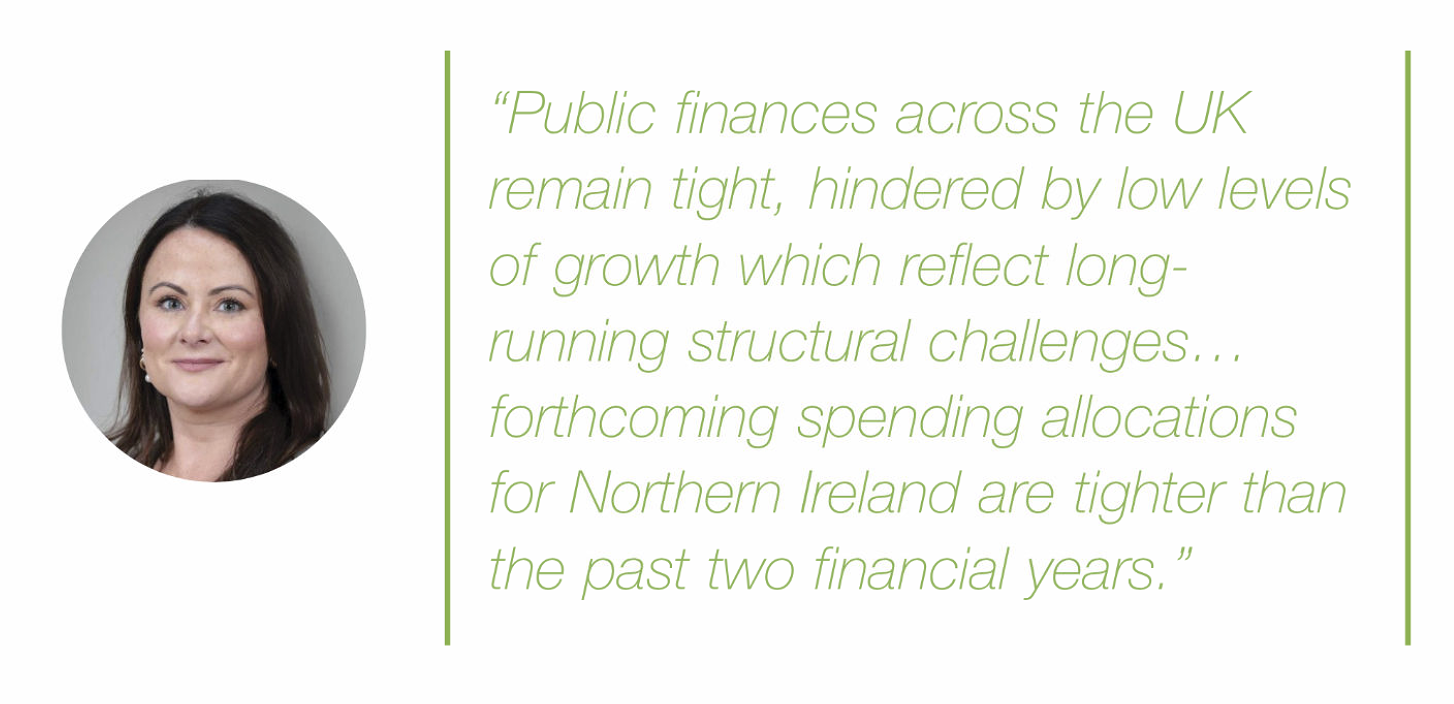
Explaining the current economic malaise, Carson says “public finances across the UK remain tight, hindered by low levels of growth which reflect long-running structural challenges. Consequently, forthcoming spending allocations for Northern Ireland are tighter than the past two financial years.”
In June 2025, an independent review by Gerarld Holtham entitled Northern Ireland’s Level of Need, found that Northern Ireland required a financial subvention level of 128 per cent. Meaning that for every £1 spent per head of population in England, £1.28 per head of population ought to be spent in Northern Ireland.
Echoing the sentiment of the report, Carson says: “It is unfortunate that the identified level of relative need here had not been revised upwards for some time. The commitment to a broader review of our fiscal framework allowed for this to be revisited. But it is worth noting that the revised figure, whilst welcome, would not be a game-changer.
“Further, the £520 million in stabilisation funding, which Northern Ireland has had in place for the past two financial years, will now cease, representing a fiscal cliff edge.”
In June 2025, an agreement was reached between the UK Treasury and Finance Minister John O’Dowd MLA, excluding £329 million of un-ringfenced agricultural funding from the methodology for calculating the Executive’s relative funding, bringing an extra £600 million for public services. When added to the 124 per cent subvention agreed by the UK Treasury, this represents a real-terms subvention level of 128 per cent.
Despite this commitment, which is only guaranteed through to 2028/29, Carson says: “The Executive faces renewed challenges in, and imperative for, transitioning towards longer-term strategic decisions.”
Public sector transformation is “fundamental to a revised approach”, Carson says, insisting that this ought to be mainstreamed across the full spectrum of government activities.
Outlining the challenge ahead, Carson says transformation “necessitates a greater focus on prevention, early intervention and the reconfiguration of some services”.
Asked for specifics, Carson claims “the utilisation of artificial intelligence will be central to this and is notably core to the UK Government’s narrative”.
Outlining the next steps to be taken, Carson says, “the Department of Finance will now seek to work with departments to identify pressures and derive allocations, which involves incremental adjustments to previous departmental budgets”.
However, many aspects of the spending review for Whitehall departments have been subjected to zero-based review of budgets, which involves scrutinising expenditure from scratch.”
Carson adds: “There may be merit in trialling this approach in certain areas of local public spending to enable enhanced scrutiny of expenditure.”
With the most recent £16.7 billion budget being published in June 2025, Carson believes the timeframe for delivering a budget should be pushed back, saying: “Ideally, a draft budget will go to the Executive in the autumn and then to public consultation to allow for a final agreed budget in early spring, ahead of the next financial year enabling due forward planning.”