Economy Minister Caoimhe Archibald MLA: ‘Foundations we can build upon’
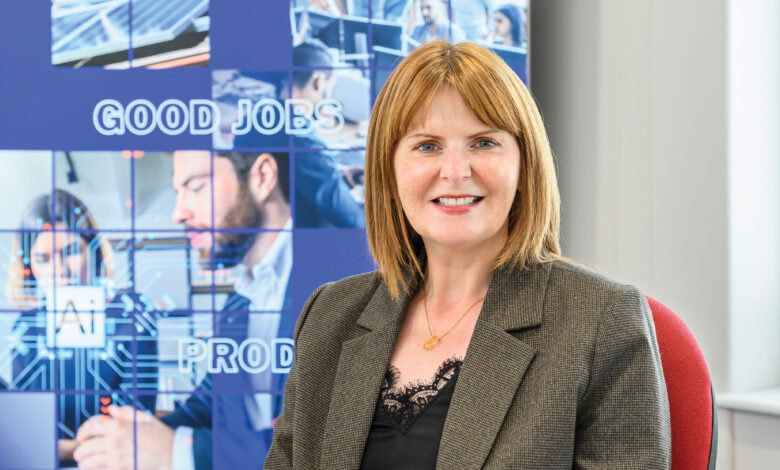
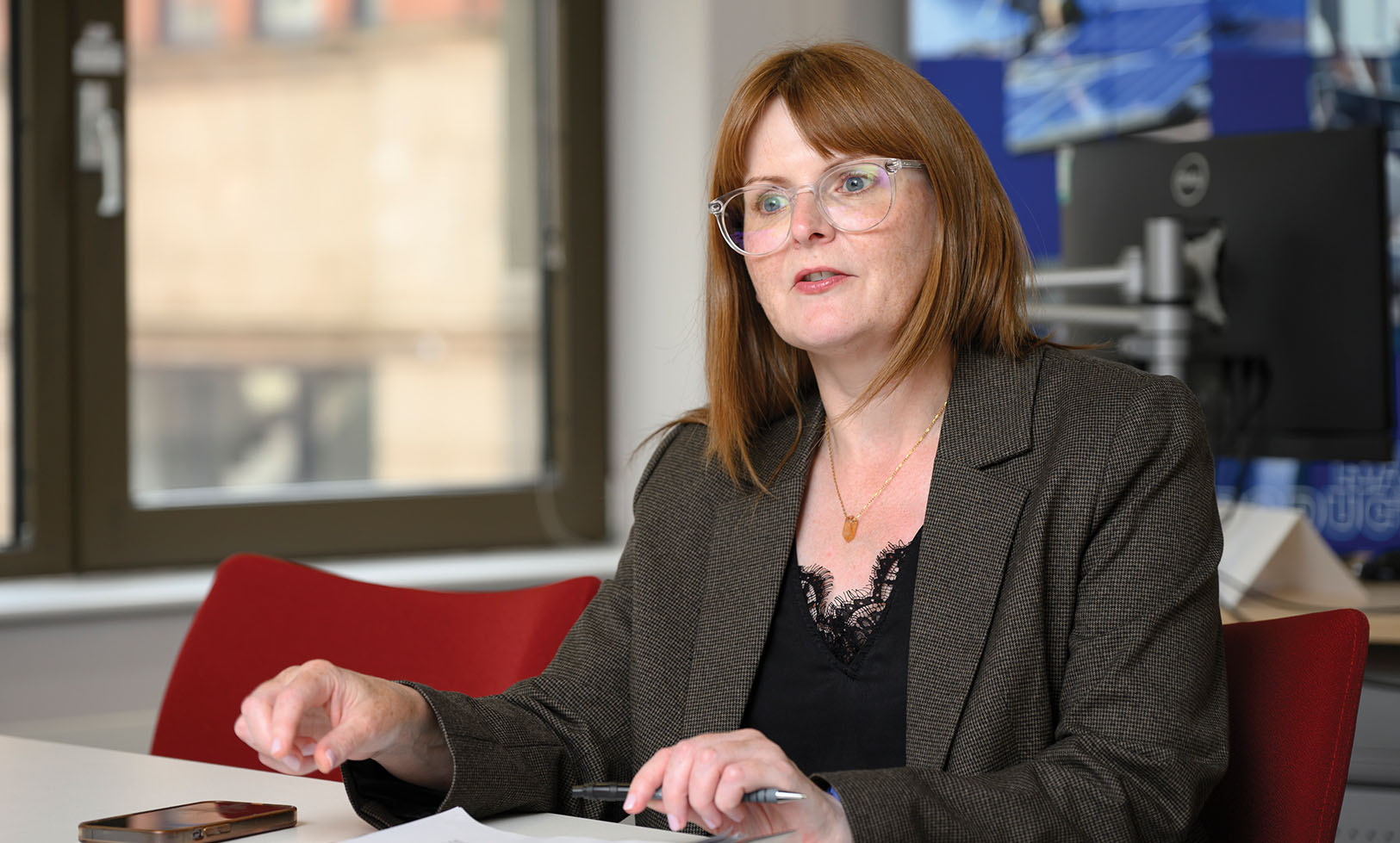
Six months on from her appointment as Minister for the Economy, Caoimhe Archibald MLA welcomes Ciarán Galway to the Department for the Economy’s (DfE) Adelaide House headquarters in Belfast city centre to discuss macroeconomic headwinds, her four Economic Vision priorities, and capitalising on the all-island economy.
Reflecting on her initial experiences in the economy brief, Archibald recalls her previous role as Finance Minister from February 2024 to February 2025, and her time as chair of the Committee for the Economy in the previous mandate.
“That was good grounding,” she explains, “for understanding the breadth of the remit. I had also worked closely with [former Economy Minister and now a Sinn Féin seanadóir] Conor Murphy and Eoin Rooney, who is my special advisor, in advance of us [Sinn Féin] coming into the Department.”
Sinn Féin’s MLA for East Derry indicates that her stint as Finance Minister allowed her the opportunity to acquire “a more strategic overview of all of the departments and an understanding of the challenges facing them, particularly the financial challenges”.
Describing the economy brief as “challenging” and a “learning curve”, Archibald remarks on the opportunity for engagement with DfE’s arm’s length bodies, the business community, universities, colleges, students, and young people.
Macroeconomic context
Commenting on the macroeconomic context, the Economy Minister initially emphasises the challenges in the global economy catalysed by a tariff landscape in a state of flux.
“This has been a challenging year, particularly from the global economic perspective; since President Trump has come into office, and all of the uncertainty that has been created in the broader economy in terms of the tariffs that have been imposed, removed, and reimposed,” she says.
While suggesting that the EU-US trade deal “gives us a little bit more certainty”, Archibald warns: “We are still in a much worse place than we were a few months ago in terms of the ability to trade freely, and that has created huge challenges for businesses trying to navigate the current situation. The uncertainty that is created in the economy as a whole creates an atmosphere that is not conducive to people doing business, to people making investments, to people in terms of their longer-term plans.”
Mitigation
Asked how this exposure to global trade changes can be mitigated, the Minister articulates a realist recognition of the Executive’s limitations to influence the external environment in this context.
“We can only control what we can control, and we will continue to create the best possible environment for businesses locally; to start up, to grow, to thrive, and for people to have opportunities, to get skilled, to get into jobs. That is what our Economic Vision is about, and the four priorities that we have within it in terms of good jobs, improving productivity, improving regional balance, and decarbonisation of the economy.”
In April 2025, the Minister announced the establishment of a tariff working group to collaborate with DfE officials, Invest NI, and InterTradeIreland to “provide market intelligence to the Minister” amid the introduction of trade tariffs by the US Government.
Outlining the feedback she has received from the working group, the Minister indicates that it aligns with her own assessment that the current trade deals are merely “headline deals”.
“There is still a lot of negotiation to be done under those, and it is very difficult to give an assessment even comparing what the different regimes are, but they [the working group] would also reflect the kind of difficult environment that has been created because of those [tariff changes].”
Prioritisation
In a sober statement at the launch of the Northern Ireland Skills Barometer 2023-2033 in early February 2025, Archibald indicated: “The coming financial year will be difficult for my department so it will be critical to prioritise and ensure maximum impact in all that we do.”
Expanding on this prioritisation, the Minister recounts how the Executive’s draft budget for 2025/2026 had been agreed in December 2024, and the finalised budget agreed by the end of March 2025.
“It is a challenging budget for the Executive as a whole, and that has meant that we, as a department, had to prioritise in terms of trying to make the best impact with what we have got. We have our priorities in terms of our four objectives, regional balance, for example, where we have prioritised funding to our local economic partnerships.
“Skills are a key priority for me, underpinning everything that we are trying to achieve and trying to get investment into our universities and colleges. So, it has been a challenge in terms of trying to do all of that and also deliver on the business of the Department.”
In the summary report of its latest skills barometer, Ulster University’s Economic Policy Centre projects that given the “precarious” state of public finances, “early signals following the [UK] Autumn 2024 Budget indicate that a similar pattern” of “political disagreements over budget allocations and industrial action stemming from pay disputes” is expected in 2025.
When this is put to the Minister, she indicates that such a trajectory is “difficult to gauge”. “When we came into the Executive, we prioritised public sector pay and resolving a number of industrial disputes that have been ongoing. We all recognise the importance of our public sector workers in terms of being able to deliver on our objectives,” she insists.
Productivity
Labour productivity is a key indicator of economic performance. As one of the four priorities under the Economy Minister’s ‘Economic Vision’, it remains, in her words, “one of the most pervasive challenges facing us”.
Indeed, in Delivering The Economic Vision: Year One Progress Report, published in February 2025, DfE’s Chief Economist, Victor Dukelow, notes: “On productivity, our output per worker is 13 per cent below the UK average with an even more pronounced gap compared to the Republic of Ireland.”
Furthermore, an April 2025 Economic and Social Research Institute (ESRI) report comparing the two economies on the island found that productivity in the North lagged behind the Republic in eight of the 10 economic sectors examined in 2021.
“It has been long running that we have been poorly performing relative to our neighbours. It is one of those issues that will be difficult to turn the tide on, and it will take some time to do that,” Archibald acknowledges.
Interpreting productivity as a synonym of prosperity and quality of life, she adds: “It is about how we address that challenge to make people’s lives better. That is why we want to improve productivity, not just as an economic measure.”
Discussing the factors informing productivity, including skills, management practices, innovation, and infrastructure, the Minister commends Invest NI in supporting businesses in leadership and management capabilities, alongside its ability to invest in innovation.
Similarly, given the broader economic and fiscal challenges faced in recent years, Archibald emphasises the tenacity of local business: “Over many, many years, our businesses have been really resilient and have innovated and responded to all of the [existential] challenges, whether that is Brexit, Covid, the ‘cost of doing business’ crisis, and now the tariffs. So we do have a really entrepreneurial and innovative business sector, and we are here to support them,” she says.
FDI
Asked how support for indigenous business can be balance against the pursuit of foreign direct investment (FDI), Archibald points to the design of the Economic Vision: “It is very much a case of us being more strategic about the FDI that we are trying to attract,” she explains: “Local businesses tell us about the challenge of getting people with skills. So [we] do not want to be bringing in more and more businesses that are essentially driving up costs for other businesses because they are [operating] in the same talent pool.
“It is about trying to supplement the business environment that we do have; attracting businesses that are going to invest in skilling people and that are going to support that broader business environment. So it is a case of us very much focusing on our priority sectors – we have seven priority sectors – and how we can support businesses locally and indigenously to be part of that broader supply chain as well, so that you have a complementary mix of FDI and indigenous business.”
Good jobs
A second priority under the Economic Vision is the delivery of the good jobs agenda. In other words, updating employment law with the aim of delivery more jobs which meet a quality threshold.
Currently, according to the Northern Ireland Statistics and Research Agency (NISRA), just two-thirds of jobs meet the definition of ‘good’ in that they are “underpinned by a permanent, non-zero hours contract which pays at least the Real Living Wage”.
A flagship piece of legislation for DfE, the Good Jobs Employment Rights Bill is currently being drafted. “It is my intention to introduce that [Bill] into the Assembly in January 2026,” she reiterates.
Described by the Minister as “the biggest upgrade in workers’ rights since the Good Friday Agreement” proposals for the Bill made in April 2025 include:
- an end to exploitative zero-hour contracts;
- paid leave during neonatal care;
- more protections for agency workers;
- stronger trade union rights;
- stronger rights to flexible working; and
- a fair distribution of tips.
In establishing these proposals, the Minister indicates her intent to “set out how we had really listened in terms of the [public] consultation and tried to strike the balance between what is going to be good for workers and what is going to be good for businesses”.
“What I committed to doing was to continue to engage with everybody involved to ensure that there was good buy in and understanding of everything that we were going to try to do with that piece of legislation. That work is continuing. My [DfE] officials have been engaged with trade unions and with business organisations. We are going out in the autumn, doing a road show across different council areas, to ensure that people do have the opportunity to feed into the drafting of that legislation and in terms of what is being brought forward and properly codified in legislation.”
Regional balance
A third priority of the Economic Vision is regional balance as per DfE’s Sub-Regional Economic Plan published in October 2024. Alongside local councils, DfE and Invest NI have established 11 local economic partnerships “to put local economic decision-making into the hands of local people, and to deliver economic growth regionally”. Simultaneously, Invest NI has been briefed with an enhanced regional focus, demonstrated by a headline target of delivering 65 per cent of investments beyond the Belfast Metropolitan Area by 2026/2027.
Today, the outlook remains one of variable growth across council areas. For instance, the range in employment rate between Mid and East Antrim, the council area with the highest rate (79.5 per cent) and Derry City and Strabane, the council area with the lowest rate (65.4 per cent) is 14 per cent.
This trend is not unique, however. As demonstrated by Delivering Balanced Regional Growth in Northern Ireland, a UUEPC report from May 2025, economic development across the OECD is generally uneven in nature.
In this context, an aspiration to create a more regionally balance economy has been articulated from the 2016 draft programme for government onwards.
“Many countries face the same challenges or similar challenges as we do,” Archibald recognises. We are a very small place, so it is a case of trying to better, or to improve our regional balance. And in some regards, there have been improvements in terms of the narrowing of the gaps that there are, but there are still huge challenges in certain regions across the North.”
Rather than relocating economic activity away from where it already exists, the Minister explains, the objective is to ensure “that everybody has an opportunity to develop their local economy”.
“What we have tried to do with the Sub-Regional Economic Plan is the establishment of those local economic partnerships across the 11 council areas. That is very much about giving power back to the local area to design their own local economic plans, and for us, then as a department, to support those local economic partnerships, to leverage that support in from other departments and the agencies, to take forward their plans and that that is being resourced by the department over the next three years.”
Decarbonisation
In the 12 months to March 2025, just 43 per cent of total metered electricity consumption was generated from indigenous renewable sources, representing a decrease of 2.4 percentage points on the previous 12 months to March 2024. This figure falls far short of the Climate Change Act (Northern Ireland) 2022 target ensuring that “at least 80 per cent of electricity consumption is from renewable sources by 2030”.
However, a commitment to decarbonisation is the fourth and final priority of the Economic Vision. In this context, the Minister faces scrutiny in effectively capturing the opportunities presented by a transition to a more sustainable economy.
“There are huge challenges for us all in terms of the targets that we have to meet, in terms of the investment that will be required.
“But it present us with significant opportunities, particularly from a business perspective, and particularly for an island like ours that has significant natural resources in terms of renewable energy.”
Aiming to “ensure that our energy is secure, affordable and clean”, the Northern Ireland Energy Strategy: The Path to Net Zero Energy was published in December 2021 and has determined the Department’s short- and long-term energy policies.
“We are almost at the midpoint of that,” the Minister observes, adding: “We are doing a mid-strategy review this year [2025]. It is an area where there is significant policy development work already being achieved through the Energy Strategy, but there is still quite a lot of work to do.”
Identifying the offshore renewable energy potential as “one of the areas where there are significant economic and business opportunities from a supply chain perspective”, the Minister outlines her department’s efforts to “support businesses to be in the position to take those”.
“Businesses in general are really keen to go on that journey in terms of decarbonisation themselves, and we had financial support in place in terms of the Energy Efficiency Capital Grant (EECG), which was really well applied to and… there was significant interest from businesses across different sectors, because they see the benefits.”
All-island economy
Meanwhile, at the end of July 2025, the Irish Government published its revised National Development Plan (NDP). With €550 million allocated to date and a further €1 billion allocated out to 2030 via the Shared Island Fund, Chapter nine of the NDP is entirely devoted to the Shared Island Initiative as it enters an “expanded phase”. In this context, Archibald addresses how her department is working to take full advantage of the all-island economy.
“Over recent years we have seen these significant increases in terms of cross border trade,” she replies. “When Conor [Murphy] came into the Department originally, last year [2024], he gave an uplift in terms of the budget to InterTradeIreland and Tourism Ireland [which] had not been fully resourced over recent years. Those organisations are now properly resourced.”
Citing the opening of Invest NI’s Dublin office in September 2024 and the commencement of the first all-island trade mission jointly led by Enterprise Ireland, Invest NI, and IDA Ireland in November as examples of progress, the Minister also references “increasingly positive relationships being built across [government] departments, across my own department, and the various part departments in the South that we work with”.
Turning to her tourism remit, the Minister describes the work of Tourism Ireland – which operates under the auspices of both DfE and the Department of Enterprise Tourism and Employment – as contributing to the objectives established by DfE’s 10-year Tourism Vision and Action Plan (January 2025) out to 2035.
“We have also been working with Fáilte Ireland in terms of developing their brands – the Wild Atlantic Way, Ireland’s Hidden Heartlands, and Ireland’s Ancient East – across the island, and we are making good progress particularly in relation to Ireland’s Hidden Heartlands,” she reveals.
Sinn Féin’s stamp on economic policy
Concluding, Archibald defines the strategic direction that her party has applied to the economy brief. “The economic vision that we have brought to the Department is all about improving prosperity across the region as a whole, and [improving] people’s lives and opportunities.
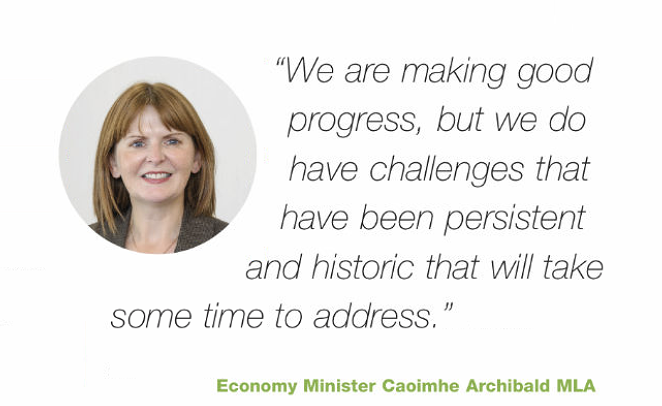
“We are making good progress, but we do have challenges that have been persistent and historic that will take some time to address, and I think that where I hope to be by the end of this mandate is that we have made good progress, and we have created foundations that we can build upon.”