Shaping Northern Ireland’s economic future
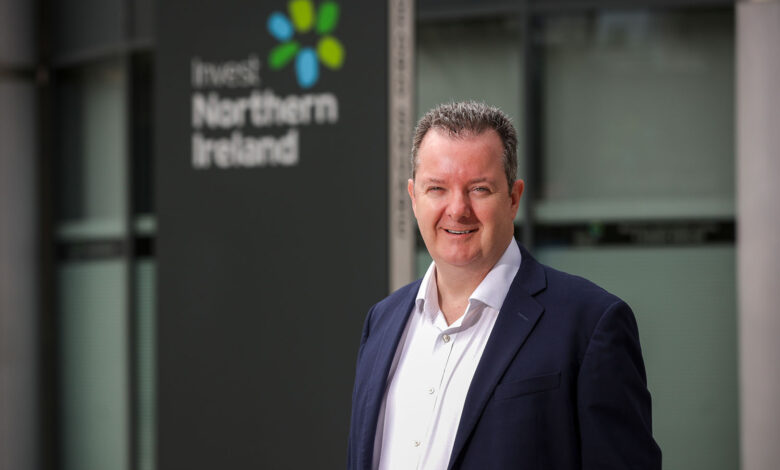
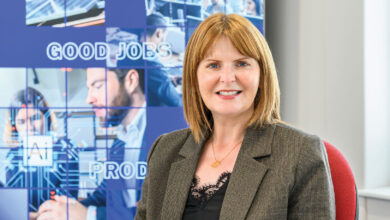
Kieran Donoghue, Chief Executive of Invest Northern Ireland, speaks to Owen McQuade about how the organisation has transformed to meet the needs of a changing economy, and why he sees strong reasons for optimism about Northern Ireland’s future.
When Kieran Donoghue became Chief Executive of Invest Northern Ireland (Invest NI) in early 2024, he set out a clear ambition: to create an organisation that is more responsive, more outward-looking, and better equipped to support an economy facing rapid change.
“Our role is to help Northern Ireland businesses succeed in a global environment that is more complex, more competitive, and more uncertain than ever before,” he says. “That meant reshaping how we operate and how we think about our impact.”
Building a more agile organisation
The past 18 months have brought significant internal change at Invest NI. A new leadership structure has been established, with senior appointments bringing both continuity and fresh perspectives.
This includes a new Chief Commercial Officer, Anne Beggs, previously Invest NI’s Executive Director for International Business and Skills, and a new Chief Operating Officer, Kathryn Hill, previously Director of Active Communities for the Department for Communities. Recruitment of a new Chief Development Officer to lead the organisation’s regional development, land and property and client solutions group is ongoing.
At the same time, the organisation has refreshed its values, digitised client processes, and reshaped its operating model to engage with a broader range of businesses, including more high-potential small and medium-sized enterprises (SMEs).
“We want to be accessible to more businesses and deliver tailored support based on their specific growth trajectory,” explains Donoghue. “In my view, that requires a dedicated inward investment team, alongside teams focused on supporting locally owned businesses, because the needs and wants, and the strengths and capabilities of these two groups of firms are different, and our approach must reflect that.”
This transformation, he argues, is about more than structure. “It is also about culture, behaviour, and mindset, and being more connected to our clients. A positive evolution in this is already clear in how our teams are working.”
“We want to be accessible to more businesses and deliver tailored support based on their specific growth trajectory”
Kieran Donoghue, Chief Executive Officer, Invest Northern Ireland
A strategy designed for impact
Published in Autumn 2024, Our Future in Focus is the first strategic plan for the organisation in several years. It sets out a clear vision to directly support the Economy Minister’s economic priorities: delivering a globally competitive, regionally balanced, sustainable, and prosperous economy.
The strategy shifts Invest NI’s focus from a traditional jobs-led model to one centred on productivity and long-term competitiveness. “We are operating in conditions of near full employment,” Donoghue explains. “That means we need to focus on helping businesses become more productive, more innovative, and better positioned to succeed in global markets. This is what will sustain competitiveness and economic growth over the long term.”
The results from year one of the new strategy demonstrate the scale of progress:
• £631 million invested in the Northern Ireland economy against a target of £525 million;
• 2,062 investment projects supported, exceeding the target of 1,500;
• £245 million committed by businesses to R&D and innovation, surpassing a target of £160 million;
• 19 new inward investors secured, against a target of 15;
• 59 per cent of investments outside the Belfast Metropolitan Area, almost achieving the 60 per cent regional balance goal; and
• £19 million invested in energy and resource efficiency projects, nearly three times the original target.
“These outcomes highlight not just strong delivery against targets, but real, tangible progress in building a more competitive and resilient economy,” says Donoghue.
“Our year one results have been encouraging, but the real significance is the momentum. Businesses are investing with confidence and looking at how to future proof themselves.”
Investing in innovation and skills
A central pillar of Invest NI’s approach is driving innovation. With £245 million of client investment in R&D recorded in year one, Donoghue sees this as vital to future growth. “Innovation is the foundation of competitiveness. If firms are not innovating, they risk falling behind,” he stresses. “The fact that businesses are committing record levels of investment into innovation shows that Northern Ireland has the ambition to compete globally.”
Skills and leadership development are also key. Last year, £31 million was invested in skills and training, helping firms build the capabilities they need to grow in an increasingly digital and knowledge-driven economy.
Driving regional balance
Historically, investment has been concentrated in Belfast. Under the new strategy, regional balance is a priority, with nearly 60 per cent of all projects supported located outside the city in year one.
“We want to make sure that economic opportunity reaches every part of Northern Ireland,” Donoghue explains. “Strong regional growth is not only fair, but it also helps to strengthen the resilience of our economy as a whole.”
The state of the economy
Donoghue is clear about both the opportunities and the challenges facing Northern Ireland. “At Invest NI, we tend to view the Northern Ireland economy through the lens of our clients, whether they are family-owned SMEs or global multinationals. When we talk to them, they are optimistic about the economy. Many are reinvesting, adopting technologies like robotic process automation and AI, and expanding into export markets.”
That optimism is underpinned by strengths in talent and skills. “The quality of graduates coming out of our universities and FE colleges is consistently highlighted by investors. Fundamentally, Northern Ireland’s economic strength is built on the ambition and capability of its people. That is a great strength for the future.”
However, there are constraints. “We have an economy effectively at full employment. The tight labour market means some firms are struggling to recruit, or recruit people with specific skills,” he says. “If they want to grow their business, that is a constraint that we need to address. Infrastructure capacity, particularly in water, energy, and planning, is another obstacle to growth. These issues must be tackled in tandem with business support if we want to unlock the full potential of the economy.”
Global influence
Global uncertainty is also a factor. Geopolitical tensions, shifting trade policies, increasing competition, rapid technological change, and cost pressures all weigh on decision-making.
Rising input costs, such as higher national insurance contributions and minimum wage levels, weigh heavily on SMEs. “Margins are often tight, so even modest increases can put firms under pressure,” he explains.
At the same time, changes to tariffs create both risks and opportunities. The tariff differential between the deal struck between the UK and the US at 10 per cent versus 15 per cent for the European Union “provides a potential opportunity for businesses in Northern Ireland, but further analysis is needed”.
In response, Invest NI has established a trade taskforce, running webinars and clinics to advise businesses on how to reconfigure supply chains and to navigate new markets, particularly in the US.
Despite these challenges, Donoghue is optimistic. “Northern Ireland’s dual access and understanding of both UK and EU markets is unique. In a world of expanded trade frictions and disrupted supply chains, that positioning is more valuable than ever.”
Future opportunities
Looking ahead, Donoghue sees particular potential in existing and emerging sectors where Northern Ireland already has capability. These include advanced manufacturing, technology, and financial services alongside sub-sectors such as fintech and regtech, life sciences, agri-food and aerospace, defence, and security.
The low carbon economy also stands out as a growth area. “We have fantastic companies in renewable energy, and the broader green economy,” he says. “Decarbonisation is not just an environmental necessity; it is a major economic opportunity.”
City and Growth Deals, with over £1.3 billion of public investment, are also set to be transformative. “These projects will create new innovation hubs and clusters across the region. Our role is to make sure businesses are ready to take full advantage of them. Invest NI, as the investment decision maker for about £700 million of the innovation and digital projects, has established a team of more than 20 people that are overseeing our involvement in the city and growth deals programme. We believe the investments emerging from the programme will be vehicles for both sectoral and regional development across NI.”
“There will always be challenges, but overall, on the basis of the engagements with our clients, we see an economy full of potential.”
Looking forward with confidence
As Invest NI enters the second year of its strategy, Donoghue is clear about the road ahead. “Year one has laid strong foundations. The next two years will be about building on that momentum, driving further investment, supporting more companies to innovate and export, and ensuring regional and sustainable growth.”
“Yes, challenges remain, whether in infrastructure, costs, or global trading conditions, but the direction of travel is positive. Businesses here are ambitious, they are investing, and they are optimistic about the future. Our job is to match that ambition with the right approach and support.”
He concludes: “Northern Ireland has all the ingredients for success – talent, resilience, innovation, a unique global position, and a ‘can-do’ attitude. If we continue to invest in our businesses and our infrastructure, we can build a truly competitive and sustainable economy for the future. At Invest NI, we are fully committed to achieving this goal.”
W: www.investni.com
T: 0800 181 4422