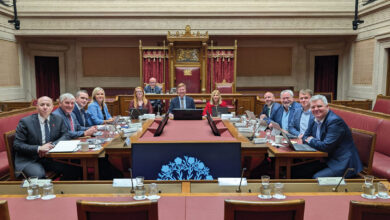
Voting age reduction ‘will not be in place’ for next Assembly election

A UK Government spokesperson has told agendaNi that the voting age reduction announced by British Prime Minister Keir Starmer MP in July 2025 “will not be in place for the May 2027 Northern Ireland Assembly and local elections”.
In July 2025, the British Prime Minister announced the most significant electoral reform in the UK since 1969, with 16- and 17-year-olds to be granted the right to vote in UK general elections and local elections. This means that if the UK general election takes place in 2029, there will be people born in 2013 who will be eligible to vote.
The reforms will also apply for elections to the Northern Ireland Assembly as elections are an excepted matter under Schedule 2 of the Northern Ireland Act 1998, meaning that it will not be necessary to seek a legislative consent motion.
Unlike Northern Ireland, the devolved governments in Scotland and Wales have the right to set the voting age in devolved elections in their respective constituent countries. 16- and 17-year-olds are eligible to votes in elections to the Scottish Parliament and the Senedd Cymru.
16- and 17-year-olds were also able to vote in the 2014 Scottish independence referendum.
However, although the announcement came 22 months prior to the likely date of the next Assembly election, agendaNi has been told that it is unlikely that 16- and 17-year-olds will have the right to vote when the election comes in May 2027.
Implementation of the proposal is being led by the UK Ministry of Housing, Local Government and Communities. In response to a query from agendaNi, a spokesperson for the Ministry said: “Our [Labour Party] manifesto commitment to lower the voting age to 16 during this parliament includes all non-devolved elections across the UK. This includes elections to the Northern Ireland Assembly and local government elections in Northern Ireland.
“We intend for the franchise change to be in place in good time ahead of the next general election. Our expectation is that this will not be in place for the May 2027 Northern Ireland Assembly and local elections.
“This bill will include a number of major changes to our electoral system, as well as expanding the franchise, and we need to get these right.”
This prediction has been backed by the Electoral Commission of Northern Ireland, which released a statement following Starmer’s announcement saying it was “unlikely” that the changes will be in place before the next Assembly election.
In response to a query from SDLP leader Claire Hanna MP in March 2025, Secretary of State Hilary Benn MP said in the House of Commons: “The Government will of course work closely with stakeholders across Northern Ireland on the implementation of this major change to the franchise and ensure we empower our young people to participate in democracy.”

Who stands to benefit?
The reduction in the age of voter eligibility has garnered the support of Sinn Féin, the Alliance Party, Ulster Unionist Party, the SDLP, and People Before Profit, but has been opposed by the DUP and TUV.
A 2024 opinion poll by LucidTalk outlines community division on the matter, with 73 per cent of nationalists in favour of the move favour, while just 6 per cent of unionist voters approved.
Writing in The Irish News in July 2025, political commentator Newton Emerson asserted: “It can safely be assumed this will benefit nationalism in Northern Ireland due to demographic trends – crudely put, the Catholic population is younger.”
While political trends in Northern Ireland are an outlier in western politics due to community divisions, recent election results in Britain and the United States have shown that Gen Z (people born post-1997) voters have been more likely to vote for conservative parties. However, the conservative movements in question – whether Nigel Farage MP and Reform in the UK, or Donald Trump and the MAGA movement in the US – have to present themselves as ‘anti-establishment’ in order to attract broad support from young voters.
This is partially attributable to the fact that, according to Business Insider, approximately 59 per cent of Gen Z consumes news through social media, marking a significant departure from previous generations who still largely consumed news through more traditional formats.
Through these formats, non-traditional media, including the ‘bro-sphere’ array of US-based podcasts, have influenced politics in an unprecedented manner. However, their hosts often lack professional media training, with a nihilistic outlook on politics exemplified by influencers such as Joe Rogan.
In the 2024 US election, this contributed to the re-election of Donald Trump, who gained unforeseen support among Black and Latino voters largely driven by Gen Z male voters who fall within these demographics.
Simultaneously, it is estimated that 67 per cent of female voters aged between 18 and 29 voted for Kamala Harris in the presidential election.
Nevertheless, in Northern Ireland, it is likely that nationalism and the Alliance Party stand to benefit due to the demographic breakdown of the new voters to be added to the electorate. The four Westminster constituencies with the slimmest majorities – East Londonderry, North Antrim, East Antrim, and East Belfast – are all held by unionists. East Londonderry MP Gregory Campbell holds a majority of only 179 votes ahead of Sinn Féin, while East Antrim and east Belfast are both held by the DUP with slim majorities over the Alliance Party.
The next Assembly election potentially presents the final chance for unionism to secure the role of the largest party in Northern Ireland because the new voters will not be eligible to vote in 2027, and could be boosted amid ongoing negotiations on ‘unionist unity’ ahead of the next Assembly election.