Improving regional balance
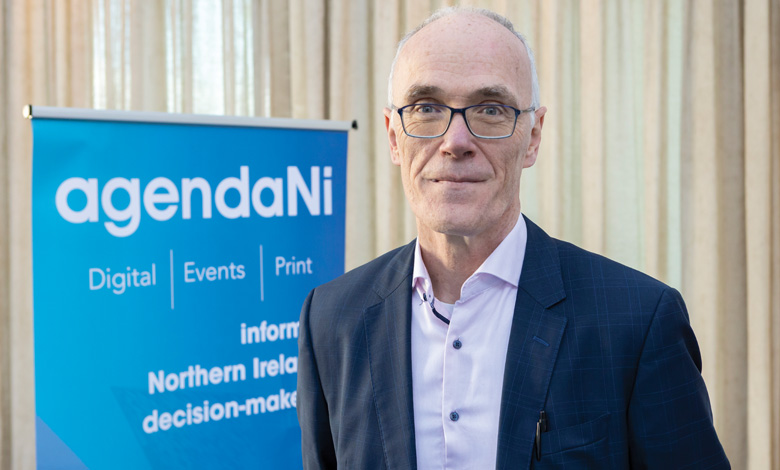
Solving the productivity shortfall holds the key to tacking regional economic inequality, according to Eoin Magennis, principal economist at the Ulster University Economic Policy Centre.
Eoin Magennis states that Northern Ireland has experienced sustained economic growth over the last 30 years. However, he emphasises that this has been “largely driven by employment growth as opposed to productivity growth”.-He explains that this imbalance is significant because “productivity underpins wages and long-term growth”, adding that improving productivity must be “an ongoing focus”.
Magennis reflects on traditional economic theory, which assumed that poorer regions would naturally catch up with richer ones. He asserts that this assumption “has been exposed very clearly”, pointing to growing regional divergence across advanced economies.
Within the UK, he says, inequality remains pronounced. “It is still very much a case of London and the rest,” he states, noting that Northern Ireland continues to sit in a lower-performing group for both productivity and output.
Despite some growth, he explains that the region’s starting point limits progress. “It started out in such a low way, that progress has not made much of a difference.”
“We may meet our targets, but whether we will hit them with the kind of quality of jobs that we want is another question.”
Cities
Magennis challenges the assumption that cities are consistently driving economic growth. While Belfast is often perceived as performing strongly, he says: “We are not seeing many stars. Belfast growth has not set the world on fire, and it is slightly below the UK average.” This underperformance, he suggests, reflects a wider challenge across UK cities and contributes to weak national productivity growth.
Magennis also highlights a disconnect between output and lived experience. “Regional inequalities does mean that the residents of affluent areas are doing well,” he says.
He explains that Belfast performs strongly on output-based measures, but “resident-based indicators place Belfast well down the rankings, with lower employment rates and higher economic inactivity”, adding: “Belfast’s position is more nuanced than we give it credit for.”
Regional inequality
Magennis outlines persistent disparities across local government districts. “There are gaps between top performing and bottom performing areas across a range of indicators, including GVA, employment, and qualifications.”
While some convergence has occurred, he cautions against interpreting this as progress. “Sometimes gaps can close, but this is not always to be wished for,” he says.
In some cases, convergence reflects declining performance in stronger areas rather than improvement elsewhere. He adds that lower-performing areas have improved, but “not at a much faster rate than other LGDs”, limiting meaningful catch-up.
Education and skills
Magennis states that education remains important but is not sufficient on its own. “Education helps, but without the employment opportunities, it does not help that much.”
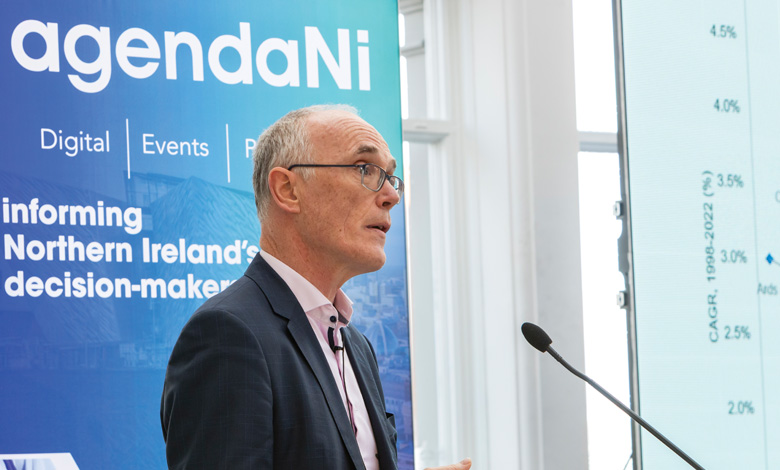
He adds that its impact is diminishing: “It is not helping to the extent as it did 20 years ago and this creates challenges in retaining talent, particularly in areas where high-quality jobs are limited.”
Structural challenges
Magennis highlights the long-term impact of deindustrialisation. In theory, he says, lost jobs should be replaced over time. However, he says that “in some places, that either did not happen or has happened more slowly”.
He points to the northwest as an example, where jobs “were not replaced to the level that they were lost at”. In this context, Magennis warns that job creation must accompany skills development.
Policy
On the role of policy in addressing regional imbalance, Magennis acknowledges a case for “spreading FDI more evenly”, but cautions that outcomes may not align with expectations.
“There is a danger in that we may meet our targets, but whether we will hit them with the kind of quality of jobs that we want is another question,” he says.
He welcomes the development of local economic partnerships, describing them as “a good idea that brings local insight into policymaking”. However, he highlights challenges in ensuring alignment and joined up thinking.
“There is going to be a challenge to get people to do things that target what they are good at, as opposed to targeting what they think they want to do,” he explains.
He also questions whether local areas have sufficient scale to support sectoral clusters, suggesting that some interventions may be more effective at a regional level.
Performance
Magennis says that Northern Ireland is not necessarily more unequal than other UK regions, and that in some areas of the region, economic disparities are narrower.
However, he attributes this to overall economic performance rather than successful regional balance. “It is an issue of poor performance overall,” he concludes.
Eoin Magennis is Principal Economist at the Ulster University Economic Policy Centre with a research background in local and regional economic development, low pay and earnings, and the all-island economy.