Sufficient progress: what has been agreed
Professor of European Politics at Queen’s University Belfast, David Phinnemore offers his analysis of the deal struck to navigate phase one of the Brexit negotiations.
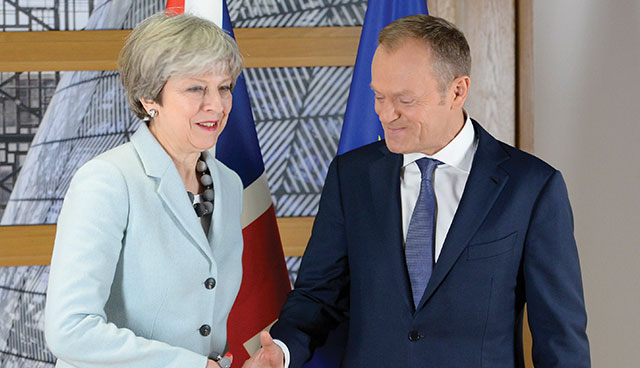
On 15 December 2017 the European Council agreed that ‘sufficient progress’ had been made on the terms of the UK’s withdrawal from the EU to move negotiations to a second phase and discussion of the future UK-EU relationship.
Importantly, as Michel Barnier, the EU’s chief negotiator has pointed out, ‘sufficient progress’ does not mean ‘full progress’; the terms of withdrawal have not actually been agreed. The much discussed ‘joint report’ agreed on 8 December sets out commitments and principles. These now need to be translated into ‘legally binding’ and ‘precise language’ in the withdrawal agreement. A draft is promised early in 2018.
Northern Ireland and the ‘unique circumstances on the island of Ireland’ will feature prominently. They have been a key focus of discussion and indeed a priority issue, especially for the EU. It is not at all clear, however, how and whether all the commitments in the ‘joint report’ can be implemented. There are already quite different interpretations emerging of what those commitments actually entail and what was indeed agreed.
There are three sets of commitments regarding ‘the Irish dimension’ to Brexit. An initial set focus on the Belfast ‘Good Friday’ Agreement which the UK and the EU agree ‘must be protected in all its parts’, adding ‘and this extends to the practical application of the 1998 Agreement on the island of Ireland and to the totality of the relationships set out in the Agreement’. This is in a context of both parties affirming that ‘the achievements, benefits and commitments of the peace process will remain of paramount importance to peace, stability and reconciliation’.
The UK government also recalls its commitment to the Agreement’s operation ‘including its subsequent implementation agreements and arrangements, and to the effective operation of each of the institutions and bodies established under them’. For supporters of the Agreement, such a commitment is welcome; the unanswered questions, however, are exactly how might Brexit affect the Agreement’s operation and how can any Brexit impact be avoided?
The ‘joint report’ raises several particular concerns. First it is agreed by the UK and the EU that their commitments ‘are and must remain fully consistent with’ the Agreement’s provisions on the constitutional status of Northern Ireland and the principle of consent. There then follow UK commitments to Northern Ireland’s position ‘as an integral part of the United Kingdom’ as well as to Ireland’s ‘ongoing membership of the European Union, and all the corresponding rights and obligations that entails’. Particular reference is made Ireland’s membership of the EU internal market and customs union.
Cooperation
Second, there is the question of maintaining north-south cooperation, presented as ‘a central part of the 1998 Agreement and…essential for achieving reconciliation and the normalisation of relationships on the island of Ireland’. The roles, functions and safeguards of the Northern Ireland Executive, the Northern Ireland Assembly, and the North-South Ministerial Council are duly acknowledged. So too is a recently completed mapping exercise which shows that South cooperation relies ‘to a significant extent’ on a common EU legal and policy framework’.
The shared view is that Brexit ‘gives rise to substantial challenges to the maintenance and development of North-South cooperation’. The UK response is to state that it ‘remains committed to protecting and supporting continued North-South and East-West cooperation across the full range of political, economic, security, societal and agricultural contexts and frameworks of cooperation, including the continued operation of the North-South implementation bodies’.
This leads into a further set of concerns – and a second set of commitments – concerning the border. Here the UK ‘recalls its commitment to the avoidance of a hard border, including any physical infrastructure or related checks and controls’. It further states that it is ‘committed … to its guarantee of avoiding a hard border’. This raises the question of how such a hard border can be avoided.
The UK response, which links the question of avoiding a hard border and maintaining north-south cooperation, is to achieve these ‘overarching requirements’ through the future UK-EU relationship. Its form is still to be determined, although there is an increasingly widespread assumption that the UK will be seeking an enhanced version of the EU-Canada Comprehensive Economic and Trade Agreement (CETA), the so-called ‘CETA-plus-plus-plus’ option.
A second UK option is to propose ‘specific solutions to address the unique circumstances of the island of Ireland’. No indication is provided of what these solutions might be. The UK government has pointed to its earlier proposals on a UK-EU customs partnership and exempting small and medium-sized cross-border traders from customs controls. Reactions have not been encouraging.
If ‘specific solutions’ cannot be found, the UK proposal is to maintain ‘full alignment with those rules of the internal market and the customs union which, now or in the future, support North-South cooperation, the all-island economy and the protection of the 1998 Agreement’. This is a bold commitment given its scope.
It is also a bold commitment in that the UK as a whole will be subject to the ‘full alignment’. This follows the DUP’s objections to any form of differential treatment of Northern Ireland and the additional commitment that ‘no new regulatory barriers [will] develop between Northern Ireland and the rest of the United Kingdom’ and ‘[in] all circumstances, the United Kingdom will continue to ensure the same unfettered access for Northern Ireland’s businesses to the whole of the United Kingdom internal market’.
Provision is made for the Executive and Assembly to agree that “distinct arrangements are appropriate for Northern Ireland”, but given unionist objections to any east-west regulatory divergence, there can be no certainty that such an option would be pursued irrespective of its economic, political, social or environmental merits especially as regards avoiding a hard border.
Reactions to the three options have understandably questioned whether they can really deliver on the commitments to avoiding a hard border and sustaining north-south cooperation. With the UK outside the customs union and the single market, checks on the movement of goods and services will be required. And in the absence of free movement, it is hard to see how north-south cooperation can be sustained without new impediments.
Returning to the Agreement, the UK and the EU acknowledge the birth right of people of Northern Ireland to choose to be Irish or British or both and be accepted as such, and agree that those with Irish citizenship will continue to enjoy rights as EU citizens; not just in the EU, but ‘including where they reside in Northern Ireland’. It is therefore agreed that the withdrawal agreement “should respect and be without prejudice to the rights, opportunities and identity that come with European Union citizenship for such people”. However, whereas there is agreement to ‘examine arrangements required to give effect to the ongoing exercise of, and access to, their EU rights, opportunities and benefits’, it is not clear whether and how these arrangements will be contained in the withdrawal agreement.
Recognition is also given to the Agreement’s provisions on Rights, Safeguards and Equality of Opportunity ‘for which EU law and practice has provided a supporting framework’. Here the UK commits to ensuring that Brexit causes ‘no diminution of rights’ and facilitating the work of institutions and bodies established by the Agreement ‘in upholding human rights and equality standards’. How, again, remains unspecified.
A third much less complicated set of joint commitments relates to maintaining a set of existing arrangements. A first commitment is to the maintenance of the Common Travel Area. A second, is to the PEACE and INTERREG funding programmes where the option of future support “will be examined favourably”.
Finally, the UK and the EU agree to maintain ‘a distinct strand of the negotiations’ focused on the giving effect to the commitments relating to Ireland and Northern Ireland. The work of officials ‘will also address issues arising from Ireland’s unique geographic situation’. A key issue is the transit of goods to and from Ireland via the UK.
The prominence given to Northern Ireland and Ireland in the joint report is a reflection of the challenges that Brexit poses, particularly around the avoidance of a hard border and the upholding of the Agreement. The report does not contain solutions. The focus is on commitments and principles. How and whether the negotiations will produce acceptable solutions is unclear. Importantly, they have been prioritised. As the joint report notes, the commitments and principles ‘are made and must be upheld in all circumstances, irrespective of the nature of any future agreement between the European Union and United Kingdom’.
The Brexit negotiations are about to enter a very interesting second phase.