Northern Ireland’s economic resilience
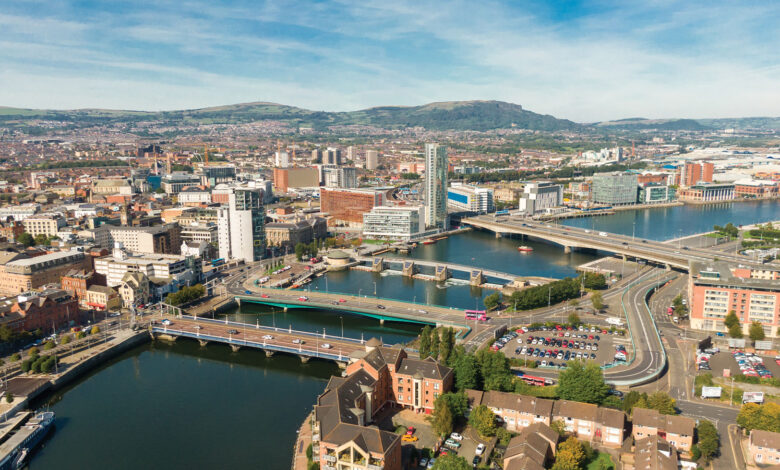
The resilience of Northern Ireland’s largely service-based economy could be stress-tested over the coming months.
Economic momentum in Northern Ireland has slowed in 2025 following a strong 2024 when the region experienced a 2.7 increase in economic growth, the highest increase since 2006 when it rose by 3.2 per cent. It is unlikely the region will get anywhere near that this year.
Addressing a recent Northern Ireland Chamber of Commerce business breakfast in Belfast, Bank of Ireland’s UK economist/market analyst Alan Bridle suggested we are currently in an “unforgiving” business environment. He attributed this to the local sensitivity around Trump tariffs and the belief that the autumn Budget will further impede business. Bridle referenced the disproportionate impact of the rise in employer National Insurance contributions on employers of low paid workers to support this.
The economist stated that Northern Ireland could be particularly negatively impacted by tariffs on its two largest exports to the US, pharmaceutical products and specialist industrial machinery. A 48 per cent tariff may be imposed on pharmaceutical products, while a 22 per cent levy may be imposed on specialist industry machinery.
On 8 May 2025, the UK and US announced the terms of a trade deal, introducing a 10 per cent baseline for UK exports entering the US.
Prevailing uncertainty
The Northern Ireland Composite Economic Index (NICEI) for Q1 2025 reveals that the region’s economy contracted by 0.6 per cent, mainly due to output declines in both construction and manufacturing. This was the first contraction since Q4 2023 and followed four consecutive quarters of growth, including a 0.9 per cent increase in Q4 2024.
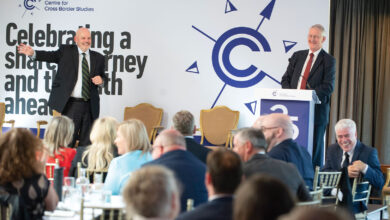
At the Chamber of Commerce business breakfast, Richard Ramsey, Professor of Practice in Economics and Policy at Queen’s University Belfast Business School, said the figures highlight a downturn for the private sector previously identified by the Ulster Bank regional growth tracker (previously known as the PMI).
He predicted: “The local economy is expected to see a growth rate of around one third of the 2024 figure, and more uncertainty looks set to prevail for the rest of the year.”
As regions and nations aim to reshape their investment propositions to become more attractive to business and enterprise, the question of whether corporation tax should be lowered has reemerged. Both Bridle and Ramsey stated that this ship has sailed.
However, Chartered Accountants Ireland (CAI) insist that in the wake of the Windsor Framework – which gives Northern Ireland access to both the EU and UK markets – lowering the rate of corporation tax could exploit the region’s potential.
CAI president Pamela McCreedy says: “No one inducement, policy, or measure applied in isolation can single-handedly transform a region’s attractiveness to investors. Dual market access, however unique a feature it is, is never going to be enough on its own to make Northern Ireland a destination of choice for inward investment.
“We need more than regulatory advantage. We need a suite of complementary policies that collectively make up a pro-enterprise proposition that positions Northern Ireland not just as an option, but as a first choice for investment. Chief among those policies must be the implementation of a more competitive rate of corporation tax.”
The devolution of corporation tax-setting powers has been legislated for since 2015, but these powers have yet to be activated. In 2021, the Independent Fiscal Commission for Northern Ireland signalled its support for the devolution of corporation tax powers, while in a survey earlier this year, two thirds of chartered accountants say they would back it, with the majority calling for a rate equal to that of the Republic of Ireland (12.5 per cent).
Meanwhile, businesses are expected to bear the brunt of the autumn Budget as Rachel Reeves attempts to plug another £40 billion-plus black hole. Her autumn 2024 Budget was the biggest real terms tax raising budget since 1968, raising £41.5 billion.
Positive trends
Despite the challenges, there is also reason for optimism regarding Northern Ireland’s economy. The housing market has experienced a steady increase in property prices, although not enough houses are being built to keep pace with demand.
The labour market has been generally robust for some time, although employment did dip for first time in four years in spring as the private sector attempted to limit overheads before April’s increase in employer national insurance contributions kicked in.
Manufacturing remains a cornerstone of the local economy, even though it continues to operate without a dedicated strategy. This change if the region is serious about creating jobs, driving innovation, and achieving regional balance.
“It is essential that any strategy is backed by an action plan that’s focused on delivery, investment in advanced manufacturing, and new models of skills development,” Alliance economy spokesman David Honeyford MLA says.
Summing up the current economic climate in Northern Ireland, Bridle said: “There is plenty of noise right now, and we are in an environment with many moving parts and pain points to navigate.”