Minister Naomi Long MLA: ‘A fair, efficient, and sustainable justice system’

Justice Minister Naomi Long MLA sits down with Joshua Murray at the Department of Justice headquarters, where she discusses her access to justice agenda, the legal aid strike, and how paramilitary influence can be reduced.
With court backlogs, legal aid reform, victims’ services, and paramilitarism all demanding attention, Minister Long describes her immediate task as one of stabilisation, delivery, and rebuilding confidence in a justice system stretched close to its limits.
Asked about her priorities since returning to office, Long emphasises continuity rather than radical reform. “When we came back post the suspension that we had, my priority was to try and ensure that the Department was able to be stable and able to deliver,” she says.
“One of the challenges for us was that we had a range of programmes that had stalled during that period and it was about trying to ensure that we could pick those up again and continue to deliver for them.”
While the agenda itself may be familiar, Long argues that the context has shifted significantly. The absence of political decision-making for three years prior to the Executive’s return in February 2024, combined with growing operational and financial challenges, has left the justice system more fragile than when the Executive last collapsed. “It was the same agenda in many ways, but with a slightly different context,” she says.
Legal aid
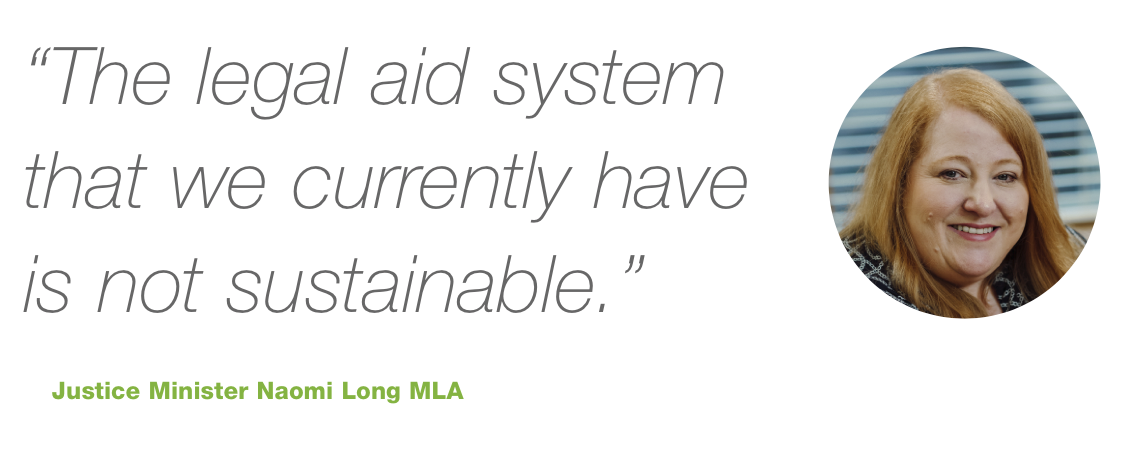
Among the most contentious issues facing the department is legal aid reform. Long says that change is unavoidable, framing the issue as one of sustainability rather than ideology. “The legal aid system that we currently have is not sustainable,” she says. “It is not sustainable financially, and it is not sustainable in terms of the way it delivers justice.”

“You have to deal with the underlying causes as well as the criminality.”
She points to a long trail of reviews and evidence underpinning the Department’s position. “There has been a huge amount of work done on this over quite some time,” she says. “We have had a range of independent reviews, a range of different inputs, including Tom Burgess – Judge Tom Burgess’ report – on legal aid, and the conclusion is very clear.”
While acknowledging the concerns raised by legal professionals, Long rejects claims that reform is being pursued without regard for barristers’ pay or access for victims. “The whole point of a legal aid system is access to justice, both for the accused and for the victims,” she says. “We need to ensure that the system is fair, that it is efficient, and that it is sustainable.”
Victims
Beyond structural reform, Long places strong emphasis on the lived experience of victims engaging with the justice system. She acknowledges that while procedural fairness is essential, the process itself can compound harm if not handled carefully.
“There are a lot of things that we do now that we did not do historically,” she says. “There is much more awareness now of the impact of trauma and the impact of being a victim of crime.”
Long highlights the burden placed on victims by repeated interviews and prolonged court processes. “For many victims, the process itself can be deeply traumatic,” she says. “It can be very traumatic for people to have to recount what has happened to them. To be interviewed multiple times, to have to repeat that story, can be re-traumatising.”
This awareness, she argues, must shape both policy and practice. “Justice should be about recovery,” Long says. “It should be about helping people to rebuild their lives, not just about the outcome of a court case.”
The Minister links this approach to broader efforts within the department to modernise how victims and witnesses are supported.
Paramilitarism
Despite progress in other areas, paramilitarism remains one of the most persistent challenges facing the justice system. Long is careful to frame the issue as one that cannot be addressed through enforcement alone.
“We have obviously the executive programme on paramilitarism,” she says. “That EPPOC [Executive Programme on Paramilitarism and Organised Crime] programme, it is evidence based. It is evidence led, but it is also very clear that enforcement alone is not enough.”
While acknowledging the importance of policing and criminal justice responses, Long stresses that paramilitary influence extends beyond violence. “The threats that paramilitaries pose are not just about violence,” she says. “It is about money. It is about power. It is about control.”
Undermining that influence, she argues, requires sustained intervention at community level. “If you want to undermine that, you have to provide alternatives for communities,” she says.
Long also highlights the risks faced by young people in areas where paramilitary structures remain embedded. “I think that is where the EPPOC programme has been really strong,” she says. “It recognises that you have to deal with the underlying causes as well as the criminality.”
Departmental leadership
Since policing and justice was devolved, the Alliance Party has been the only party to hold leadership of the Department of Justice, with independent unionist MLA Claire Sugden having briefly held the role between 2016 and 2017.
When asked if another party should be allowed to hold the role of Justice Minister, Long says: “That is not a matter for me,” she says. “That is a matter for the Assembly to decide who leads the Department of Justice.”
She rejects the notion that justice should be treated as an exception within the Executive. “People talk about us having some kind of special arrangement around the Department of Justice,” she says. “But ultimately, it is a department like any other, and it should be subject to the same democratic processes.”
Delivery
Long avoids speculation about her own political future, instead returning repeatedly to the theme of delivery. “I have no idea,” she says. “First of all, I do not know whether I will be Justice Minister in the future. I do not know what the future of delivery holds.
“I have been really clear that I am about delivery,” she states. “I am about making sure that the system works as well as it can for the people who rely on it.”