Investing in vital infrastructure for the delivery of new housing

Leaders in Northern Ireland’s housing sector debated the need for vital infrastructure to deliver new housing during a panel discussion chaired by Ulster University Professor Paddy Gray at the agendaNi Northern Ireland Housing Conference.
What is the single greatest barrier to delivering new housing?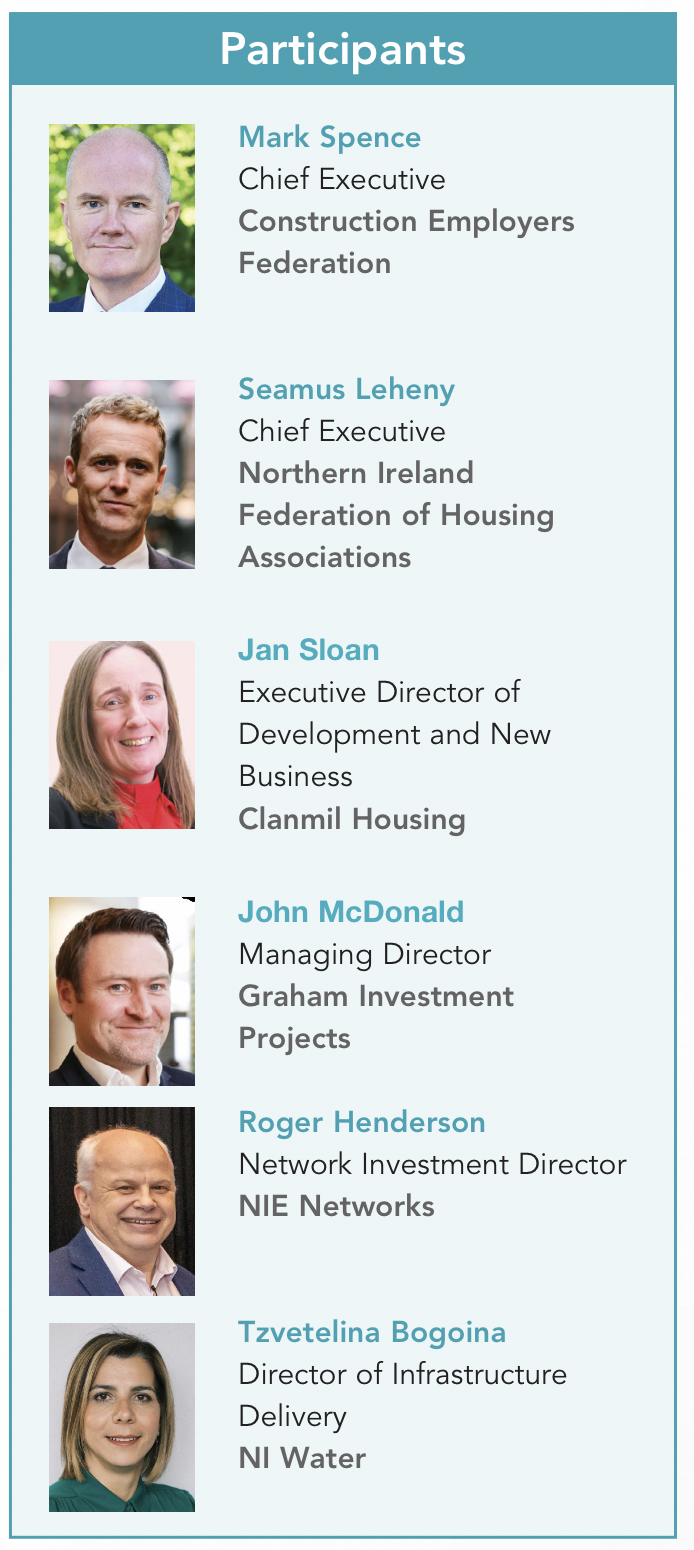
Mark Spence
The most acute challenge is the lack of investment in water and wastewater infrastructure. Developers are on their last viable sites because they cannot get connections. 19,000 homes cannot be built due to this deficit.
Seamus Leheny
Water infrastructure is the biggest hurdle, particularly in high-demand areas like north and west Belfast and the Foyle region. Planning inconsistencies across councils also slow things down. The lack of government grant funding also holds us back.
Jan Sloan
It is not just about pipes and wires; it is about creating communities. We cannot just build homes in isolation; people need schools, transport, and amenities.
John McDonald
Construction inflation and funding costs are pressures, but infrastructure is the one thing we cannot control. We spend years and millions on planning, only to hit a wall with water or electricity connections.
Roger Henderson
We are increasing investment in grid capacity, but the bigger challenge is outdated connection policies. The charging model here is out of step with Great Britain and Ireland, making it harder to attract investment.
Tzvetelina Bogoina
Chronic underfunding means we are maintaining an aging system instead of expanding it. We are the only UK water utility that has not met regulator targets because of funding shortfalls. Half of what is needed is not being delivered, and wastewater is hit hardest because drinking water takes priority.
Can housing associations deliver between 3,000 and 4,000 homes annually if conditions improve?
Seamus Leheny
Absolutely. Our members already deliver between 1,500 and 1,800 homes annually with current funding. The model works; for every £100 of government grant, we leverage £84 in private finance. With proper infrastructure and consistent planning approvals, delivering 3,000 to 4,000 homes is achievable.
Jan Sloan
While housing associations have the ambition and capability to scale up, we face practical constraints. Suitable land in high-need areas is finite, and infrastructure must keep pace. With the right funding model and infrastructure investment, we could significantly increase output.
John McDonald
The housing association model is certainly more stable than private development right now, because of their ability to blend public and private funding. However, hitting those numbers would require addressing the same infrastructure bottlenecks constraining developments. The associations would also need to expand their development teams and processes to handle that scale of delivery.
Mark Spence
Even if funding increased, water infrastructure constraints would still limit where and how quickly they could build. We are seeing housing associations increasingly having to fund infrastructure solutions themselves, which reduces their budgets.
Roger Henderson
From an electricity perspective, we are preparing for increased demand. Our new price control period includes significant capacity upgrades. However, the lead times for major infrastructure mean coordination is essential. If housing associations planned their pipeline in advance with utilities, connections could keep pace with their ambitions.
Tzvetelina Bogoina
Our current infrastructure limitations would make 3,000-4,000 new connections annually challenging in many areas. Even with developer-funded solutions, there are physical constraints in our network that require strategic investment to overcome.
Who should pay for infrastructure investment?
Mark Spence
We need a blended approach. Developer contributions can play a role, but expecting them to cover the full £800 million shortfall would add £55,000 to each home’s cost, which is unsustainable. Government must lead, possibly through mutualising NI Water to access new funding streams while protecting domestic users from direct charges.
Seamus Leheny
The Welsh mutual model shows how public utilities can access capital markets while retaining public ownership. For housing, our model proves how public funding can leverage private investment. A similar approach for infrastructure where government provides a stable base that attracts other investment would be more effective than flat developer levies.
John McDonald
Developer contributions have limits. They work for site-specific issues but cannot solve systemic underinvestment. Homes England shows how strategic public investment unlocks development. Here, we need government to fund strategic infrastructure, with developers contributing to local upgrades.
Tzvetelina Bogoina
As operators, we need certainty. Whether through government funding, regulated asset models, or blended finance, the key is multi-year commitments that let us plan. Currently, half our required investment is not funded. Developer solutions help at individual sites, but strategic problems need strategic funding. That must come from government policy decisions.
Roger Henderson
Clear, stable regulatory frameworks attract investment. For electricity, we are increasing network investment through defined price controls. A similar model for water, where costs are fairly allocated between users, developers and government, could provide the certainty needed for long-term infrastructure planning.
Jan Sloan
It is a shared responsibility. Housing associations already invest in site-specific solutions, but this reduces how many homes we can deliver. Government must fund strategic upgrades, while developers contribute to local connections. Most importantly, we need transparency about costs and priorities.
Should Northern Ireland consider water charges?
Seamus Leheny
Any minister proposing domestic water charges would face immediate backlash. There are better ways, like mutualisation, that could improve funding without the political pain of direct billing.
Tzvetelina Bogoina
We do not take a position on funding methods; that is for policymakers. What matters is securing adequate, stable funding. Currently, businesses pay charges while households do not, creating an imbalance. Any solution must balance affordability with the need to invest – whether through charges, taxation, or other models.
Mark Spence
The debate needs to mature. We pay less for utilities than elsewhere, yet expect equal service. While full domestic charges may be politically difficult, some contribution may be necessary. The alternative is continued underinvestment harming housing and the wider economy.
Jan Sloan
Any changes must protect vulnerable households. That said, the current model is not working. If water charges were introduced alongside protections for low-income families, and with clear benefits in service quality, it might work.
Roger Henderson
From an energy perspective, clear cost recovery is essential for investment. While water is different, the principle holds. Services need sustainable funding. The challenge is designing a system that is fair, transparent, and politically deliverable.
John McDonald
The development sector could live with water charges if they were predictable and accompanied by reliable service. But, given political realities, it is more practical to explore other options like infrastructure levies or developer agreements that do not involve direct household billing.
What lessons can be learned from other jurisdictions?
John McDonald
Homes England invests directly in infrastructure, takes equity stakes in developments, and uses overage agreements to recycle funds. Their approach turns infrastructure from a barrier into an enabler. We need to see infrastructure as an investment, not just cost.
Seamus Leheny
Ireland’s Land Development Agency shows how strategic land assembly can work. It acquires sites, secures planning, and partners with developers. We need that proactive approach here.
Mark Spence
Scotland’s infrastructure-first approach is instructive. Its planning system identifies infrastructure needs upfront, with developers contributing through agreed tariffs. It is not perfect, but provides more certainty than our reactive system. We also should not ignore how Dublin’s crisis developed; we are repeating their mistakes.
Tzvetelina Bogoina
English water companies invest nearly double per customer what we can. Their regulatory model provides stable funding for long-term programmes. While our governance differs, the principle holds; adequate, predictable investment delivers better services and supports growth.
Roger Henderson
Great Britain’s connections reforms show how policy can unlock capacity. By streamlining processes and aligning charges with need, they have accelerated connections. Simple changes could make Northern Ireland more competitive for energy-intensive development.
Jan Sloan
The Dutch model of integrated housing and infrastructure planning stands out. It coordinates development with transport, schools, and utilities from the outset, creating sustainable communities. We often bolt infrastructure onto housing, rather than planning them together. That joined-up thinking is what we need to emulate.