Harnessing data to transform health and social care

Effective use of data can focus prevention activities, lead to earlier interventions, and provide patients with more agency, outlines Paul Rice, chief digital information officer at the Department of Health.
Rice says that Northern Ireland is ready to exploit digital and data but acknowledges that funding models need to be dynamic. He says: “Inevitably, as we rely more on technology, we build up a tariff of ‘technical debt’ to maintain and enhance the core digital infrastructure that has become central to our new working practices and transformation activities.”
Rice contends that the North has not yet fully leveraged its capacity for innovation but is primed to do so. He states that the health and care sector’s focus has shifted from IT to digital. Rice says this is “profoundly” important, as this is where the greatest level of disruption and transformation opportunity exists.
Challenges and opportunities
Fundamental challenges facing the health and social care sector include an ageing population, the high proportion of people with long-term illnesses, and health inequities. The combination of these three challenges leads to a loss in the number of healthy working years, and this impacts economic activity.
“The magnitude of the challenge can set you back on your heels,” says Rice who adds that data and digital can be utilised to address it.
He says there are multiple assets across the region which can be used to respond to challenges the sector faces including the encompass system. This creates a strong foundation for the sector to digitally develop. Rice asserts that the data developed and delivered through initiatives like encompass must be used to enhance treatment.
He states that the MyCare app enables citizens to “take a higher degree of interest and involvement in their own health and care”. This creates opportunities to provide focused messages to people about self-management and care. However, the digital expert explains that the app covers health and social care but does not yet cover primary care.
Data can also be used to detect diseases earlier, personalise treatment plans and recommendations, and ensure patients remain at the centre of decision-making. “This is beyond co-creation, this is about agency,” says Rice.
“The idea of patient agency is something we need to exploit and build on going forward. Because we are not IT anymore, we are digital transformation. They are profoundly different.”
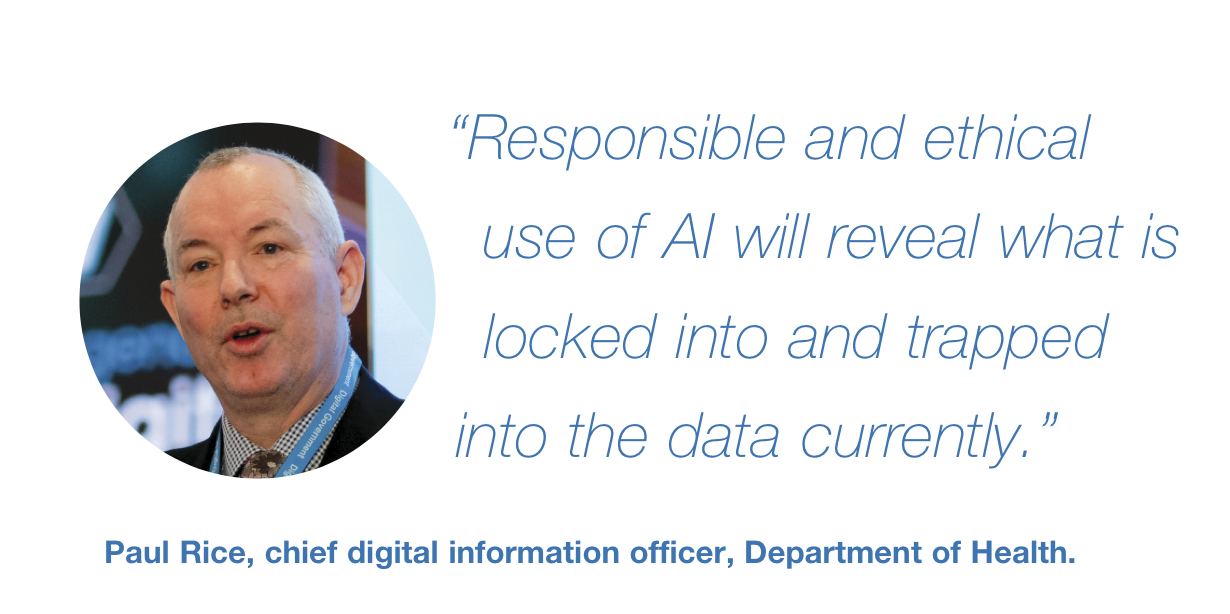
The digital expert asserts that AI can be used to help clinicians diagnose more accurately and efficiently, provide easier and more timely access to services, and streamline processes by analysing data for pattern prediction. Rice asserts that “responsible and ethical use of AI” will reveal “what is locked into and trapped into the data currently”.
He identifies implementing neighbourhood health models as central to the Health and Social Care NI Reset Plan. Rice asserts that when data is leveraged in a neighbourhood health model, it enables prevention as citizens are provided with the knowledge they need to stay healthy.
It leads to earlier interventions as citizens can manage their conditions better. Neighbourhood health models also provide patients access to digital services to help them self-manage.
“We are still too paternalistic, we still serve. We do not co-create and beyond co-create, ensure agency,” says Rice. “The neighbourhood model will thrive with some digital and data underpinnings, but also because philosophically it is a different proposition for the population.”
Sustainable system
Stating that Northern Ireland is “small enough to be personal, big enough to be powerful”, he adds that there are “really strong assets in the region” including universities and entrepreneurs. The digital expert indicates that the North has the foundations to enable innovation. Additionally, there is a “strong alliance emerging” between the departments of Health and the Economy.
Rice reprises Chuck Friedman’s (a professor from the University of Michigan Medical School) definition of a learning health system: “A place where science, informatics, incentives, and culture are aligned for continuous improvement and innovation, with best practices seamlessly embedded in the delivery process, [with] patients and families active participants in all elements, and new knowledge captured as an integral by-product of the delivery experience.”
Applying this to Northern Ireland, he says: “We need to understand and enable our clinicians and frontline professionals. We also need to understand the improvement opportunities existing in our administrative and operational processes. Using the insights and experience of the public will identify bottlenecks and fractured pathways, using their capabilities boosts our capacity.
“It is that trifecta, professionals, people power and improved processes, and purposive application of digital and data that will give us the sustainable health and care system that we morally have to deliver.”