Explaining the Executive’s economic vision
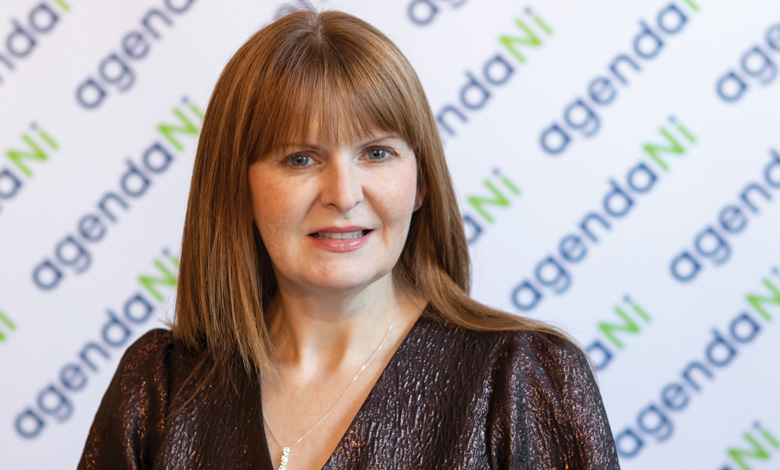
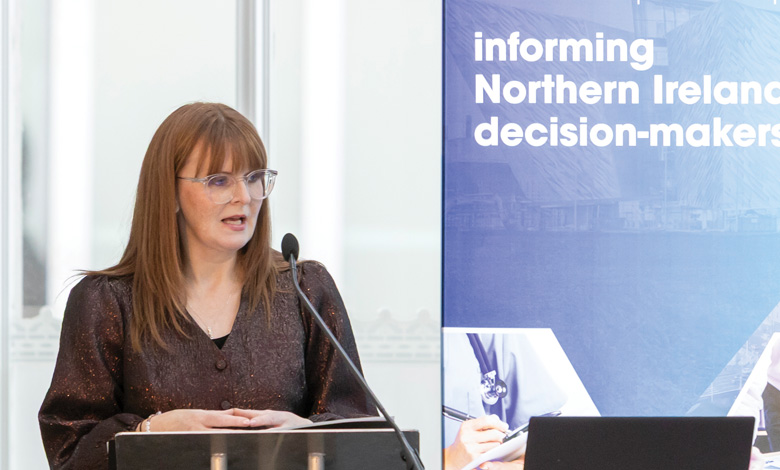
Economy Minister Caoimhe Archibald MLA discusses her four pillar economic vision aimed at harnessing recent growth to deliver good jobs, regional balance, higher productivity, and net zero.
Archibald outlines her four pillars for the local economy: “Creating good jobs, promoting regional balance, increasing productivity and delivering net zero.”
On employment, she says: “My department is drafting the most significant upgrade of our employment law in a generation. The aim is to improve conditions for workers, strengthen trade union representation, and help prevent good employers from being undercut by competitors employing poor working practices.”
She states that Northern Ireland starts from a relatively strong position in terms of job quality. “Currently, two-thirds of jobs here pay at least the real living wage and provide a non-zero hour permanent contract,” she says, describing this as “a good starting point to build upon”.
Productivity remains a structural weakness in the local economy, particularly when compared to neighbouring jurisdictions. “Our productivity is 12 per cent below the UK average and at least 20 per cent lower than the South.”
“Since the Windsor Framework was introduced, our exports have increased by 2 per cent compared to a 9 per cent decline across Britain.”
To address this, the Minister says that the Executive is focusing on the expansion of seven high productivity sectors, alongside increased adoption of advanced technologies. “The recent matrix AI report [AI and the future of work in Northern Ireland] highlights the potential of artificial intelligence to boost our productivity,” she says.
That potential is being supported by public investment: “We have invested 16 million pounds in the new artificial intelligence collaboration centre, a partnership between Queen’s University, Belfast Ulster University, and Invest NI,” Archibald says.
Regional balance
Addressing longstanding regional imbalance, Archibald highlights reforms to how investment performance is measured. “For the first time, Invest NI has been set a regional target and an ambitious one at that,” she says.
Invest NI has been tasked with increasing the proportion of investments outside the Belfast metropolitan area from 56 per cent to 65 per cent over three years. “Having hit 59 per cent in year one, Invest NI is on course to achieve that target,” she says.
Local economic planning is also being reformed: “My department has also established 11 local economic partnerships, and action plans are now being submitted for my approval.”
Minister Archibald explains the nature of these partnerships: “While I am allocating budget to these partnerships, their key purpose is to ensure that Executive departments have a better understanding of local needs and priorities and can therefore develop policies that better promote regional balance.
“The growth potential of the northwest is particularly strong, and the expansion of Magee is the most important project in that region.”
She adds: “Thanks to the work of the Magee Task Force, we now have a comprehensive roadmap to expand university provision in Derry to 10,000 students,” she says, further contextualising that enrolment at Magee has increased by 55 per cent since 2021 to over 6,300 in 2025.
Reducing income disparities between regions is identified as a longer-term objective. “Over time, we intend to close this gap,” Archibald says, referencing figures showing that “in 2025 full time median weekly wages in Belfast were over £150 higher than in Causeway Coast and Glens”.
Green growth
On decarbonisation, Archibald acknowledges progress while underlining the importance of maintaining public buy-in.
“If we are to retain public support for continued progress towards net zero, it is crucial that ordinary people feel the benefit of the transition,” she says.
Archibald points to the renewable electricity price guarantee scheme as an example, noting that “the final scheme design… commits to giving people living near renewable electrical generators a discount on their bills”.
The Minister argues that the region’s industrial structure positions it well for green growth. “Our strong manufacturing base provides a solid foundation to create good green jobs,” she says.
Skills
Across all four objectives, skills are identified as the critical enabling factor. “All four of my objectives are underpinned by skills,” Archibald says.
She outlines recent investment in this area. “Last year, we invested an extra £12 million in 20 different projects supporting over 10,000 people and 500 employers,” she says.
Labour market data suggests some positive early impact. “Over the last year, there has been a 10 per cent fall in vacancies due to skills shortages,” she says.
A longer-term framework has also been set out in the form of the Skills Action Plan, which was launched in October 2025 and aims to increase the proportion of the working age population with qualifications at level three and above from a baseline of 57.2 per cent in 2020 to between 70 and 75 per cent by 2030.
Delivery
Nearly one year after she succeeded Senator Conor Murphy as Minister for the Economy, Minister Archibald reflects: “When the Executive was restored [in February 2024], our economy was continuing to deal with the inflationary consequences of Russia’s aggression in Ukraine, the aftermath of Covid and, of course, the outworkings of Brexit.
“The cost of doing business crisis has been exacerbated since then by bad decisions like the British Government’s increase in employers’ National Insurance,” Archibald says while also pointing to global trade instability. “Companies have also been dealing with the added costs and uncertainty created by US tariff policy.”
However, Archibald says that overall economic performance in the North has remained comparatively strong. “Despite those challenges, our businesses continue to demonstrate their resilience.”
She points to growth estimated at 3.5 per cent over the last year, compared to 1.5 per cent in Britain. Trade performance has diverged further since the Windsor Framework came into effect, with exports rising locally while declining elsewhere in the UK. “Since the Windsor Framework was introduced, our exports have increased by 2 per cent compared to a 9 per cent decline across Britain,” she says.
Labour market indicators are presented as similarly positive. “Earnings here increased by 7.4 per cent in the year to April 2025 again, higher than in Britain and all Ireland,” Archibald says, adding that “trade has increased by 5 per cent in a year”.
“This is all positive, but it is critical that this growth is channelled towards societal goals,” she says.
Concluding, Archibald acknowledges concerns within the business community about the state of political affairs as the mandate proceeds. “With less than 18 months left in this mandate, I know there is a concern among some, particularly within the business community, about political positioning under way in some quarters.”
However, she stresses that her priorities remain unchanged. “For my part, my focus is firmly on delivery and on supporting our businesses to continue to thrive.
“I am committed to working together with all partners to ensure that that happens.”